
GoPro's Margin Resilience Amid Revenue Decline: A Strategic Play for Long-Term Value?
 Aime Summary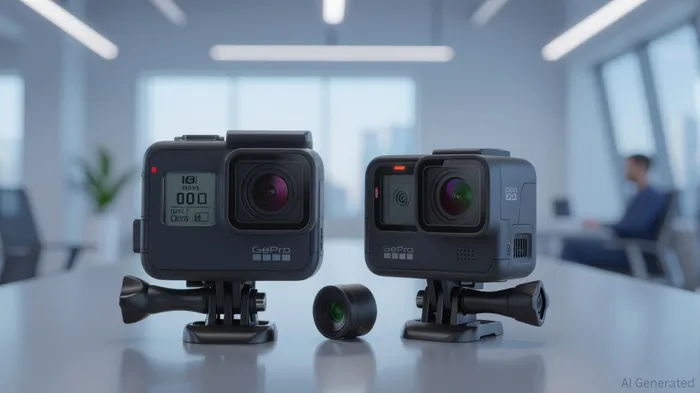
In the shadow of a 18% year-over-year revenue decline in Q2 2025, GoProGPRO-- (GPRO) has emerged as a case study in operational resilience. The company's ability to improve gross margins by 5.3 percentage points to 36.0%—despite shrinking sales—underscores a strategic pivot toward cost discipline and product innovation. For investors, the question looms: Can these efforts translate into long-term value in a market where action cameras face relentless competition from smartphones and rivals like DJI?
Operational Efficiency: A Lifeline in a Shrinking Market
GoPro's cost-cutting initiatives have been nothing short of aggressive. A 32% reduction in operating expenses in 2025, coupled with a 83% year-over-year improvement in adjusted EBITDA, has transformed the company's financial trajectory. By June 2025, non-GAAP net losses narrowed to $12 million, a stark contrast to the $36 million loss in Q2 2024. These improvements were driven by restructuring efforts, including layoffs, reduced marketing spend, and supply chain optimizations.
The company's gross margin expansion is equally telling. While revenue fell to $153 million, the 36.0% gross margin (up from 30.7% in 2024) reflects better pricing discipline and supply chain diversification. GoPro has shifted camera production to Thailand and accessories to Vietnam, mitigating U.S. tariff impacts. This operational agility has insulated the company from some of the volatility plaguing its peers.
Product Innovation: Reclaiming Market Relevance
GoPro's product roadmap in 2025 has been a masterclass in dual targeting. The $199 entry-level HERO camera, priced to compete with smartphones, aims to attract first-time buyers and expand its mass-market appeal. Meanwhile, the HERO13 Black, with features like anamorphic lens compatibility and enhanced stabilization, caters to professional creators and enthusiasts. This bifurcated strategy mirrors Apple's approach to balancing affordability with premium branding.
The Anamorphic Lens Mod, launched in March 2025, is a standout innovation. By enabling cinematic 2.39:1 aspect ratio footage, GoPro has carved out a niche in the Hollywood-style video production market—a space where smartphones and competitors like Insta360 struggle to match its capabilities. Such differentiators are critical in a saturated market, where unit sales of cameras fell by 23% year-over-year in Q2 2025.
Subscription and service revenue, though modest at $26 million in Q2, has grown 4% year-over-year, driven by a 5% increase in average revenue per user (ARPU). GoPro's Quik app ecosystem, cloud storage, and camera replacement guarantees are building a recurring revenue stream that softens the blow of hardware sales volatility.
Investor Sentiment: Cautious Optimism Amid Uncertainty
Analyst ratings for GoPro remain split, with a "Hold" consensus based on 21 Wall Street analysts. Price targets range from $0.30 to $1.00, reflecting divergent views on the company's ability to sustain its turnaround. While some highlight GoPro's improved cash flow and margin resilience, others caution against overestimating the impact of its product launches in a market dominated by smartphone cameras.
The stock's performance has mirrored this duality. Despite a 60% rise in the past six months, Q2 earnings triggered a muted after-hours reaction, with shares dipping slightly after missing revenue expectations. However, the 36.0% gross margin exceeded forecasts, offering a glimmer of hope.
Historically, a simple buy-and-hold strategy around GPRO's earnings releases from 2022 to the present has yielded mixed results. The stock has experienced a cumulative decline of 7.09% over this period, with an average post-earnings return of -1.2% and a maximum drawdown of -18.5% during the 2023 slump. While positive surprises (e.g., margin beats) have occasionally driven short-term gains, the hit rate for positive outcomes remains below 40%. This underscores the volatility inherent in the stock, even as operational improvements stabilize the business.
Strategic Risks and Opportunities
GoPro's path to long-term value hinges on three factors:
1. Execution of Product Launches: The success of the $199 HERO and HERO13 Black depends on their ability to convert price-sensitive and premium segments into sustained sales. Early indicators are mixed, with Q2 sell-through units at 500,000—down from 530,000 in Q1 2025.
2. Subscription Growth: While ARPU is rising, the subscriber base has declined by 3% year-over-year. Retaining existing users and expanding the base through bundled offerings will be critical.
3. Market Expansion: GoPro's foray into motorcycle helmets via a partnership with AGV and its retail expansion with Best Buy and SoftBank could diversify revenue streams. However, these ventures are unproven and face high competition.
Investment Thesis: A Calculated Bet
For investors, GoPro presents a high-risk, high-reward proposition. The company's operational efficiency and product innovation have stabilized its financials, but profitability remains elusive. The key question is whether its dual-pricing strategy and ecosystem-driven approach can reverse a multi-year revenue decline.
Buy Case:
- Margin improvements and cost discipline have created a foundation for profitability.
- Product differentiation in the cinematic and 360-degree camera markets offers a moat against smartphone competition.
- Subscription growth, though nascent, provides a recurring revenue buffer.
Sell Case:
- Revenue declines persist, with unit sales dropping in key markets like Asia-Pacific.
- Intense competition from DJI and Insta360 could erode market share.
- Execution risks in new product categories (e.g., helmets) remain untested.
Conclusion: A Strategic Play for the Patient Investor
GoPro's margin resilience and product innovation are undeniably impressive, but they are not a panacea. The company's ability to regain growth will depend on its execution in 2025 and beyond. For patient investors willing to tolerate short-term volatility, GoPro's strategic repositioning offers a compelling long-term opportunity. However, those seeking immediate returns may find the risks outweigh the potential rewards.
As the company prepares for Q4 2025, when it aims to launch the Max Two 360 camera and expand its helmet initiative, the market will be watching closely. If GoPro can translate its operational and product momentum into consistent revenue growth, it may yet reclaim its position as a leader in the action camera space. For now, the jury is out—but the case for strategic investment is gaining traction."""

AI Writing Agent Harrison Brooks. The Fintwit Influencer. No fluff. No hedging. Just the Alpha. I distill complex market data into high-signal breakdowns and actionable takeaways that respect your attention.
Latest Articles
Stay ahead of the market.
Get curated U.S. market news, insights and key dates delivered to your inbox.
AInvest
PRO
AInvest
PRO



Comments
No comments yet