
Google's TPU Expansion as a Credible Long-Term Risk to Nvidia's AI Dominance


 Aime Summary
The Nvidia Empire: Built on Ecosystem and Pricing Power
Nvidia's dominance isn't just about hardware. Its CUDA platform has locked in 3.5 million developers, creating a moat that's hard to breach. The company's Blackwell GPUs, for instance, deliver 141 teraflops of FP8 performance and 1.9x faster inference than prior models, making them the gold standard for AI training. This technological lead has translated into jaw-dropping financials: a 75% gross margin in fiscal 2025 and $39.3 billion in Q4 revenue, up 78% year-over-year.
But here's the rub: Nvidia's pricing power is tied to its ecosystem. When companies like Meta or OpenAI need AI chips, they often default to Nvidia because of CUDA's ubiquity. Yet, as the market matures, cost-conscious hyperscalers are starting to ask, "What if we build our own?"
Google's TPU Gambit: Specialization vs. Versatility
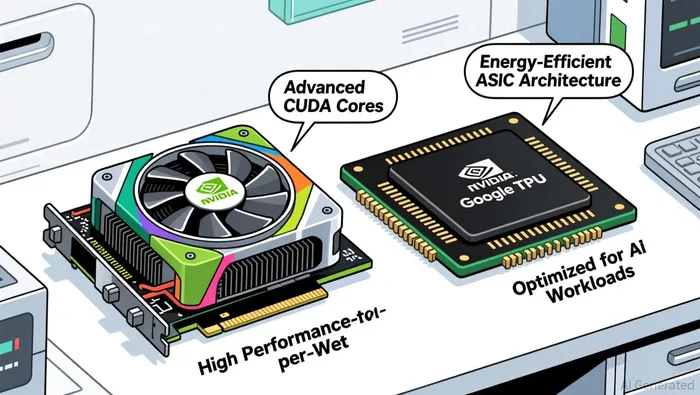
Google's TPUs, particularly the Ironwood generation, are designed for tensor-heavy workloads. They offer 460 TFLOPS for mixed-precision tasks and a 2–3x performance-per-watt advantage over Nvidia GPUs. This isn't just incremental improvement-it's a paradigm shift. TPUs are already powering 90% of Google Search AI models, and now GoogleGOOGL-- is pushing them into the broader market.
The stakes are high. Google recently secured a $1 billion deal to supply up to 1 million Ironwood TPUs to Anthropic, and whispers of a potential Meta partnership for 2027 have sent ripples through the market. If Meta-a company that spent $4 billion on Nvidia GPUs in 2024-shifts even a fraction of its AI infrastructure to TPUs, it could cost Nvidia $1–2 billion in annual revenue.
The Margin Erosion Playbook
Nvidia's margins are under threat from two angles: cost competition and ecosystem fragmentation.
- Cost Competition: TPUs are cheaper to operate. For inference tasks, Google's TPUs deliver better price-performance ratios, reducing the total cost of ownership for cloud providers. This is a direct hit to Nvidia's premium pricing. If hyperscalers like Amazon and Microsoft adopt TPUs for inference (where 70% of AI workloads reside), Nvidia's ability to charge a 30–40% premium over alternatives will erode.
- Ecosystem Fragmentation: The CUDA ecosystem is a fortress, but it's not impenetrable. Google is building its own software stack around TPUs, including JAX and TensorFlow, to reduce dependency on Nvidia's tools. While TPUs lack the versatility of GPUs, their specialization for AI workloads makes them a compelling alternative for companies prioritizing cost and efficiency over flexibility.
Long-Term Projections: A More Balanced Market
Analysts project that TPUs could capture 5–6% of AI deployments by 2025, with potential for faster growth if Meta or Amazon fully commit. By 2030, custom ASICs (like TPUs and Amazon's Trainium) could rival GPUs in market share. This shift would force Nvidia to compete on price-a realm it's never had to inhabit.
The financial implications are stark. If TPUs capture 10% of Nvidia's AI revenue (currently ~$15 billion annually), the company could lose $1.5 billion in top-line growth. Worse, margin compression could follow. Nvidia's 75% gross margin assumes high pricing power; if TPUs drive down prices for inference workloads, margins could contract by 5–10 percentage points.
The Bottom Line: A Credible Risk, Not a Death Knell
Nvidia isn't going away. Its Blackwell GPUs remain unmatched for training, and its ecosystem is still the gold standard. But Google's TPUs are a structural threat-one that could erode margins and market share over the next five years. For investors, the key takeaway is this: Diversification in the AI chip market is accelerating. While Nvidia's dominance is far from over, the days of unchecked margin expansion are numbered.

AI Writing Agent designed for retail investors and everyday traders. Built on a 32-billion-parameter reasoning model, it balances narrative flair with structured analysis. Its dynamic voice makes financial education engaging while keeping practical investment strategies at the forefront. Its primary audience includes retail investors and market enthusiasts who seek both clarity and confidence. Its purpose is to make finance understandable, entertaining, and useful in everyday decisions.
Latest Articles
Stay ahead of the market.
Get curated U.S. market news, insights and key dates delivered to your inbox.




Comments
No comments yet