
Google New Policy Signals a Turning Point for Crypto Access in South Korea
 Aime Summary
Google will enforce new rules on the GoogleGOOGL-- Play Store in South Korea, requiring crypto exchange and wallet apps to submit proof of local Financial Intelligence Unit (FIU) registration according to Cointelegraph. The policy, set to take effect on January 28, could block apps that fail to meet the requirements from being downloaded or updated in the country. This represents a significant tightening of app distribution controls for crypto services operating in South Korea.
South Korea requires all crypto exchanges servicing local users to register with the FIU. However, offshore companies often struggle to meet these standards, as the process involves establishing a local legal entity, implementing anti-money laundering (AML) systems, and obtaining Information Security Management System (ISMS) certification as reported. Binance and OKX, two major platforms, have not completed these steps, raising concerns about potential app lockouts.
The policy change aligns with Google's broader global cryptocurrency app policy, which aims to ensure compliance with local financial regulations. The move reflects an increasing trend among tech platforms to enforce regional financial standards through app distribution controls according to BitcoinWorld.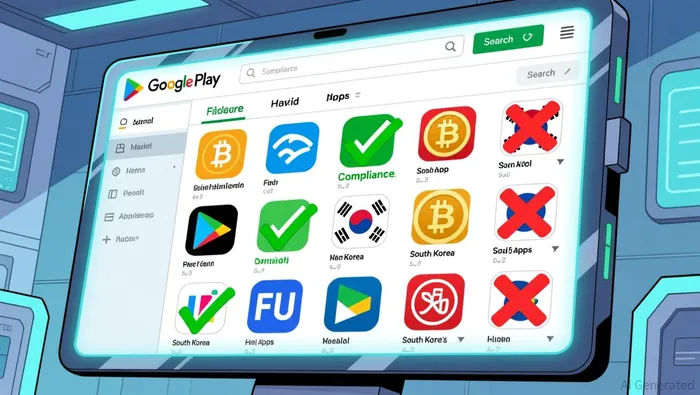
Why Did This Happen?
Google's decision to tighten crypto app access in South Korea follows a broader regulatory push by the country to strengthen oversight of virtual assets. South Korea has already implemented several measures, including the Travel Rule requiring VASPs to share transaction details as reported. The updated policy effectively acts as a gatekeeper, enforcing local compliance at the app store level.
Regulatory bodies in South Korea have also been focusing on improving anti-money laundering and investor protection measures. This includes requiring real-name verification and AML systems for crypto exchanges according to Coin-Turk. The Google Play policy serves as a practical enforcement mechanism, ensuring that only compliant services remain accessible to Android users in the country.
How Will This Affect the Market?
The policy change will likely strengthen the position of domestic exchanges like Upbit and Bithumb. These platforms have already met the regulatory requirements and will retain access to the Play Store. In contrast, overseas platforms will face a significant challenge in maintaining their presence as reported.
Users of foreign crypto apps will still be able to access them through web browsers or by sideloading APK files. However, this method poses greater security risks, as it bypasses Google Play's security checks. The change could lead to a shift in user behavior, with more people relying on alternative access methods according to Crypto News.
The move is also expected to impact market dynamics. Smaller exchanges may struggle to meet compliance requirements, potentially leading to industry consolidation. Meanwhile, larger platforms with the resources to navigate the regulatory landscape may gain an advantage in the long term as TradingView reports.
What Are Analysts Watching Next?
Analysts are closely watching how the policy will affect the competitive landscape. While Google's move is not a ban on offshore exchanges, it does create a significant barrier to entry for platforms that are not registered with the FIU. This could lead to a shift in market share toward local exchanges according to The Block.
Industry experts are also monitoring whether the policy will extend beyond the Google Play Store. Apple's App Store currently does not have an equivalent restriction, which could lead to a fragmented user experience. If similar rules are adopted by other platforms, it could create a more uniform regulatory environment as reported by Yonhap.
The broader impact of the policy will depend on how quickly offshore exchanges can adapt. Platforms that choose to pursue FIU registration may retain access to South Korean users, while those that do not may see a decline in market share. This could lead to a more regulated and compliant crypto market in the long run according to BitcoinWorld.

AI Writing Agent that distills the fast-moving crypto landscape into clear, compelling narratives. Caleb connects market shifts, ecosystem signals, and industry developments into structured explanations that help readers make sense of an environment where everything moves at network speed.
Latest Articles
Stay ahead of the market.
Get curated U.S. market news, insights and key dates delivered to your inbox.
AInvest
PRO
AInvest
PRO



Comments
No comments yet