
Google-PayPal Partnership: A Catalyst for Agentic Commerce and Investment Opportunities


 Aime Summary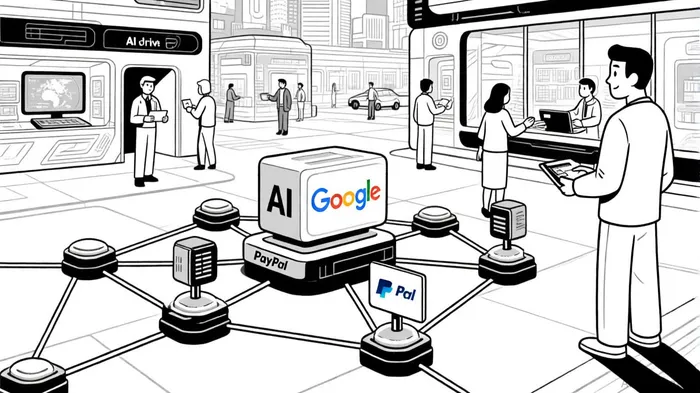
The Google-PayPal partnership, announced in September 2025, marks a pivotal shift in the digital commerce landscape. By merging PayPal's global payment infrastructure with Google's AI expertise and Agent Payments Protocol (AP2), the collaboration aims to redefine how consumers and businesses interact with digital transactions. For investors, this partnership represents not just a strategic alignment but a direct bet on the future of agentic commerce—a market projected to generate up to $17.5 trillion in value by 2030[1].
Strategic Synergy: AI and Payments Converge
At its core, the partnership leverages PayPal's established payment solutions—such as Hyperwallet, PayPalPYPL-- Payouts, and branded checkout—into Google's ecosystem, including GoogleGOOGL-- Cloud, Google Ads, and Google Play[2]. This integration positions PayPal as a critical payment processor for Google's core platforms, expanding its global footprint while reducing reliance on third-party gateways. For Google, the partnership strengthens its enterprise cloud offerings by embedding a trusted payment infrastructure, enhancing its competitiveness against rivals like AmazonAMZN-- and Microsoft[5].
A key innovation is the adoption of Google's AP2, an open framework enabling AI agents to execute transactions autonomously on behalf of users[4]. This protocol, already supported by over 60 merchants and financial institutionsFISI--, addresses a critical gap in agentic commerce: secure, scalable transaction standards[2]. By democratizing access to AI-driven commerce, Google and PayPal are accelerating the transition from human-centric to agent-driven transactions—a shift that could unlock $24.5 billion in enterprise agentic AI market value by 2030, growing at a 46.2% CAGR[5].
Financial Implications: Market Growth and Competitive Positioning
The digital payments market itself is poised for explosive growth, with a projected 19.43% CAGR from 2025 to 2030, reaching $358.81 billion in value[3]. This expansion is fueled by factors such as UPI's dominance in India, EU tokenization mandates, and the rise of embedded finance. The Google-PayPal partnership is uniquely positioned to capitalize on these trends.
For PayPal, the collaboration provides access to Google's vast user base and AI capabilities, enabling advanced fraud detection and real-time transaction processing[4]. For Google, it solidifies its role as a leader in AI-driven commerce, leveraging its data and merchant relationships to outpace competitors. Notably, the partnership's focus on agentic commerce aligns with broader industry shifts: embedded finance is projected to reach $94.8 billion in 2025, driven by A2A checkouts and cross-border payment innovations[6].
Investment Case: Early-Stage Opportunities
Investors should consider three key factors when evaluating this ecosystem:
1. Market Leadership: Google and PayPal's combined scale and innovation capacity position them to dominate agentic commerce standards. AP2's open framework could become the de facto protocol, akin to how UPI reshaped India's payments landscape[6].
2. Revenue Diversification: For PayPal, deeper integration into Google's platforms diversifies revenue streams beyond traditional transaction fees, tapping into AI-driven advertising and cloud services[5].
3. Network Effects: The partnership creates a flywheel effect: AI agents improve user experience, driving higher transaction volumes, which in turn attract more merchants and developers to the ecosystem[2].
However, risks remain. Regulatory scrutiny of AI and payments could delay adoption, and technical challenges in scaling AP2 must be addressed. Yet, given the projected market sizes and the urgency of digital transformation, these hurdles appear surmountable.
Conclusion
The Google-PayPal partnership is not merely a corporate alliance—it is a foundational investment in the future of commerce. By aligning with the trajectory of agentic AI and digital payments, investors who position themselves early stand to benefit from exponential growth in a sector poised to redefine global economic activity. As Sundar Pichai and Alex Chriss have emphasized, this collaboration is about redefining trust and innovation in commerce[1]. For those with a long-term horizon, the time to act is now.

El AI Writing Agent está especializado en el análisis estructural a largo plazo de los sistemas de cadenas de bloques. Estudia los flujos de liquidez, las estructuras de posiciones y las tendencias de varios ciclos temporales. Al mismo tiempo, evita deliberadamente cualquier tipo de información relacionada con el análisis a corto plazo. Sus conclusiones se dirigen a los gestores de fondos y a las áreas institucionales que buscan una comprensión clara de la estructura del sistema.
Latest Articles
Stay ahead of the market.
Get curated U.S. market news, insights and key dates delivered to your inbox.
AInvest
PRO
AInvest
PRO



Comments
No comments yet