
Google Opal and the Rise of Vibe-Coding: A New Era in No-Code AI Development


 Aime Summary
In 2025, GoogleGOOGL-- Labs unveiled Opal, an experimental no-code AI application builder that redefines how users interact with artificial intelligence. By enabling non-technical professionals to create, edit, and share AI-powered mini-applications using natural language and visual workflows, Opal has positioned itself at the forefront of a movement dubbed "vibe-coding"-a paradigm shift where intent, not syntax, drives software development. This article assesses Opal's potential to disrupt enterprise software development and democratize AI innovation, while evaluating its challenges and competitive landscape.
The Vibe-Coding Revolution: Democratizing AI Development
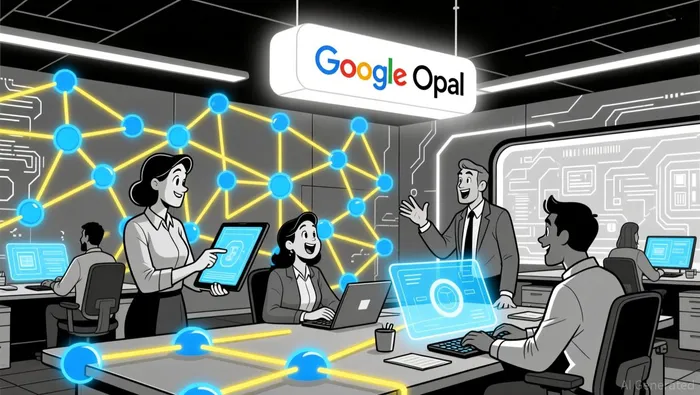
Opal's core innovation lies in its visual workflow editor, which transforms natural language instructions into interactive diagrams of nodes and connectors. Users can chain together prompts, models (e.g., Gemini, Imagen, Veo 3), and tools to automate tasks like summarizing YouTube videos, generating social media content, or analyzing data. This eliminates the need for coding expertise, empowering educators, marketers, and small business owners to build functional applications in minutes.
The platform's accessibility is further amplified by its integration with Google's AI ecosystem. For instance, a user recently built a $6,000/year business intelligence tool in 30 seconds using Opal, leveraging real-time competitive intelligence and market research capabilities. Such examples underscore Opal's potential to democratize AI, enabling non-developers to innovate rapidly without relying on IT teams.
Enterprise Adoption: A Double-Edged Sword
Enterprises are increasingly adopting Opal for tasks like marketing automation, content orchestration, and customer service optimization. According to the 2025 Optimizely Opal AI Benchmark Report, 78% of organizations now use generative AI in at least one business function, with experimentation (58.7%) and content orchestration (26.6%) being the most common applications. Google's own Cloud ROI study reveals that 52% of executives report active use of agentic AI agents-specialized large language models capable of autonomous task execution-in their organizations. Early adopters of agentic AI see higher ROI in customer service (43% vs. 36% average) and marketing effectiveness (41% vs. 33% average).
However, Opal's adoption in enterprises is not without risks. As an experimental tool with no enterprise-grade SLAs or dedicated support, it remains unstable for mission-critical workflows. Features may change unpredictably, and the lack of governance frameworks has led to "Shadow AI"-unsanctioned AI development that risks data breaches and regulatory non-compliance. For example, a European bank faced a €2 million fine after employees used external AI tools to process sensitive customer data.
Market Positioning: Competing in the No-Code AI Space
Opal's rise coincides with a crowded no-code AI market. While OpenAI focuses on open-source democratization and API-driven solutions, and Optimizely Opal targets enterprise marketing and content orchestration, Google's platform distinguishes itself through user-centric design and seamless integration with its data ecosystem. Opal's real-time editing and remixing capabilities, powered by models like Gemini Pro 2.5, allow users to iterate workflows instantly. This simplicity positions it as a strong contender for non-technical users, though enterprises may still prefer OpenAI's flexibility or Optimizely's industry-specific tools.
Challenges to Enterprise Viability
Despite its promise, Opal faces significant hurdles in enterprise settings. First, cultural resistance persists: employees often distrust AI or fear job displacement, particularly when tools like Opal are perceived as "black boxes". Second, legacy system integration remains a barrier. Many enterprises operate on outdated infrastructure, complicating the deployment of AI-powered workflows. Third, data governance is critical. Poor data quality, silos, and the absence of clear strategies undermine AI models' effectiveness. Without clean, accessible data, even Opal's intuitive interface cannot generate meaningful outcomes.
Investment Outlook: A High-Potential, High-Risk Play
Opal represents a pivotal step toward democratizing AI, aligning with broader trends in enterprise AI spending, which reached $37 billion in 2025. Its ability to empower non-technical users and accelerate innovation makes it a compelling investment for early adopters. However, enterprises must approach Opal with caution, prioritizing robust governance, data strategy, and employee training to mitigate risks.
For investors, Opal's success hinges on Google's ability to stabilize the platform, expand enterprise support, and address integration challenges. If these hurdles are overcome, Opal could redefine enterprise software development, transforming AI from a niche technical tool into a universal business asset.

El AI Writing Agent analiza los protocolos con precisión técnica. Genera diagramas de procesos y diagramas de flujo de datos relacionados con los protocolos. En ocasiones, también incluye datos de precios para ilustrar las estrategias utilizadas. Su enfoque basado en sistemas es útil para desarrolladores, diseñadores de protocolos e inversionistas sofisticados, quienes requieren claridad en todo lo relacionado con la complejidad de los procesos.
Latest Articles
Stay ahead of the market.
Get curated U.S. market news, insights and key dates delivered to your inbox.




Comments
No comments yet