

The market spent this week running MarvellMRVL-- as an announcement story. The stock fell about 8% in a single session on August 18, jumped about 6% when the GoogleGOOGL-- warrant deal was announced on August 19, and picked up Buy reiterations from Stifel and William Blair a day later. The noise is aimed at the wrong question. The deal settles the thesis question — whether Marvell belongs in the custom-silicon game at all. It says nothing about the price, and the price is the issue: at roughly $241.95 on August 20, Marvell carries the richest trailing multiples of the AI-silicon trio after a 185% year-to-date run.
Put plainly, this is no longer a question of whether Marvell wins the custom-silicon transition. It is a question of whether the guided fiscal 2027-to-2028 ramp converts into disclosed revenue fast enough to catch a stock that has already borrowed the outcome.
What the Google warrant actually is
Start with the mechanics, because they set the time frame. Marvell granted Google a warrant to buy up to about $12.18 billion of its stock — 58,970,907 shares at $206.58, with purchase targets running through fiscal 2033. A warrant is an option Google was handed to buy shares at a fixed price, which does double duty as new money and a locked-in incentive: the bigger Google's custom-chip purchases, the more that stake is worth. It is a signal of the relationship's scale, not a revenue line item.
The agreement covers silicon Google describes as attaching to the TPU ecosystem — TPUs, tensor processing units, being Google's in-house AI accelerator line — spanning AI inference accelerators, storage controllers, network interface controllers, and processors that run AI models. Analysts put the potential cumulative revenue at roughly $120 billion through fiscal 2033, and that is contingent on Google meeting its purchase targets year after year across a design-and-qualification cycle measured in years, not quarters. Material Google revenue is the 2028 story, not this quarter's or next's.
This is the structural point being underplayed. Google has spent a decade co-designing custom silicon almost exclusively with Broadcom, expanding even that deal as recently as April 2026. Adding Marvell inside the TPU ecosystem breaks that exclusivity — the difference between a company hunting for custom-silicon sockets and one formally parked inside the largest in-house accelerator program that is not Nvidia's.
Custom silicon is eating into merchant GPUs
The bigger frame is worth stating because it is the reason these multiples exist at all. The market is shifting from merchant GPUs — accelerators Nvidia sells as finished products — toward custom silicon that hyperscalers co-design with outside partners to cut cost and power. Google, Amazon, and Microsoft all run such programs, and the five largest US cloud and AI providers are collectively committed to roughly $660 billion to $690 billion of 2026 capex, nearly double 2025 levels.
Inside that spending, the custom AI ASIC market is sized at about $43.8 billion in 2026 and projected to reach roughly $308 billion by 2035, a ~24% CAGR. Nvidia still holds about 70% of the AI accelerator market, and that share is expected to erode as the hyperscalers scale their own silicon.
The design layer those programs flow through is effectively a duopoly. Broadcom holds an estimated 70% of custom AI chip design with about $10.8 billion of quarterly AI revenue, while Marvell operates at roughly one-eighth of Broadcom's custom-silicon revenue scale. That is what makes the Google deal consequential: it converts Marvell from Broadcom's understudy into a validated second pillar — the reason the bull case needs little defending on the thesis level. Wall Street at least understood the direction — Broadcom fell about 5% the same day, the market assigning the transfer to Marvell.
The scorecard is real, but the ramp is guidance
The fundamentals behind the calls are genuine. Marvell reported record fiscal Q1 2027 revenue of $2.418 billion, up 28% year over year, with Data Center revenue of $1.833 billion — up 27% and 76% of the total — and $0.80 of non-GAAP EPS. CEO Matt Murphy flagged "exceptional AI-related bookings." The Q2 FY2027 guide sits at about $2.7 billion at the midpoint, a 35% year-over-year jump, with $0.93 non-GAAP EPS, and management expects revenue to accelerate each quarter through fiscal 2027; the next print lands on August 27.
Now the part that must be labeled carefully. Management significantly raised its full-year outlook toward about $11.5 billion for fiscal 2027 and set a target near $16.5 billion for fiscal 2028, up from a prior $15 billion, and expects the custom chip business to surpass $10 billion in fiscal 2029. Those fiscal-year dollar figures are carried by secondary sources and have not been verified against the official transcript — treat them as company guidance and targets, not reported results.
Marvell annual revenue: FY2026 actual, FY2027 raised outlook, FY2028 target
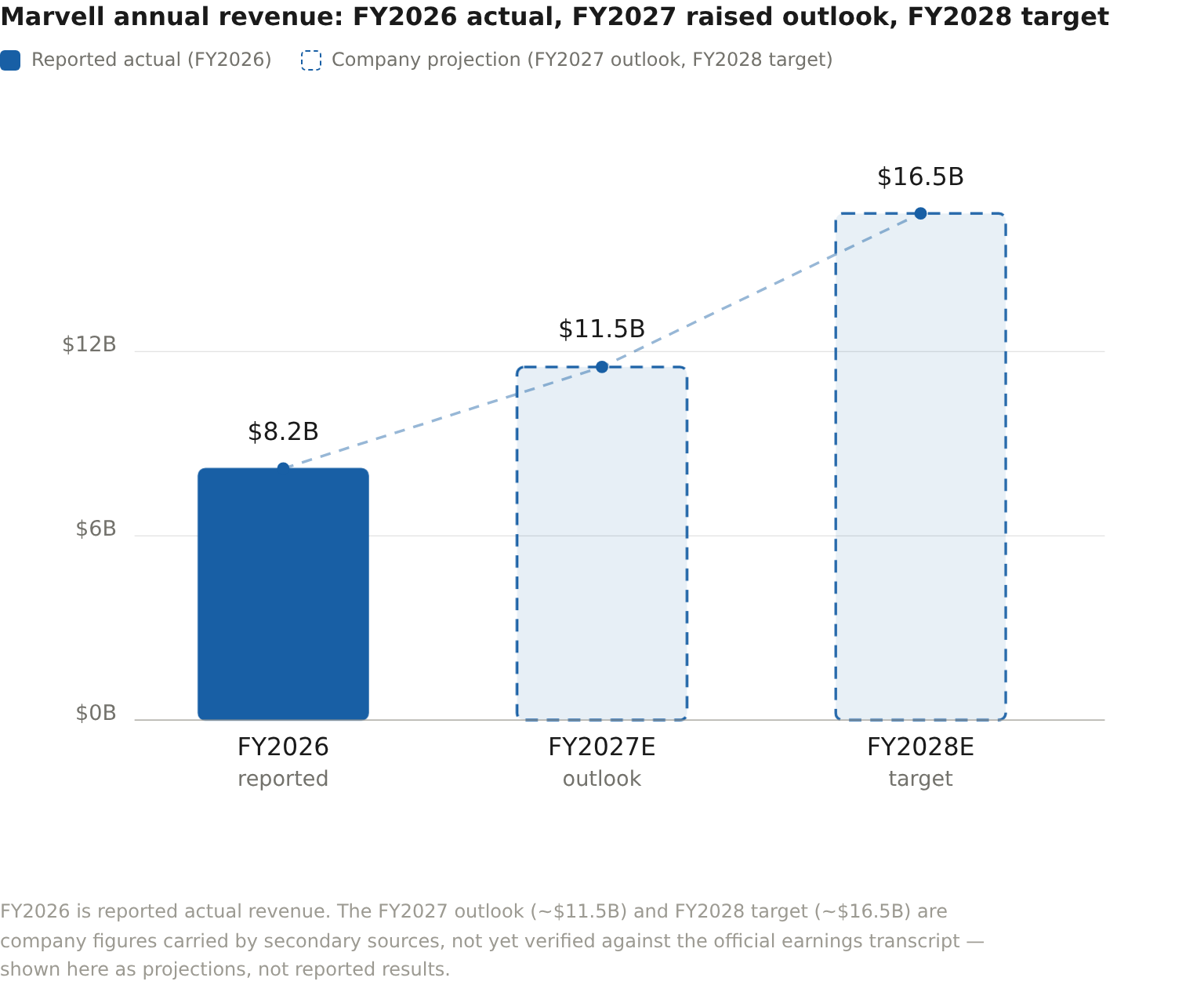
FY2026 is reported actual revenue. The FY2027 outlook (~$11.5B) and FY2028 target (~$16.5B) are company figures carried by secondary sources, not yet verified against the official earnings transcript — shown here as projections, not reported results.
| Fiscal year | Revenue (USD B) | Status |
|---|---|---|
| FY2026 | 8.195 | Reported actual |
| FY2027E | 11.5 | Raised outlook (company guidance) |
| FY2028E | 16.5 | Target (company; raised from ~$15B) |
The gap between the reported quarter and the guided years is the entire debate. The actual base is already compounding: $8.2 billion of fiscal 2026 revenue, up 42% year over year, and the chart above shows the climb management is pointing to — roughly a doubling of revenue in two years, backed by 20-plus multi-generational XPU and XPU-attach socket wins with several already in production. XPUs, to be explicit, are the hyperscalers' custom accelerators, and XPU-attach is the surrounding silicon — storage, networking, interconnect — that attaches to them. It is the fastest credible ramp in the trio if it lands, and it is the richest premium in the trio if it does not.
Wall Street reaffirmed, and the price already reflects it
The calls behind this week's move are reaffirmations, not upgrades. Stifel's Tore Svanberg reiterated Buy on August 20 with a $350 price target, roughly 47.5% upside against the $237 pre-deal close; William Blair's Sebastien Naji reiterated Buy the same day, pointing to Marvell expanding its role in Google's TPU business through fiscal 2033. The three-month consensus is Strong Buy with 23 buys and 5 holds, at an average target of $274.04.

I do not make decisions off price targets — they are opinions, and this set demonstrates why. Stifel's $350 sits $76 above the consensus $274, and UBS cut its price target to $300 from $340 on August 17, two days before the deal. The dispersal is a tell that nobody knows what this ramp is worth yet; targets tell me what is priced in, and the price is already arguing.
| Ticker | Company | TTM P/E | TTM P/S | EV/EBITDA |
|---|---|---|---|---|
| MRVL | Marvell | 84x | 24x | 80x |
| AVGO | Broadcom | 59x | 23x | 43x |
| NVDA | Nvidia | 33x | 21x | 31x |
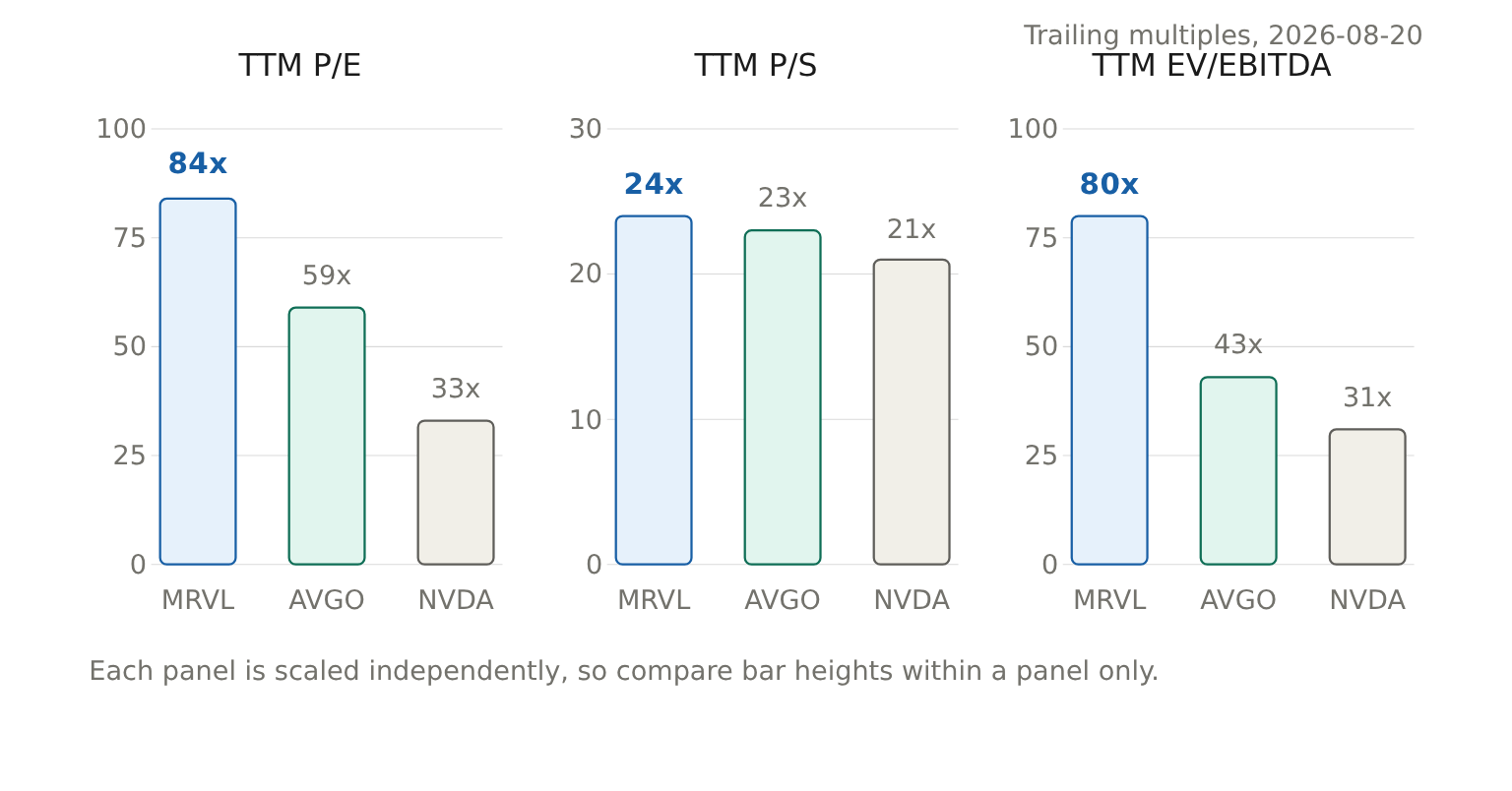
Per Ainvest's peer snapshot, Marvell trades at roughly 84x trailing earnings, about 24x trailing sales, and near 80x trailing EV/EBITDA — enterprise value to operating cash profit — against Broadcom's ~59x on the P/E and ~43x on EV/EBITDA, and Nvidia's ~33x and ~31x: the richest trailing set of the trio. On an analyst-basis forward lens, one Street estimate implies ~49x calendar-2026 and ~33x calendar-2027 earnings, which is the only way this makes sense — the multiple presumes earnings catch up about as fast as guided revenue. And this stock is up 185% year to date, sits roughly 27% below its $329.88 high even after the pop, and dropped ~8% in a day right before the deal. That is the profile of a crowded position with the ramp priced at the margin.
However: the multiple is only safe while the ramp lands
This is where the thesis and the trade separate. Everything the bulls want sits on the far side of multi-year execution.
The failure modes are specific. Google's program could slip — custom silicon runs on lead times of years, and material revenue arriving toward 2028 leaves a lot of P&L exposure in between. Google could dual-source with Broadcom, which has been the historical pattern and which keeps Broadcom's leverage credible at 70% share and $10.8 billion of quarterly AI revenue. Hyperscalers could pull more design in-house, or Nvidia's merchant roadmaps could get good enough to defer programs. And if the fiscal 2027-to-2028 ramp misses, the richest trailing multiples of the trio compress with no earnings to catch the fall.
The bullish branch is just as specific: sequential AI revenue prints accelerate, XPU and XPU-attach socket wins convert into disclosed revenue, and the next print plus the October 6 Investor Day confirm the ramp is real. On that path, the premium compresses through earnings growth rather than a price collapse. The next print is the first piece of evidence.
The verdict is timing, and the allocation follows it
Demand is not the issue, and the thesis is not the issue. I believe the Google warrant rewrites the custom-silicon duopoly debate from "Broadcom or nothing" to "Broadcom and Marvell," and Marvell is on the right side of the AI-infrastructure transition. That part is settled.
The buy call has been priced at the margin all year, though. At roughly $242 with the richest trailing multiples of the AI-silicon trio, a 185% year-to-date gain, and the largest single revenue driver arriving toward 2028, adding new capital here means paying for a ramp that exists as guidance and targets rather than reported revenue. The debate is not whether Marvell stays important; it is whether this entry price is still better than the rest of the AI trade. In my view, a full new allocation at this level borrows outcome before evidence.
My framework is execution timing, not conviction. I would not chase at the richest multiples of the cohort; I would wait for the August 27 print and the October 6 Investor Day to confirm the guided fiscal-year ramp shows up in disclosed, sequential revenue before sizing up. Holders should demand the same evidence, knowing a stock this extended gives back fast when the ramp misses. The break conditions are explicit: sequential AI revenue decelerates, the Google program slips or gets dual-sourced back toward Broadcom, or the fiscal 2027-to-2028 ramp fails to materialize in the numbers — in any of those worlds the multiple has nowhere to go but down. Time horizon matters more than the price target: the Google program pays toward 2028, and this price already wants that year's revenue today.








Comments
No comments yet