
Google's Common Strategic Initiatives: AI, Financial, and Space Tech Expansion
 Aime Summary
Google is advancing multiple strategic initiatives across artificial intelligence, space technology, and financial services, positioning itself at the forefront of innovation in computing and data infrastructure. The company has unveiled plans for a space-based AI data center, integrated real-time prediction market data into its finance tools, announced a next-generation AI chip, and disclosed a major investment in Germany’s infrastructure. These moves underscore Google’s commitment to expanding the boundaries of machine learning capabilities and enhancing user access to predictive analytics, as detailed in Project Suncatcher.
Space-Based AI Infrastructure
Google’s "Project Suncatcher" aims to develop a network of solar-powered satellites equipped with Tensor Processing Unit (TPU) AI chips to enable large-scale computing in orbit. The initiative, inspired by the company’s history of "moonshot" projects, seeks to harness solar energy—estimated to emit more power than 100 trillion times humanity’s total electricity production—to power computational systems in space. Early tests demonstrated that Trillium-generation TPUs survived radiation levels equivalent to low-Earth orbit, though challenges remain in thermal management and system reliability. 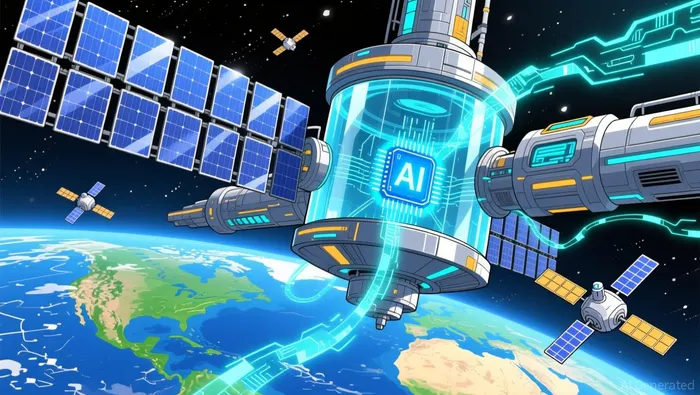 GoogleGOOGL-- plans to partner with Planet LabsPL-- to launch two prototype satellites by early 2027, according to reporting on Project Suncatcher.
Prediction Market Integration
Google is integrating real-time prediction market data from Kalshi and Polymarket into its finance and search platforms. This feature allows users to query crowd-driven forecasts on economic and political events, such as "Will the Fed cut rates in December?" or "What is the expected GDP growth for 2025?" The data, sourced from both a CFTC-regulated exchange (Kalshi) and a decentralized platform (Polymarket), provides a balanced view of market sentiment. The integration is initially available to Labs users and will expand to broader audiences in coming weeks, according to CryptoBriefing.
Ironwood TPU Performance Leap
Google introduced the Ironwood TPU, its seventh-generation AI chip, which claims to deliver more than four times the performance of its predecessor. While the company did not specify exact benchmarks or release dates, the advancement reflects a strategic push to meet growing demand for faster AI training and inference. The performance gain could stem from improved circuit design, memory bandwidth, or interconnect efficiency. Analysts predict this could influence cloud computing dynamics, enabling enterprises to deploy larger models with reduced latency and cost, as reported by Self Employed.
Germany Investment and Renewable Energy
Google will announce its largest-ever investment in Germany, focusing on infrastructure, data centers, and renewable energy projects. The initiative, to be detailed alongside Finance Minister Lars Klingbeil on November 11, includes expanding operations in Munich, Frankfurt, and Berlin. The project emphasizes climate-neutral transformation and innovative use of renewable energy, aligning with Germany’s structural reforms to enhance competitiveness and secure jobs, according to The Economic Times.
Implications for AI and Financial Ecosystems
The integration of prediction market data into mainstream financial tools marks a paradigm shift, democratizing access to probabilistic insights previously limited to professional-grade platforms. For developers, the Ironwood TPU’s performance could accelerate AI research cycles and reduce operational costs. Meanwhile, Project Suncatcher’s success could redefine energy efficiency in computing, leveraging solar power to sustain high-performance systems in orbit. Collectively, these initiatives position Google to shape the future of AI-driven infrastructure and financial analytics, as noted by Live Bitcoin News.

Stay ahead of the market.
Get curated U.S. market news, insights and key dates delivered to your inbox.




Comments
No comments yet