
Google's Cash Flow Is Breaking: AI Spending Hits the Gas, But Where Are the Returns?
Google's latest earnings report revealed a major shift that goes beyond revenue growth or profitability. The company's cash flow structure is changing rapidly as one of the world's strongest cash-generating businesses redirects more of its money toward artificial intelligence infrastructure.
In the same quarter last year, Google generated roughly $10 billion in free cash flow. One year later, as AI-related capital spending accelerated, free cash flow fell to approximately negative $5.9 billion. The difference of more than $15 billion in quarterly free cash flow highlights a fundamental change in how Google is using its cash.
For more than two decades, Google built one of the most powerful cash machines in the world through Search and YouTube advertising. However, the money generated from those businesses is now being poured into AI data centers, chips, computing power, and other infrastructure.
The key question for investors is whether these massive AI investments can eventually generate enough returns. If even a company as financially strong as Google begins to see significant free cash flow pressure from AI spending, the impact could be much larger for the entire AI ecosystem.
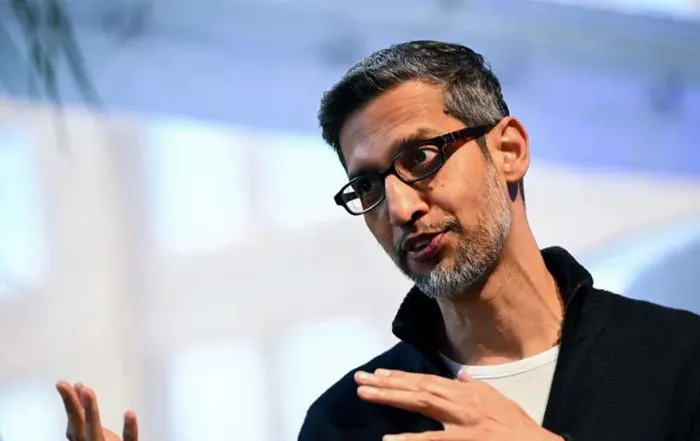
Google Built One of the World's Best Cash-Generating Businesses
For the past two decades, Google has been one of the most profitable companies in the technology industry. Its business model was simple but extremely powerful: attract billions of users through Search and YouTube, then monetize that attention through advertising.
Search advertising became one of the most profitable businesses ever created. Unlike many industries that require heavy investment to grow, Google's advertising business generated enormous amounts of cash with relatively low capital requirements.
The company had the ideal combination of scale, profitability, and stability. Every year, billions of dollars flowed into Google's balance sheet from advertisers who wanted access to its massive user base. That cash allowed Google to buy back shares, invest in new products, and maintain one of the strongest financial positions among global technology companies. For investors, Google represented certainty. It was a company that could consistently turn user activity into cash flow.
Google Is Now Spending Its Advertising Cash on AI Infrastructure
The rise of artificial intelligence has transformed the competitive landscape of technology. The next generation of technology competition is not only about software and algorithms. It is increasingly about physical infrastructure. Companies need enormous data centers, advanced AI chips, networking systems, and energy capacity to train and operate increasingly powerful models.
Google is now using the cash generated from its traditional businesses to compete in this new AI infrastructure race. The company is taking the profits created by Search and YouTube and investing them into the foundation of the AI economy. This represents a major change from Google's previous business model. Historically, Google was a relatively asset-light company that generated huge profits without requiring massive capital spending. AI is pushing Google into a much more capital-intensive environment.
The company is making a huge bet that today's infrastructure spending will create tomorrow's AI-driven revenue. However, the challenge is that the spending happens immediately, while the returns may take years to appear.
The Biggest Risk: AI Spending Is Growing Faster Than AI Returns
The biggest concern facing Google and the broader technology sector is not whether companies can afford AI investment. Companies like Google, Microsoft, Amazon, and Meta have enormous financial resources. AI infrastructure will generate enough economic value to justify the spending.
Building AI infrastructure requires billions of dollars upfront. Data centers need to be constructed, chips need to be purchased, and models require continuous computing power. But the revenue side remains uncertain. Google expects AI to create new opportunities through AI-powered search, Gemini products, enterprise AI services, and cloud computing. If these businesses grow quickly, the current investment cycle could prove extremely valuable. However, if AI adoption develops more slowly than expected, companies could face a difficult situation: massive infrastructure costs without enough new cash flow to support them.
Google is not a struggling company. It is one of the strongest and most profitable companies in the world. If a company with Google's financial strength is already seeing free cash flow pressure from AI investment, the impact could be much larger for companies that have weaker cash generation or rely heavily on future AI growth expectations. This is why AI Infra's cash flow matters so much.
The Next Test for the AI Market
Google's results may represent an early signal for the entire AI investment cycle. Other members of the Mag7, including Microsoft, Amazon, and Meta, are also making massive AI infrastructure investments. Their next week earnings reports will provide an important test for whether Google's situation is unique or part of a broader industry trend. Investors will be watching whether these companies show the same pattern: strong revenue growth but weakening free cash flow due to rising AI capital expenditures.
The entire AI boom is based on one major assumption: today's enormous spending will create much larger profits in the future. If companies can prove that AI investments are generating real returns, the current spending cycle could become one of the most important technology investments in history. But if capital spending continues rising while cash flow remains under pressure, the market may begin questioning whether AI valuations have moved too far ahead of reality.
History has shown that a technology revolution can be real while investment expectations still become excessive. The internet transformed the world, but many companies that invested heavily in internet infrastructure failed because returns did not arrive quickly enough. AI may face a similar test.
Conclusion
Google's latest earnings report is not a sign that the company is losing its ability to make money. In fact, Google remains one of the strongest cash-generating companies in the world. But the company's cash flow shift reveals a deeper change: the profits created by the internet era are now being used to finance the AI era.
For years, Search and YouTube advertising created massive amounts of cash. Today, that cash is being redirected toward AI infrastructure, with the hope that these investments will create the next generation of growth. But if AI spending keeps increasing while free cash flow continues weakening, the market could face a major reassessment.
The most important question is no longer how much companies are investing in AI. The question is whether those investments can eventually become real cash flow.

Tianhao Xu is currently a financial content editor, focusing on fintech and market analysis. Previously, he worked as a full-time forex trader for several years, specializing in global currency trading and risk management. He holds a master’s degree in Financial Analysis.
Latest Articles
Stay ahead of the market.
Get curated U.S. market news, insights and key dates delivered to your inbox.


AInvest
PRO
AInvest
PRO



