
Google's AI Expansion Legal Setbacks and Market Strategies Reshape World Liberty Financial Dynamics
 Aime Summary
Google Inc. (NASDAQ: GOOGL) continues to expand its influence across multiple sectors, leveraging artificial intelligence, digital infrastructure, and strategic partnerships to shape global technological landscapes. Recent developments highlight the company's dual focus on advancing scientific research and challenging established market dynamics, while also navigating regulatory and geopolitical hurdles. These initiatives underscore Google's evolving role in both innovation and industrial competition.
AI-Driven Stem Cell Research with Kyoto University
Google has partnered with Kyoto University to enhance the production of induced pluripotent stem (iPS) cells using artificial intelligence. This collaboration aims to optimize the safety and efficiency of iPS cell generation, accelerating their potential for medical applications such as regenerative therapies and drug discovery. By integrating machine learning into laboratory workflows, the project seeks to reduce costs and variability in stem cell research, addressing long-standing challenges in the field.
Visual Discovery Platform Challenges Social Media Giants
In a strategic move to capture younger demographics, GoogleGOOGL-- launched a new "Images" tab within its mobile app, offering a personalized visual feed of curated content. This feature directly competes with platforms like TikTok and Pinterest by providing users with a searchable, ad-supported stream of images and collections. By embedding the feature within its existing user base, Google aims to drive engagement and monetize visual content without requiring users to leave its ecosystem.
Geopolitical Delays Hinder Subsea Cable Expansion
Google's efforts to expand global internet infrastructure face significant setbacks due to security risks in the 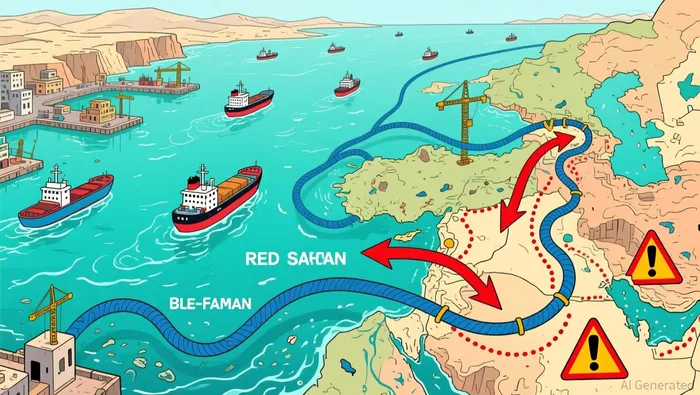 Sea. Projects such as the Blue-Raman cable system and Meta's 2Africa initiative have experienced prolonged delays, with construction halted in key regions due to missile attacks and regulatory challenges. These disruptions not only delay connectivity goals in underserved regions but also force companies to incur additional costs by leasing alternative routes, straining financial returns for investors.
AI-Powered Defense Technology Deployment
Google has partnered with General Dynamics Information Technology (GDIT) to deploy AI-driven cloud solutions for U.S. defense and intelligence agencies. Utilizing Google Distributed Cloud, a secure, portable cloud infrastructure, the collaboration enables mission-critical operations in environments with limited connectivity. Demonstrated during the Mobility Guardian 2025 exercise, the technology supports rapid force deployment and logistics management, reflecting Google's growing role in national security applications.
Legal Challenges Over Search Algorithm Practices
A Berlin court has ruled that Google must pay €465 million ($540 million) to German price comparison platform Idealo for allegedly manipulating search results to favor its own services. The ruling, which acknowledges systematic suppression of competitors like Idealo and Testberichte.de, aligns with prior European Commission antitrust actions against Google. While the awarded amount is significantly lower than the €3.5 billion sought by Idealo, the decision opens avenues for further claims and underscores ongoing legal scrutiny of Google's market dominance.
Data Collection Concerns with Discontinued Nest Thermostats
Security researcher Cody Kociemba revealed that Google continues to collect data from discontinued Nest Learning Thermostats, despite disabling remote control features. The devices, no longer supported by official updates, transmit information about temperature changes, occupancy, and environmental conditions. This practice has sparked debates over user privacy and the implications of "smart" device obsolescence, particularly as third-party solutions like FULU's No Longer Evil project seek to restore functionality despite no official support.

Stay ahead of the market.
Get curated U.S. market news, insights and key dates delivered to your inbox.
AInvest
PRO
AInvest
PRO



Comments
No comments yet