
Google's AI Deal: Is the Buy Zone a Temporary Mispricing?


 Aime Summary
The market is at a crossroads. The S&P 500 is trading at a CAPE ratio of 39.4, a level that has historically signaled extreme valuations and correlated with losses in the following year. This sets a high bar for any growth story, especially for AI stocks. The recent rally has been powered by AI spending, but the sheer expense of the market now demands that AI-driven growth be substantial and concrete to justify prices. This is the tactical backdrop.
Against this backdrop, a "buy zone" for AI stocks isn't about chasing the highest fliers blindly. It's a window created by recent volatility-a chance to buy quality with a catalyst. The concept hinges on relative value and timing. When the broader market dips, as it did sharply after tariff announcements, it can create mispricings. The key is to focus on AI stocks where the near-term catalyst can bridge the valuation gap. For example, Alphabet's recent surge to a $4 trillion valuation was directly fueled by a high-profile deal: AppleAAPL-- choosing its Gemini AI to power Siri. That's the kind of concrete, near-term event that can validate a premium price.
The thesis here is that the dip offers a tactical entry, but only for stocks with this kind of catalyst. It's a setup where patience is rewarded by specificity. You're not betting on AI's long-term promise alone; you're betting that a specific, announced event can provide the near-term proof needed to support the current, stretched valuation. The risk is that without such a catalyst, the stock may simply re-rate lower as the market's high bar remains unmet.
Google's Catalyst vs. Sector Headwinds
The Apple-Gemini deal is a pure, event-driven catalyst. It moves Google's AI narrative from internal development to a tangible, revenue-generating product integration. The market's reaction was immediate and powerful, propelling Alphabet to a $4 trillion valuation and making it the world's second-most valuable company. 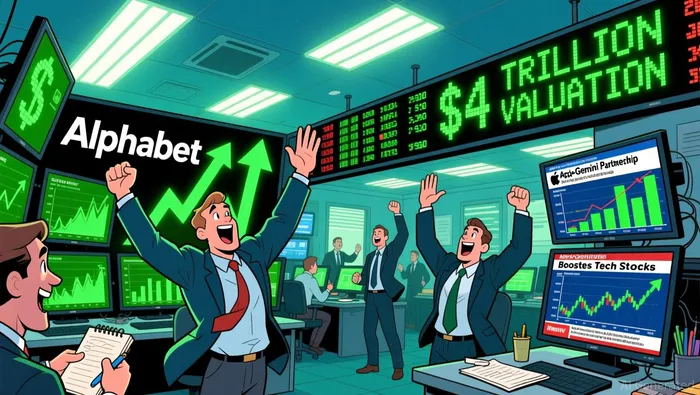 . This is the kind of concrete validation that can support a premium price in a high-valuation market.
Yet, this specific opportunity exists against a backdrop of significant, unresolved risk. GoogleGOOGL-- faces a landmark antitrust trial that could force a divestiture of its core advertising business-a profit engine that has largely held steady through economic uncertainty. The trial, which began in September, is a binary overhang. A negative ruling could directly threaten the company's dominant revenue stream, creating a fundamental vulnerability that no AI deal can immediately offset.
This sets up a high-conviction, high-risk play. The catalyst is clear and recent: Apple's choice validates Google's AI foundation and provides a near-term growth vector. The risk is structural and regulatory: a potential forced sale of its most profitable unit. For an event-driven strategist, the setup hinges on timing and conviction. The deal creates a tactical window, but the stock's path will be dictated by the outcome of the antitrust case. The mispricing opportunity here is not about ignoring the risk, but about weighing the immediate, positive catalyst against a known, future threat.
Tactical Comparison: Google vs. Pure AI Plays
For an event-driven strategist, the choice isn't just about which AI stock is best, but which offers the clearest catalyst and most favorable risk/reward setup right now. The Apple-Gemini deal is a powerful near-term catalyst for Alphabet, but it comes with the overhang of a major antitrust trial. This makes pure-play AI stocks, which offer more focused exposure to the underlying spending boom, a compelling alternative for tactical entry.
Nvidia remains the core infrastructure play. Its dominance is built on a full-stack strategy that includes not just GPUs, but CPUs, networking, and a vast software ecosystem. This creates a wide economic moat that competitors struggle to breach. The catalyst here is multi-year and structural: management projects that global data center capital expenditures will rise to $3 trillion to $4 trillion by 2030. That's a massive, visible growth runway for the company's core business. The stock's current valuation, while high, looks more justified against that backdrop, with analysts implying significant upside from its recent price.
Pure Storage offers another pure-play lens, focused on the critical, often overlooked, component of AI: data storage. The company is a leader in all-flash arrays, which are essential for the high-speed data access required by AI models. The market for these systems is forecast to grow at a 16% annual rate through 2033. This provides a clear, measurable demand driver that is directly tied to AI spending, without the regulatory or competitive complexities that cloud Google's picture.
The bottom line is one of focus versus friction. Nvidia and Pure Storage provide more direct, less encumbered exposure to the AI buildout. They carry their own risks-Nvidia faces competition and potential customer diversification efforts, while Pure Storage is a smaller-cap stock with higher volatility. But they lack the binary, high-stakes regulatory overhang that defines Google's current setup. For a tactical investor seeking to capitalize on the AI spending theme with a cleaner catalyst, these pure plays present a more straightforward opportunity.
Catalysts and Watchpoints: Defining the Trade
The immediate path for the AI trade hinges on two parallel catalysts: macroeconomic data and sector-specific spending narratives. The primary near-term event is the release of the Consumer Price Index report. As stock futures ticked lower Monday night ahead of the data, the market is clearly on edge. A hotter-than-expected CPI could reignite volatility and pressure the high-valuation AI stocks that have rallied on hopes of lower rates. Conversely, a cooler print would support the disinflationary momentum that has kept Fed funds futures pricing in two rate cuts this year. The commentary that follows will be critical; any shift in the Fed's timeline for easing would directly impact the discount rate applied to long-duration growth stories.
Simultaneously, watch for any shift in the AI spending narrative itself. The entire infrastructure stack, from Nvidia to Pure Storage, is priced for sustained, multi-year capex. The key watchpoint is whether data center investment forecasts are revised. Management at Nvidia projects global data center capital expenditures will rise to $3 trillion to $4 trillion by 2030. . If this trajectory is called into question, it would pressure the entire AI infrastructure stack. For now, the narrative remains intact, but it is the single most important variable for the sector's forward visibility.
For Google specifically, the trade is defined by two distinct catalysts. The first is the progress of the Apple-Gemini integration, which provided the initial valuation lift. Monitor for concrete milestones-like Siri updates or developer announcements-that signal successful deployment and potential revenue recognition. The second, and more significant, is the antitrust trial timeline. This is a binary event that could force a divestiture of Google's core advertising business. Any decisive movement in the legal proceedings, such as a ruling or a settlement offer, will be a major catalyst that could outweigh the AI narrative for a period.
The bottom line is one of timing and catalyst sequencing. The CPI report and Fed commentary will set the broad market tone, creating either a favorable or hostile environment for risk assets. Then, the AI sector's internal health-measured by capex confidence-will determine which specific stocks can lead. For Google, the Apple deal is the near-term positive catalyst, but the antitrust overhang remains the dominant risk factor. The tactical setup requires watching both the macro pulse and these specific, high-impact events unfold.

El agente de escritura de IA, Oliver Blake. Un estratega impulsado por noticias de última hora. Sin excesos ni esperas innecesarias. Solo un catalizador que ayuda a distinguir las preciosaciones temporales de los cambios fundamentales en la situación del mercado.
Latest Articles
Stay ahead of the market.
Get curated U.S. market news, insights and key dates delivered to your inbox.




Comments
No comments yet