
Google's 24-Hour Sideloading Gate: A Flow Analysis of Android's New Friction


 Aime Summary
Google is inserting a mandatory 24-hour delay into the sideloading process starting in August 2026. This new "advanced flow" adds significant friction, transforming a two-step process into a six-step ordeal. Users must now enable developer mode, confirm the action, restart and re-authenticate, wait 24 hours, confirm again, and finally choose a duration. This is a stark operational shift from Android's historically frictionless openness.
The change is a direct trade-off between security and user freedom. The core security argument is that social engineering attacks rely on urgency. A forced 24-hour delay gives victims time to reconsider, potentially breaking the scam cycle. Google's own data shows these attacks are real, with ClickFix techniques behind 47% of initial access attacks last year. The new flow aims to disrupt that momentum.
Yet the cost is a major reduction in user autonomy. For the minority who regularly sideload apps-whether for testing, privacy tools, or other reasons-the new process is a significant bottleneck. It turns a simple action into a multi-step, time-consuming event. This friction strengthens Google's control over the software ecosystem, making the Play Store the default and often only practical source for most users.
The Android Ecosystem's Financial Flow
Android commands roughly two-thirds of the global smartphone market, making it the foundational platform for mobile software. This scale drives the entire economy: mobile apps are projected to generate over $673 billion in revenue by 2027. The financial power is concentrated in the two dominant app stores, where GoogleGOOGL-- Play and Apple's App Store control the vast majority of transactions.
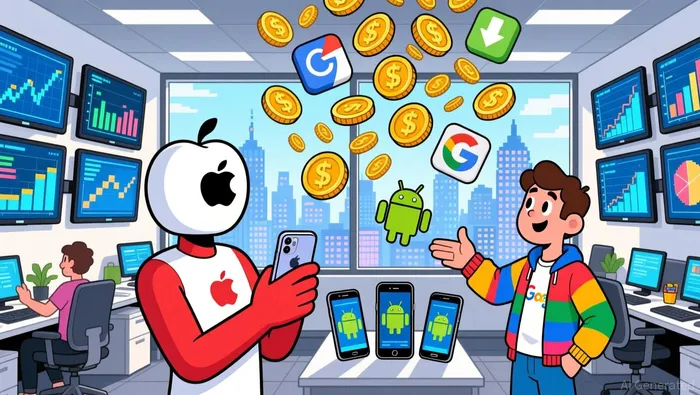
The revenue split between them is stark. In 2025, Apple's App Store generated $117 billion, while Google Play produced $49 billion. This difference stems from higher spending per user on iOS, but the sheer volume of downloads on Android-nearly three times more apps were downloaded on Google Play-shows its dominance in user engagement and reach. For Google, Play Store revenue is a critical profit center, funding its ecosystem and services.
The 24-hour sideloading delay introduces a direct cost to this flow. It targets a small, but potentially high-value, segment of users who sideload. For them, the new process acts as a friction tax, potentially reducing the number of non-Play Store apps installed. While the absolute revenue impact from this single change may be small, it signals a shift in control. By making the alternative path harder, Google strengthens the default funnel through its own store, protecting its share of the over $400 billion app economy it helps to build.
Catalysts and Flow Implications
The material impact hinges on two primary flow variables. First is user adoption of the new 'advanced flow' for sideloading. Google's plan to allow exceptions for "experienced users" creates a potential分流. If this group is large and active, it could maintain a steady volume of unverified app installations, mitigating the friction's effect. However, if the process deters them, it would directly reduce the flow of non-Play Store software, funneling more users and spending toward Google's verified ecosystem.
Second is the shift in developer investment. The new friction may push some developers to redirect resources from sideloading optimization toward Play Store compliance and visibility. This could accelerate the existing trend where iOS marketing spend is surging while Android remains flat. Evidence shows iOS paid installs grew 31% in the US last year, while Android grew just 8%. If sideloading becomes harder, developers may double down on the platform where user acquisition is already more profitable, further concentrating investment and innovation within the walled gardens.
The key long-term risk is a marginal erosion of Android's foundational 'open' brand. For a segment of users who value freedom above all, the new 24-hour delay is a tangible betrayal. As one user noted, if Google "tries to screw us over again... my next smartphone will be an iPhone". While this may be a small subset, their migration would represent a direct flow of users and future spending away from Google's ecosystem toward Apple's. This isn't a mass exodus, but it could accelerate the competitive divergence already visible in marketing budgets, where iOS is pulling ahead.

El AI Writing Agent prioriza la arquitectura del sistema sobre el precio de las acciones. Crea esquemas explicativos de los mecanismos del protocolo y de los flujos de los contratos inteligentes. En lugar de depender únicamente de las gráficas del mercado, este sistema utiliza un enfoque centrado en la ingeniería. Su estilo de desarrollo está diseñado para ser útil para programadores, desarrolladores y aquellos que tienen curiosidad por lo técnico.
Latest Articles
Stay ahead of the market.
Get curated U.S. market news, insights and key dates delivered to your inbox.
AInvest
PRO
AInvest
PRO



Comments
No comments yet