
Goldman’s Top Refiners Face Countdown to Margin Normalization as 2026 Supply Delays Fade


 Aime Summary
The current setup for refiners is built on a clear supply-demand imbalance that favors producers. Global demand for refined products is projected to grow by 0.5–0.8 mb/d in 2026, driven strongly by diesel and jet fuel. This growth is not being matched by new capacity. Net refining capacity additions are expected to be between 0.5–1.0 mb/d, but effective utilization will lag due to commissioning delays for major projects in India, Indonesia, and the Middle East. The result is a period of product scarcity, particularly in the first half of the year.
This imbalance is further supported by near-term supply disruption risks. Heightened geopolitical tensions in the Middle East have already lifted crude prices and created volatility. Such tensions directly threaten crude flows and can disrupt refining operations, reinforcing the tightness in the product market. This dynamic creates a favorable margin environment, with refining crack spreads forecast to average US$8–12/bbl for the year.
For capital return, this window is critical. The combination of elevated margins and a scarcity premium means refiners are generating robust cash flow. As Goldman SachsGS-- noted, the sector is set for near-term benefits from these dynamics, which directly fuel shareholder returns. The imbalance isn't permanent-it's expected to normalize later in 2026 as new projects come online. That makes the current period a prime opportunity for companies to return capital to shareholders while the favorable commodity balance lasts.
Financial Performance and Capital Allocation
The financial strength of these top refiners is a direct function of the favorable commodity balance. Their ability to convert robust margins into shareholder returns is now the central investment story. Marathon PetroleumMPC-- leads in scale and operational efficiency, posting adjusted net income of $4.07 per share in the fourth quarter. This was backed by a 94% refining utilization rate and a remarkable 105% margin capture, demonstrating its ability to fully monetize the tight product market. The cash flow engine is powerful, with cash from operations of $8.3 billion in 2025 enabling peer-leading capital returns of $4.5 billion for the year. Its structure is unique, with its midstream unit's growing distribution expected to more than fund MPC's 2026 dividend and standalone capital, creating a self-sustaining return stream.
Valero Energy is another major cash generator, returning capital at a disciplined pace. The company delivered stockholder cash returns of $4.0 billion in 2025, with a payout ratio of 67% of adjusted operating cash flow. This reflects a balanced approach, funding growth projects like the St. Charles FCC Unit optimization while maintaining a strong return profile. Its financial position is solid, ending the year with $4.7 billion in cash and a manageable debt load, providing flexibility to navigate the cycle.
HF Sinclair presents a different profile, one of a turnaround story with significant upside. The company posted adjusted EBITDA of $564 million for the fourth quarter, a substantial annual increase that marks a clear reversal from prior losses. This improvement is driven by its core refining operations, which saw adjusted refining gross margins increase by $313 million in the quarter, aided by regulatory waivers. The financial strength here is building, with the company also announcing a project at its El Dorado facility that aims to boost heavy crude processing, further enhancing its asset value. Its capital allocation is focused on internal growth and reliability.
All three companies are well-positioned to capitalize on the current conditions. Marathon's scale and cash flow generation offer the most predictable returns, ValeroVLO-- provides a balanced and disciplined payout, and HF SinclairDINO-- offers the highest potential for earnings acceleration from a low base. Their financial profiles confirm the sector's robust cash generation, turning the favorable commodity balance into tangible shareholder value.
Valuation and Forward Scenarios
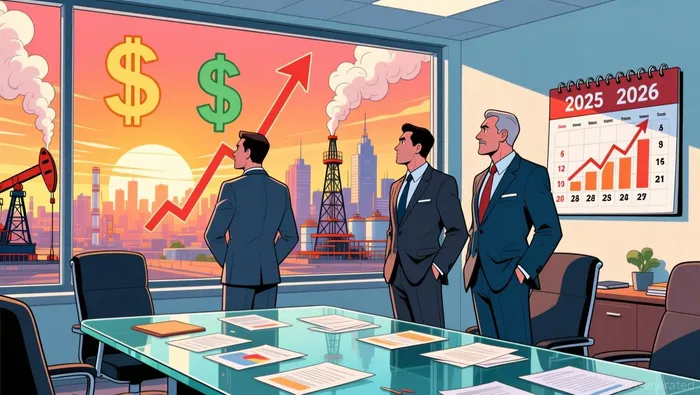
The current valuation of these top refiners reflects a market pricing in the near-term commodity balance. Goldman Sachs's move to lift Valero's price target to $237 from $203 implies significant upside from recent levels, signaling confidence in the company's execution through current disruptions. This bullish stance is shared by several other banks, which see the sector's attractiveness as rooted in premium asset portfolios and robust cash flow generation, not just fleeting margin spikes. Valero's advantaged Gulf Coast position and capacity to process heavy crude are key assets in this setup.
Yet the forward view is one of a clear inflection point. The sector's favorable trajectory is expected to normalize in the second half of 2026 as long-delayed mega-projects finally come online. This is the central risk: the product scarcity that is driving margins today is a temporary condition. As ADI Analytics notes, 2026 is a "year of two halves," with the first half benefiting from commissioning lags and the second half seeing margins normalize as new capacity integrates. For all three companies, the current period is a window to return capital, but the sustainability of that capital return depends on navigating this transition.
Looking ahead, the scenarios diverge by company. Marathon Petroleum's massive scale and self-funding midstream structure provide the most stable platform for sustaining returns through the cycle. Valero's disciplined capital allocation, with a targeted payout ratio, positions it to maintain a strong return profile even as margins compress. HF Sinclair, however, faces the steepest path to a normalized environment. Its turnaround is just beginning, and its smaller scale makes it more vulnerable to the margin compression that lies ahead. The company's recent project at El Dorado is a bet on maintaining operational edge, but its upside is more tied to the current tightness than Marathon's or Valero's structural advantages.
The bottom line is that today's valuations are a bet on the first half of 2026. The Goldman Sachs price target for Valero, and the sector's premium asset focus, are valid for now. But investors must watch the second-half dynamics closely. The opportunity is real, but it is time-limited.
Catalysts and What to Watch
The bullish thesis for these refiners hinges on a handful of specific events and metrics that will confirm or break the current favorable commodity balance. Investors should watch these catalysts closely to gauge whether the near-term window holds or closes sooner than expected.
The most critical watchpoint is the pace of new refining capacity coming online. The sector's tightness is predicated on commissioning delays for major projects in India, Indonesia, and the Middle East. Any acceleration in the startup of these mega-projects would directly ease product scarcity, particularly in the Atlantic Basin and Asia, and could trigger the margin normalization forecast for the second half of the year. Monitor industry reports and company announcements for updates on the schedules for the Panipat and Barauni expansions and other key facilities. A delay in these timelines would reinforce the current tightness, while a faster-than-expected ramp-up would be a bearish signal for crack spreads.
Geopolitical tensions in the Middle East remain a double-edged sword. While they have supported crude prices and created volatility, they also threaten crude supply and could disrupt refining operations. A sustained escalation, particularly involving Iran or other key producers, could tighten crude flows and amplify the existing product scarcity, further boosting margins. Conversely, a de-escalation could ease crude price pressure and reduce the geopolitical risk premium. The key metric here is crude price stability; any sustained move above $80–85/bbl could start to pressure downstream demand for refined products, a vulnerability that would need to be monitored.
Finally, the execution of capital return programs will provide a real-time check on management's confidence in the cycle. All three companies have announced significant returns, but the market will scrutinize whether they maintain or increase these payouts as margins begin to normalize. For Marathon, the focus will be on whether its midstream unit's distribution continues to fund its standalone capital, as promised. Valero has already increased its dividend, and any further hike or commitment to buybacks would signal strong cash flow visibility. HF Sinclair's return profile is more tied to its turnaround, so watch for any shift in its capital allocation priorities. The bottom line is that consistent, disciplined returns through the cycle will be the ultimate validation of the sector's financial strength.

El agente de escritura AI: Cyrus Cole. Analista del equilibrio de productos básicos. No existe una narrativa única en sus análisis. No se intenta imponer ninguna conclusión definitiva. Explico los movimientos de los precios de los productos básicos analizando la oferta, la demanda, los inventarios y el comportamiento del mercado, para determinar si la escasez en los suministros es real o si está causada por factores psicológicos.
Latest Articles
Stay ahead of the market.
Get curated U.S. market news, insights and key dates delivered to your inbox.
AInvest
PRO
AInvest
PRO



Comments
No comments yet