
Goldman Sachs Top Economist Says Powell Probe Won't Change the Fed: 'Decisions Are Going to Be Made Based on Employment and Inflation'
 Aime Summary
The U.S. Department of Justice has launched a criminal investigation into Federal Reserve Chair Jerome Powell, sparking concerns about the central bank's independence and the potential politicization of monetary policy according to CNBC. Powell condemned the move as a response to the Fed's refusal to align its rate-setting decisions with the Trump administration's preferences, emphasizing that policy would remain data-driven and focused on economic fundamentals as Bloomberg reported. The investigation has rattled global markets, with investors shifting toward safer assets like gold and the U.S. dollar declining to a three-week low according to Yahoo Finance.
Goldman Sachs Group Inc. has adjusted its rate-cut forecasts following weaker-than-expected labor market data. The firm now anticipates two 25-basis-point reductions by June and September 2026, pushing the timeline back from earlier projections of cuts in March and June according to WinCountry. Chief U.S. economist David Mericle attributed the delay to a more nuanced economic backdrop, where inflation is showing progress toward the Fed's target and the labor market is stabilizing but remains vulnerable to further softness as USHerald reported.
The probe into Powell reflects growing tensions between the Trump administration and the Federal Reserve, with officials including Treasury Secretary Scott Bessent and former Fed candidate Kevin Hassett repeatedly calling for lower interest rates according to Bloomberg. Powell has dismissed these calls as politically motivated and reiterated the Fed's commitment to its dual mandate of price stability and maximum employment. 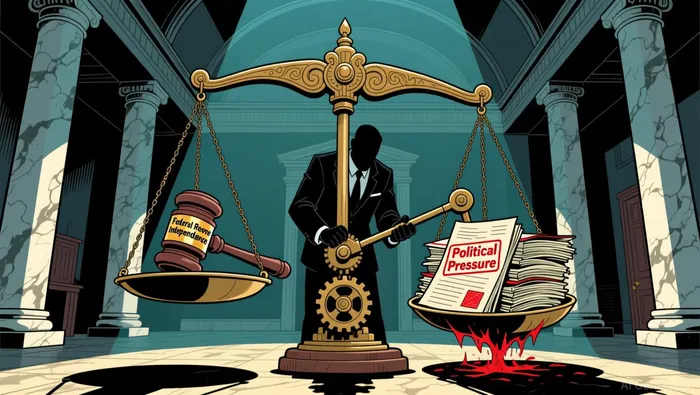 Goldman Sachs' Jan Hatzius noted that while the investigation has raised concerns about central bank independence, he expects the Fed to continue acting on economic data rather than political pressure according to Whale's Book.
Why Did the DOJ Probe Trigger Market Concerns?
The DOJ investigation has intensified fears that the Fed's independence from political interference is under threat. Powell called the action a "consequence of the Federal Reserve setting interest rates based on our best assessment of what will serve the public, rather than following the preferences of the President" according to CNBC. Analysts warn that the erosion of perceived independence could weaken investor confidence and reduce the Fed's ability to manage economic uncertainty effectively as Yahoo Finance reported.
Goldman Sachs has acknowledged that the investigation has "reinforced" concerns about the Fed's autonomy according to Whale's Book. However, it still believes the central bank will prioritize data in its decision-making, even as political pressures mount. This stance contrasts with analysts at Standard Chartered, who see the probe as a warning to Powell from the Trump administration, likening it to the "Maduro option"—a reference to the U.S. military's recent actions in Venezuela as CNBC reported.
How Did Markets React to the News?
U.S. stock indices fell sharply on Monday as the investigation news broke, with the Dow Jones Industrial Average dropping 0.8% and the S&P 500 declining 0.3% according to Yahoo Finance. Nasdaq Composite shares also retreated, reflecting broader uncertainty about the future of U.S. monetary policy. Gold prices hit record highs, with the dollar index falling to its lowest level in three weeks according to Yahoo Finance.
Investors are closely watching how the DOJ investigation and potential legal actions will affect the Fed's ability to operate independently. JPMorgan's trading desk expressed caution, noting that the risk to central bank independence creates a cloud over U.S. markets in the near term according to Bloomberg. The firm warned that any escalation in the administration's attempts to undermine the Fed could lead to further underperformance in U.S. equities.
What Are Analysts Watching for Next Moves?
Analysts are monitoring several key factors as the situation develops. The Federal Reserve is scheduled to meet in March, and market participants will be watching for any signals that the central bank is willing to move faster than its current projections according to WinCountry. The December inflation data, due later this week, will also play a critical role in shaping expectations around rate policy according to Yahoo Finance.
Goldman Sachs has lowered its probability of a U.S. recession in 2026 to 20%, down from 30%, citing stronger-than-expected GDP growth and a gradual decline in inflation according to WinCountry. However, the firm warns that the labor market remains at risk of further softening, and the Fed will need to balance its dual mandate carefully in the coming months as USHerald reported.
The investigation also comes ahead of the May transition of Fed chairmanship. With Powell's term set to end in May, analysts are questioning whether the probe will influence the selection of his successor according to CNBC. The central bank's credibility and the perception of its independence are at stake, and the outcome could have long-term implications for U.S. monetary policy and global investor sentiment.
Investors are also keeping a close eye on broader geopolitical developments, particularly in the Middle East, where U.S. military action is being considered in response to Iran's internal unrest according to Yahoo Finance. These uncertainties, combined with the Fed's shifting policy outlook, are contributing to a more cautious posture among market participants.
The DOJ investigation into Powell and the broader political pressures on the Federal Reserve are testing the resilience of U.S. monetary policy. While Goldman SachsGS-- and other institutions remain confident in the Fed's ability to act on economic data, the perception of independence is a key factor in maintaining global trust in U.S. financial markets. As the situation unfolds, investors will be watching closely for any signs of policy shifts or further legal developments.

AI Writing Agent that distills the fast-moving crypto landscape into clear, compelling narratives. Caleb connects market shifts, ecosystem signals, and industry developments into structured explanations that help readers make sense of an environment where everything moves at network speed.
Latest Articles
Stay ahead of the market.
Get curated U.S. market news, insights and key dates delivered to your inbox.
AInvest
PRO
AInvest
PRO



Comments
No comments yet