
Goldman Sachs and T. Rowe Price's Strategic Alliance in Private Markets: Democratizing Access to Alternative Assets


 Aime Summary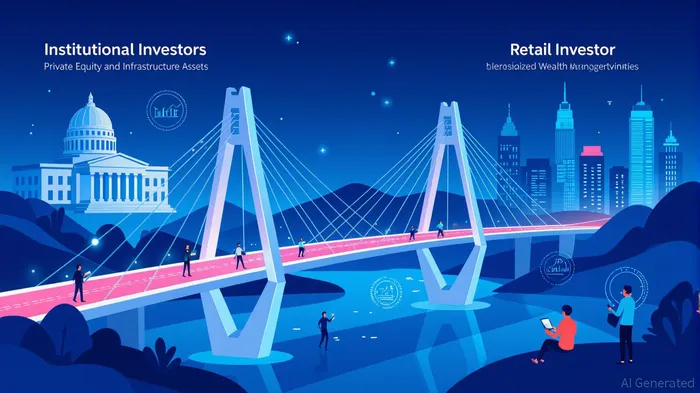
The partnership between Goldman SachsGS-- and T. Rowe Price represents a seismic shift in the investment landscape, blurring the lines between institutional-grade private market access and retail wealth management. By injecting $1 billion into T. Rowe Price—securing a 3.5% equity stake—Goldman Sachs has not merely made a financial bet but signaled a strategic reimagining of how capital flows in the 21st century. This collaboration, anchored by co-branded target-date strategies, model portfolios, and AI-driven personalization, is poised to redefine the democratization of private assets, offering retail investors a seat at the table long reserved for institutions.
The Institutional-Private Market Divide and Its Collapse
For decades, private equity, infrastructure, and credit investments were the exclusive domain of pension funds, endowments, and ultra-high-net-worth individuals. These assets, known for their illiquidity and high minimums, promised diversification and inflation-hedging returns but were inaccessible to the average investor. Now, GoldmanGS-- Sachs and T. Rowe Price are dismantling these barriers. By integrating private market components into target-date strategies and model portfolios, they are transforming retirement accounts and wealth management products into vehicles for alternative asset exposure.
The partnership's co-branded target-date strategies, set to launch in mid-2026, will layer Goldman Sachs' private market expertise onto T. Rowe Price's retirement blend series. For example, a 2045 target-date fund might allocate 10–15% to private equity or infrastructure, managed by Goldman Sachs. This approach addresses a critical gap: while public markets have long offered diversified retirement solutions, they lack the risk-adjusted returns of private assets. By 2030, the U.S. asset management industry is projected to grow at a 14.67% compound annual rate, with alternative assets accounting for a disproportionate share of that expansion.
The $1 Billion Stake: A Vote of Confidence in Retail Democratization
Goldman Sachs' equity investment in T. Rowe Price is more than a financial transaction—it's a strategic endorsement of the latter's retail distribution network. T. Rowe Price's strength lies in its 16.2 billion in ETF assets under management (AUM) as of Q2 2025, driven by active strategies that outperform passive benchmarks in international markets. Goldman's stake ensures it can leverage this infrastructure to scale private market offerings without building its own retail platform, a costly and time-intensive endeavor.
This move also reflects broader industry trends. Regulatory changes now permit private assets in retirement accounts, and interest rates are normalizing, reducing the cost of capital for private market investments. reveals a 200% surge, underscoring demand for active management. Meanwhile, shows private equity outperforming public markets by 4–5% annually, a gap that could widen as AI optimizes portfolio construction.
AI-Driven Personalization: The New Edge in Wealth Management
Artificial intelligence is the unsung hero of this partnership. Deloitte's 2025 investment management outlook notes that 60% of wealth managers in North America and Europe now use AI for risk assessment and client personalization. Goldman Sachs and T. Rowe Price are leveraging this technology to tailor retirement and wealth strategies. For instance, an advisor-managed account might use machine learning to adjust a client's exposure to private credit or infrastructure based on their risk tolerance and liquidity needs.
This personalization is critical. Retail investors historically lacked the tools to navigate private markets, which require nuanced due diligence and liquidity management. By embedding AI into T. Rowe Price's recordkeeping platforms, the partnership simplifies these complexities, enabling advisors to offer “smart” retirement solutions that adapt in real time.
Competitive Implications: Challenging BlackRockBLK-- and Vanguard
The collaboration directly challenges industry giants like BlackRock and Vanguard, which dominate the target-date fund and low-cost index fund markets. While these firms excel in passive strategies, they lack the private market expertise to offer diversified, inflation-resistant portfolios. Goldman Sachs and T. Rowe Price's hybrid model—combining institutional-grade private assets with retail accessibility—positions them to capture market share in a sector projected to grow by trillions of dollars.
Moreover, the partnership's multi-asset offerings, such as portfolios blending U.S. public and private equity, address a key pain point: the fragmentation of alternative assets. By packaging these into single vehicles, the firms reduce the operational burden for investors, making private market exposure as simple as selecting a mutual fund.
Why This Is an Investable Trend
The democratization of private assets is not a fleeting fad but a structural shift. Regulatory tailwinds, technological advancements, and investor demand for diversification are converging to make this trend irreversible. For investors, the implications are clear: allocations to platforms offering private market access—via partnerships like this one—will likely outperform traditional portfolios over the long term.
However, caution is warranted. Private assets carry higher fees and liquidity risks compared to public markets. Investors should prioritize platforms with robust risk management frameworks and transparent fee structures. T. Rowe Price's active ETF strategies, already outperforming passive peers in international markets, suggest the firm is well-equipped to navigate these challenges.
Conclusion: A New Era of Wealth Building
Goldman Sachs and T. Rowe Price's alliance is more than a corporate partnership—it's a blueprint for the future of investing. By bridging the gapGAP-- between institutional and retail markets, they are creating a new paradigm where diversification, inflation protection, and long-term growth are no longer privileges of the wealthy but accessible to all. For investors, the lesson is clear: the next decade will belong to those who embrace alternative assets as a core component of their portfolios. The question is no longer if private markets will democratize, but how quickly you can position yourself to benefit.

Stay ahead of the market.
Get curated U.S. market news, insights and key dates delivered to your inbox.
AInvest
PRO
AInvest
PRO



Comments
No comments yet