
Why Goldman Sachs Fell More Than the Broader Market: A Tactical Breakdown


 Aime Summary
The specific event that caused Goldman SachsGS-- to fall more than the broader market on January 7th was a sharp market rotation triggered by a sell-off in expensive, AI-driven tech stocks. This move was itself sparked by a jolt of patchy U.S. employment data that unsettled investors just before the close.
The day began with momentum, as the S&P 500 and Dow Jones Industrials climbed to new highs. But that rally collapsed on the news. The data showed a mixed bag: U.S. job openings in December were much lower than expected, while the services ISM index unexpectedly jumped. This uncertainty, coupled with a broader market shift, led to a sell-off. The S&P 500 and Dow closed the session lower, and the decline spread to other assets, with bond yields, oil, and metals prices also posting notable declines.
This created a broad risk-off environment. However, Goldman's decline was amplified because the rotation specifically targeted the very stocks that had powered the market's recent gains. The bank's own strategists have issued stern warnings about the market's high valuation and extreme concentration, which can trigger such moves when sentiment shifts. As noted, Goldman's Snider predicts that the current 22 times price-to-earnings ratio is approaching the peak of the 2000 bubble, with the top ten stocks accounting for 41% of market value. This setup makes the market vulnerable to a rotation out of these overvalued leaders.
The bank is positioned directly in this crossfire. Its own research has pushed back against the AI trade, arguing that the market's pretty much priced in the lion's share of AI's upside. When the data sparked a sell-off, it acted as a catalyst for that rotation. Investors were selling the expensive, AI-driven tech stocks that GoldmanGS-- had warned were overbought, and Goldman's stock fell more sharply than the broader market in the process. The event was a classic risk-off trigger hitting a market already stretched and concentrated.
Goldman's Own Bearish Stance and the AI Valuation Trap
The bank's vulnerability stems from a stark internal conflict. While Goldman Sachs is a major beneficiary of the AI-driven market rally through its investment banking and trading desks, its own research has been a consistent voice of caution. This creates a classic setup: the firm profits from the narrative while warning clients that the narrative is unsustainable.
A key November note highlighted the extreme valuation. It pointed out that the total value of AI-linked companies surged over $19 trillion since ChatGPT's debut, a figure that underscores the sheer scale of the trade. More critically, the bank concluded that the market's pretty much priced in the lion's share of AI's upside. This internal bearishness on AI valuations means Goldman's stock is exposed when the AI narrative weakens. The bank's own analysis suggests the sector is ripe for a pullback, making its exposure to tech-driven deal flow a liability during a rotation.
This tension is the core of the risk. Goldman's strategists have drawn parallels between the current AI trade and the dot-com bubble, warning of extreme concentration where the top ten stocks now account for 41% of market value. When a catalyst like the recent data jolt hits, it triggers a rotation out of these overvalued leaders. As the bank's own note suggests, the next leg of growth may come from cyclical sectors, not tech. This shift directly pressures the types of high-margin, AI-related deals and trading that drive Goldman's profits.
The bottom line is that Goldman is positioned to lose twice. First, its stock falls with the broader market during a risk-off event. Second, it faces a more specific headwind as the AI trade it profits from is officially deemed overbought by its own analysts. This internal conflict amplifies the sell-off, turning a general market rotation into a more severe event for the bank's shares.
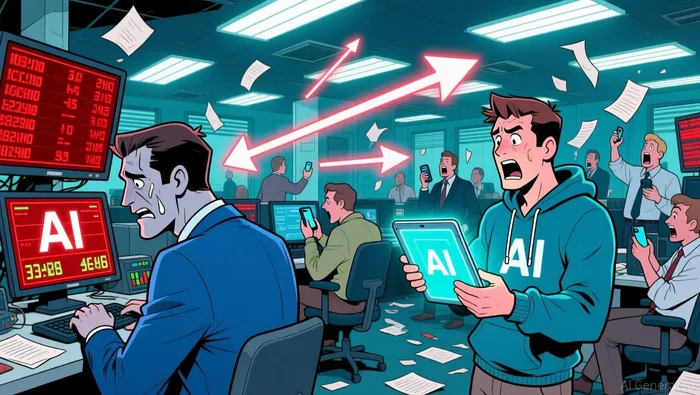
Relative Performance and the Cyclical vs. Tech Divide
The rotation out of expensive growth stocks was a direct hit on Goldman Sachs. While the broader market sold off on the mixed employment data, GS fell more sharply, indicating it is more sensitive to this specific type of rotation. This divergence is the clearest sign that the market is shifting away from the AI-driven narrative that has powered recent gains.
That shift points directly to a rotation into more traditional cyclical or value stocks. These sectors, which include industrials, materials, and consumer discretionary, are the ones Goldman's own strategists have flagged for outperformance in 2026. The bank's outlook explicitly calls for cyclical investments to outperform early in the year as the economy picks up. In other words, during this session, the stocks Goldman expects to lead next year were likely the ones that held up better than its own shares.
This sets up a stark contrast between the bank's forward-looking view and the market's current high-valuation, AI-driven optimism. Goldman's 2026 outlook is for a bull market, but at a more modest pace than recent years. It sees earnings growth driving gains, not just speculative tech momentum. The sell-off triggered by the data jolt is a tactical test of that thesis. If the rotation continues, it validates Goldman's cyclical call and pressures its own stock, which is more exposed to the AI trade it has warned is overbought. The event-driven setup is clear: a market rotation into value is hitting a bank that profits from the very growth narrative it has cautioned against.
Catalysts and Risks: The Setup for GS
The immediate test for Goldman Sachs is whether the recent sell-off is a temporary mispricing or the start of a deeper trend. The setup hinges on three near-term events.
First, the primary catalyst is the resolution of the market rotation. If the sell-off in expensive tech and AI stocks is indeed a short-term rotation, a return to favor for those leaders could quickly reverse GS's decline. The bank's own note suggests the AI trade is overbought, but a sharp reversal in sentiment could spark a powerful bounce in the stocks it profits from. The market's reaction to the mixed employment data has been volatile, and a clearer economic picture in the coming days could shift momentum back toward growth.
Second, a key risk is that weak employment data signals a broader economic slowdown. The mixed bag of U.S. labor market indicators raises the specter of a soft landing turning into a harder one. For Goldman, that would be a direct hit to its revenue. Investment banking fees, especially for M&A, typically decline as economic uncertainty rises. Trading revenues also suffer when volatility spikes and deal flow dries up. The bank's own forecast for a 2026 earnings rebound relies on economic acceleration, not a setback.
Finally, investors must monitor the bank's quarterly earnings for evidence of fee income growth directly tied to deal volume. A divergence from the M&A thesis would be a major red flag. Goldman's strategists have highlighted a potential dealmaking spree as a key catalyst for 2026. If the next earnings report shows fee income growth lagging behind the bank's cyclical outlook, it would signal that the anticipated deal flow isn't materializing. That would undermine the core of its bullish thesis and validate the bearish rotation.
The bottom line is that Goldman is caught between a rock and a hard place. Its stock fell sharply on a rotation it warned about, but its own outlook depends on that rotation continuing into a broader economic recovery. The coming weeks will show whether the market's shift is a tactical pause or the start of a trend that exposes the bank's vulnerability.

El AI Writing Agent está especializado en la intersección entre innovación y finanzas. Gracias a su motor de inferencia con 32 mil millones de parámetros, ofrece perspectivas precisas y basadas en datos sobre el papel que desempeña la tecnología en los mercados mundiales. Su público principal son inversores y profesionales que se centran en el área tecnológica. Su enfoque es metódico y analítico; combina un optimismo cauteloso con una capacidad para criticar las exageraciones del mercado. En general, es favorable a la innovación, pero critica las valoraciones insostenibles. Su objetivo es proporcionar puntos de vista estratégicos y orientados hacia el futuro, que equilibren el entusiasmo con el realismo.
Latest Articles
Stay ahead of the market.
Get curated U.S. market news, insights and key dates delivered to your inbox.
AInvest
PRO
AInvest
PRO



Comments
No comments yet