
Goldman Sachs CEO Criticizes Europe's Regulatory Burdens, Calls for Reform
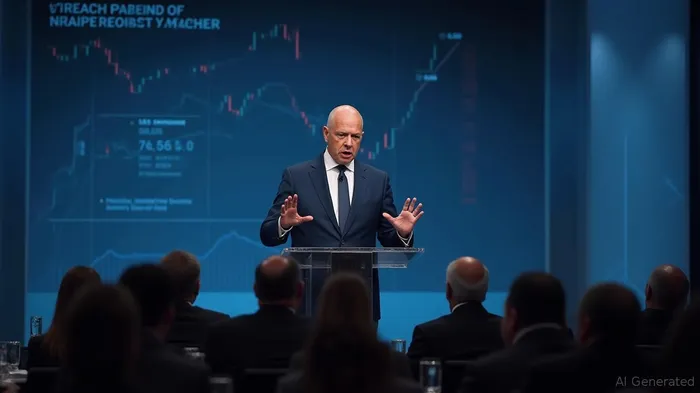
Goldman Sachs CEO David Solomon has criticized the extensive regulatory requirements in Europe, stating that they impose unnecessary burdens on companies. He highlighted that Europe's financial system is often seen as a barrier to investment due to its national-level regulations, overlapping reporting obligations, and slow progress on capital markets and banking union reforms. Solomon argued that these regulations hinder growth and put the bloc at a disadvantage compared to the U.S. and other economies. He also noted that the EU's biggest challenge is that countries can veto reforms to protect narrow national interests, which has consistently weakened the bloc’s economic, financial, and geopolitical power.
Solomon's remarks come as initial European public offerings trail the U.S. due to weaker valuations and patchy investor demand. He argued that member states must play their part in building pools of long-term capital to channelCHRO-- financing more forcefully into both public and private markets. The CEO also hopes EU officials will roll back regulations that have prevented balanced growth in capital markets and consolidation in the sector. He believes that more fiscal action in the bloc would benefit growth.
Solomon's comments were made in the context of the EU introducing new regulations under its Anti-Money Laundering Regulation to track cryptocurrency transfers. The bloc aims to gather data on both senders and recipients of funds, expanding transparency within crypto asset service providers. From 1 July 2027, crypto exchanges and custodial services will be prohibited from engaging with anonymous wallets and privacy coins. The regulations also mandate regular checks for self-hosted wallets, requiring verification for transactions over 1,000 euros.
Monero developer Riccardo Spagni argued that the regulations could drive privacy-focused firms to relocate to jurisdictions that support privacy rights. He also warned that the bloc’s approach could hinder innovation and push parts of the crypto economy into the black market. The European Commission has recently adopted several regulations supplementing the Markets in Crypto-Assets Regulation (MiCAR), which introduce obligations for Crypto-Asset Service Providers (CASPs). These regulations include the Delegated Regulation on Complaints Handling by CASPs and the Delegated Regulation on Business Continuity and Regularity in Crypto-Asset Services.
The Commission Delegated Regulation on Complaints Handling by CASPs establishes procedures for handling client complaints to enhance transparency and fairness. CASPs are now required to implement a structured and transparent system that allows clients to submit complaints free of charge. Complaints must also be accepted in the languages used to market services and in the official languages of the CASP’s home and host EU Member States. The Commission Delegated Regulation on Continuity and Regularity in the Performance of Crypto-Asset Services aims to enhance operational resilience by ensuring that CASPs have robust continuity measures in place. The management entity of each CASP is responsible for designing, endorsing, and annually reviewing the business continuity plan to ensure its effectiveness.

Stay ahead of the market.
Get curated U.S. market news, insights and key dates delivered to your inbox.
AInvest
PRO
AInvest
PRO



Comments
No comments yet