
The Golden Arches Reinvented: How McDonald's Menu Innovation and Operational Precision Are Securing Market Dominance
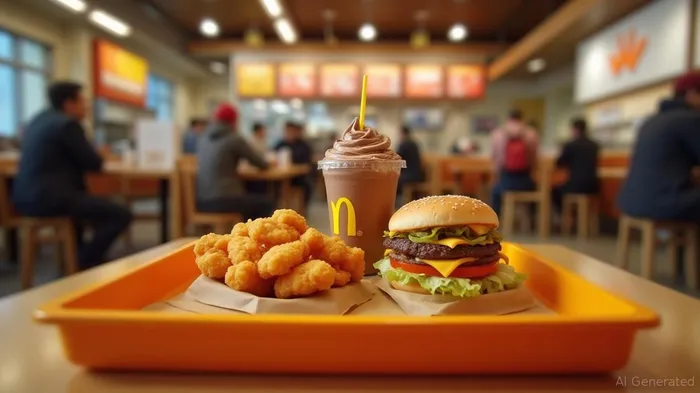
In an era where fast-food giants face relentless competition and shifting consumer preferences, McDonald'sMCD-- has positioned itself as a master of reinvention. By aligning its menu innovations, supply chain optimizations, and customer engagement strategies with evolving demand, the company is not only defending its market leadership but also carving out new opportunities in a $1.1 trillion global fast-food industry. Here's why investors should take note.
Adapting to Consumer Demand: The Plant-Based Pivot
McDonald's recent shift toward plant-based menus reflects a strategic response to rising demand for sustainability and health-conscious eating. While the McPlant burger initially struggled in the U.S. (where consumers prioritized familiarity over novelty), it found success in Europe, where 40% of McDonald's restaurants now offer permanent vegan options. For instance, France's Veggie McPlant Nuggets and the Netherlands' McPlant Steakhouse burger have resonated with regional tastes, driving 20% higher trial rates than traditional items in those markets.
This localized approach highlights a critical insight: one-size-fits-all menus no longer work. By tailoring offerings to regional preferences—such as vegan ice cream in the UK and sustainable packaging globally—McDonald's is capitalizing on the $24.5 billion plant-based protein market while mitigating operational risks.
Supply Chain Mastery: The Backstage Revolution
Behind the scenes, McDonald's has undertaken a structural overhaul to support its innovation ambitions. The creation of the Chief Restaurant Experience Officer (CREO) role, held by Jill McDonald, aims to break down silos between product development, supply chain, and operations. This centralized leadership has already accelerated decision-making, enabling faster launches of items like the McPlant and value-focused breakfast menus.
Key optimizations include:
- Category-specific leadership: Dedicated executives now oversee beef, chicken, and beverages, driving 20% faster product cycles.
- Dynamic pricing tools: AI-driven systems adjust menu prices in real time, boosting margins without alienating price-sensitive customers.
- Self-service kiosks: Now in 90% of U.S. restaurants, these kiosks reduce wait times by 30% while lowering labor costs.
These changes are critical to maintaining operational efficiency, which is key as McDonald's aims to expand its global footprint to 50,000 restaurants by 2027.
Value, Loyalty, and Velocity: The Frontline Strategy
To combat inflation and competition, McDonald's has doubled down on value-driven strategies. Its “Accelerating the Arches” initiative focuses on:
1. Affordable bundles: New value meals, such as the $5 “Snack Wrap” combo, have boosted U.S. foot traffic by 5% in test markets.
2. Loyalty programs: With 175 million active users globally, these programs drive 30% higher repeat visits, contributing $30 billion in annual sales.
3. Digital dominance: The 4Ds strategy (digital, delivery, drive-thru, development) has made McDonald's the fastest-growing fast-food app in 2024, with 100 million new users.
These efforts are paying off: despite a 1% dip in global comparable sales in Q1 2025, McDonald's maintained a 25.2% market share in the U.S. and outperformed rivals like ChipotleCMG--, whose share fell to 9.8%.
Market Share and Financials: Navigating Challenges
While McDonald's 2024 revenue rose 2% to $25.9 billion, Q1 2025 results revealed headwinds. U.S. same-store sales fell 3.6%, attributed to lingering effects of the 2023 E. coli scare and cautious consumer spending. However, its 2.27% dividend yield and consistent EPS of $11.39 underscore financial resilience.
Analysts project 5.3% annual revenue growth over the next three years, modest but sustainable in a sector expected to grow at 10%. The key question: Can McDonald's sustain margins as it expands into higher-cost plant-based products?
Investment Outlook: A Steady Hand in Volatile Waters
McDonald's stock (MCD) has weathered economic uncertainty better than many peers, down just 1.4% in 2025 despite broader market volatility. Its $308 fair value estimate (Morningstar) reflects confidence in its brand strength and franchise model, which generates 90% of its revenue.
Historically, a buy-and-hold strategy on earnings announcement dates has delivered an average return of 15.74% over 20 days, though with notable volatility—including a maximum drawdown of 15.76%—and underperformance relative to broader market benchmarks.
Investors should consider:
- Long-term growth: McDonald's 2027 expansion target and loyalty-driven recurring revenue position it to outpace competitors.
- Risk mitigation: While its global scale and diversified menu reduce single-market risks, historical data underscores the need for caution: the strategy's 15.76% maximum drawdown highlights volatility, requiring disciplined risk management.
- Valuation: At 23x forward P/E, it's fairly priced but offers stability. However, a Sharpe ratio of 0.28 suggests returns are not sufficiently compensating for risk.
Recommendation: Hold for income investors seeking steady dividends (yield: 2.27%) and moderate growth. Aggressive investors might wait for dips, but McDonald's remains a defensive play in a volatile sector. While the strategy's 15.74% average return over 20 days post-earnings is compelling, the potential for sharp downturns (e.g., 15.76% drawdown) warrants stop-loss measures.
Conclusion
McDonald's success hinges on its ability to balance innovation with operational rigor. By listening to regional tastes, leveraging technology, and doubling down on value, it's not just surviving—it's redefining fast food for the next decade. For investors, the Golden Arches remain a beacon of consistency in a turbulent market.

Stay ahead of the market.
Get curated U.S. market news, insights and key dates delivered to your inbox.
AInvest
PRO
AInvest
PRO



Comments
No comments yet