
Gold's Volatility Amid Shifting US Policy Signals
 Aime Summary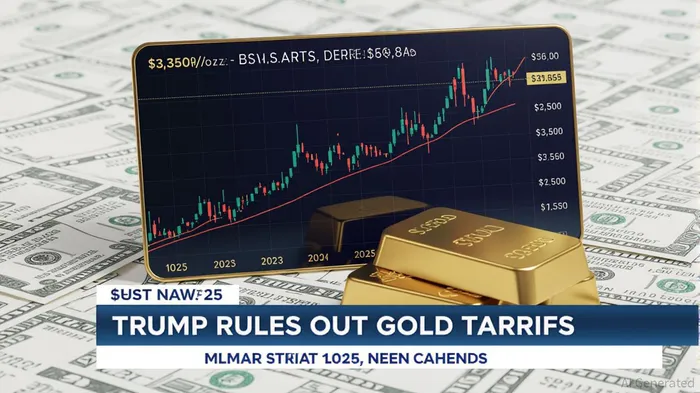
The U.S. inflation report for July 2025 painted a nuanced picture of economic pressures. Headline CPI rose 2.7% annually, while core CPI hit 3.1%, the highest in five months. These figures, though below expectations, signaled persistent inflationary forces, particularly in sectors like furniture and footwear, where Trump's tariffs are beginning to manifest. Meanwhile, energy prices fell sharply, tempering overall inflation. The Federal Reserve now faces a delicate balancing act: a potential September rate cut looms, but policymakers remain wary of tariff-driven cost shocks that could reignite inflation.
Gold's response to this mix of signals has been volatile. After briefly surging to $3,350/oz on hopes of a Fed pivot, prices reversed, testing critical support at $3,334. The Trump administration's abrupt pledge to exclude gold bars from its tariff agenda further destabilized the market. Futures dropped 2.4% in a single session, erasing earlier gains. This volatility underscores gold's sensitivity to policy uncertainty. While tariffs on goods like furniture have pushed core inflation higher, the exclusion of gold from these measures has created a paradox: investors are hedging against inflation but remain wary of policy-driven distortions.
Safe-haven demand, however, remains robust. Central banks added 166 tons of gold in Q2 2025, with unreported purchases likely inflating this figure. ETFs, particularly in Asia, have seen record inflows, with Chinese investors driving 44% growth in retail demand. This trend reflects a broader de-dollarization strategy, as nations diversify reserves to mitigate risks from U.S. policy shifts. Gold's role as a hedge is further reinforced by its inverse correlation with the dollar, which has weakened amid fiscal concerns and geopolitical tensions.
Investor behavior reveals a fractured landscape. Democrats, more attuned to inflation risks, have increased account monitoring and sought professional advice, while Republicans have leaned into market opportunities. The S&P 500's 5.19% gain in July (led by tech stocks) contrasts with a 3.26% drop in healthcare, highlighting sectoral divergences. Meanwhile, gold ETFs and mining equities have attracted tactical buyers, with J.P. Morgan projecting gold to average $3,675/oz by year-end.
For investors, positioning in gold requires a multi-layered approach. First, allocate 5–10% of portfolios to gold ETFs (e.g., SPDR GoldGLD-- Shares, GLD) for stability and liquidity. These vehicles offer low fees and efficient exposure to price movements. Second, consider mining equities for amplified returns, but prioritize established producers like Perseus Mining or Serabi Gold, which balance operational resilience with growth potential. Third, hedge against dollar weakness by pairing gold with U.S. Treasury bonds, which could benefit from a Fed pivot.
Historical data suggests that even conservative strategies in gold ETFs can yield modest consistency. A simple buy-and-hold approach at support levels, for instance, has shown a 70% hit rate (7 wins out of 10 trades) when holding for 15 trading days. While the average return of 0.13% is limited, this track record highlights the potential for small, incremental gains in a low-volatility environment.
Technical indicators suggest caution. Gold's failure to break above $3,400 and its bearish trendline on the two-hour chart signal short-term vulnerability. However, central bank demand and geopolitical risks provide a long-term floor. Investors should monitor the 100-day MA ($3,361) and 50-day MA ($3,373) as key resistance levels. A break below $3,330 could trigger further declines, testing the $3,300 psychological level.
In conclusion, gold's volatility reflects the interplay of inflation, tariff uncertainty, and safe-haven demand. While policy pivots create near-term turbulence, structural factors—central bank diversification, de-dollarization, and inflationary pressures—support a bullish case for gold. A balanced strategy, combining ETFs, mining equities, and tactical hedging, offers a path to navigate this complex landscape. As the Fed's next move looms, investors must remain agile, leveraging gold's dual role as both a hedge and a strategic asset.
"""

Delivering real-time insights and analysis on emerging financial trends and market movements.
Latest Articles
Stay ahead of the market.
Get curated U.S. market news, insights and key dates delivered to your inbox.




Comments
No comments yet