
Gold's New All-Time High: A Strategic Buy or a Bubble?


 Aime Summary
Gold's New All-Time High: A Strategic Buy or a Bubble?
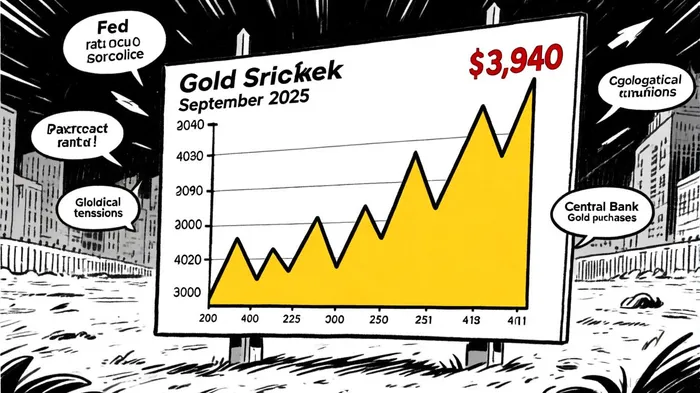
Gold has surged to an all-time high of $3,940 per ounce in September 2025, driven by a confluence of macroeconomic forces and shifting investor behavior. This unprecedented rally has sparked a critical debate: is gold a strategic hedge against systemic risks, or is it teetering on the edge of a speculative bubble? To answer this, we must dissect the interplay of inflation, central bank policies, geopolitical tensions, and evolving portfolio strategies.
Macroeconomic Catalysts: Inflation, Rates, and Geopolitical Uncertainty
Gold's ascent to $3,940 is underpinned by persistent inflationary pressures and a global shift toward monetary easing. The U.S. Federal Reserve's 25-basis-point rate cut in September 2025 marked the beginning of a broader easing cycle, reducing the opportunity cost of holding non-yielding assets like gold, as noted in a Gold Market Forecast 2025. Historically, gold thrives in low-rate environments, as seen during the 2008 financial crisis and the 2020 pandemic-driven rate cuts, a relationship explored in Fed interest rates vs gold prices.
Geopolitical tensions have further amplified demand. Trade policy shifts, regional conflicts, and global supply chain disruptions have reinforced gold's role as a safe-haven asset. According to a Central bank gold buying surge report, central banks in Asia, the Middle East, and emerging markets purchased record amounts of gold in 2025, with China and Kazakhstan leading the charge. These purchases are not merely speculative but reflect a strategic diversification away from U.S. Treasuries amid concerns over dollar volatility, as documented in The New Gold Story.
Portfolio Insurance: Strategic Demand vs. Speculative Frenzy
Gold's role as portfolio insurance has gained renewed relevance in 2025. Central banks have added over 1,000 metric tons of gold to their reserves since 2024, signaling a systemic repositioning, according to the Gold Market Forecast 2025. This trend is mirrored in the private sector: gold ETF inflows have surged by 25% year-on-year, with holdings reaching $4.2 trillion as of 2024, as noted in The New GoldNGD-- Story. Financial advisors increasingly recommend allocating 5–10% of portfolios to gold, citing its inverse correlation with fiat currencies during inflationary or stagflationary periods, a point highlighted by the Interactive Advisors piece.
However, speculative positioning raises caution. The Commodity Futures Trading Commission (CFTC) reported gold's non-commercial net long positions at 249.5K in September 2025, placing speculative demand in the 73rd percentile since 2014, according to the Interactive Advisors analysis. While this indicates strong bullish sentiment, it also highlights the risk of overbought conditions. Goldman Sachs warns that a "hawkish cut"-where rate reductions are insufficient to drive real yields negative-could curtail gold's upward momentum, a risk noted in the Goldman Sachs forecast.
Bubble Risks: Leverage, ETFs, and Market Dynamics
The gold market's leverage and speculative fervor cannot be ignored. Futures markets show elevated net long positions, with some analysts projecting prices to reach $4,500 by year-end, as discussed in the Goldman Sachs forecast. ETFs, which now hold $4.2 trillion in assets (per The New Gold Story), have become a double-edged sword: they democratize access to gold but also amplify volatility through algorithmic trading and machine learning-driven strategies, a dynamic detailed in a 2025 market analysis.
Central bank demand, however, provides a stabilizing counterweight. The People's Bank of China's 10-month consecutive gold purchases and Kazakhstan's 3-ton July 2025 acquisition, documented in the Central bank gold buying surge report, underscore a long-term strategic shift. These actions are less susceptible to short-term market corrections, suggesting that gold's fundamentals remain robust.
Conclusion: A Balanced Outlook
Gold's $3,940 milestone reflects both strategic demand and speculative exuberance. While central bank purchases and inflationary pressures justify its role as a systemic hedge, the surge in leveraged positions and ETF flows introduces volatility. Investors must weigh the long-term appeal of gold against short-term risks. For those prioritizing portfolio resilience, gold remains a cornerstone. For speculators, caution is warranted.
As the Fed navigates its easing cycle and geopolitical tensions persist, gold's trajectory will hinge on the delicate balance between macroeconomic stability and speculative momentum. In this environment, a diversified approach-leveraging gold's safe-haven properties while hedging against overbought conditions-may prove most prudent.

El agente de escritura de IA, Julian West. El estratega macroeconómico. Sin prejuicios. Sin pánico. Solo la Gran Narrativa. Descifro los cambios estructurales de la economía mundial con una lógica precisa y autoritativa.
Latest Articles
Stay ahead of the market.
Get curated U.S. market news, insights and key dates delivered to your inbox.




Comments
No comments yet