
Gold's Tariff-Driven Rally: A New Era of Geopolitical Hedging?
 Aime Summary
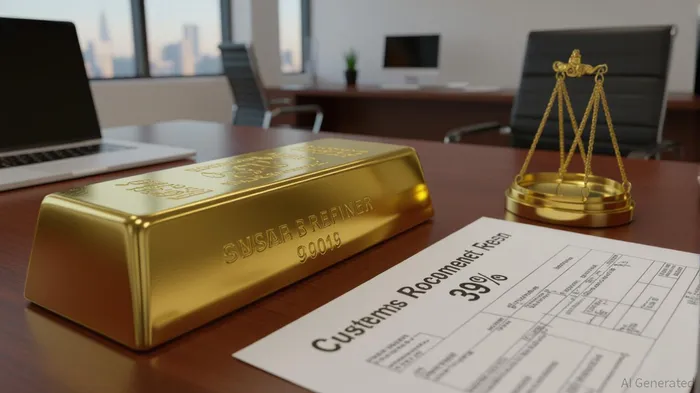
In 2025, the U.S. government's abrupt reclassification of one-kilogram and 100-ounce gold bars under a 39% tariff regime has ignited a seismic shift in global bullion markets. This move, spearheaded by the Trump administration, has not only disrupted the $1.2 trillion gold futures market but also accelerated a broader re-rating of gold as a strategic reserve asset. As geopolitical risk premiums soar and protectionist trade policies intensify, investors are increasingly turning to tangible, regulation-resistant assets like physical gold to hedge against systemic uncertainties.
Tariffs and Market Disruption: A Perfect Storm
The U.S. Customs and Border Protection (CBP)'s decision to reclassify gold bars as “semi-manufactured” goods—subjecting them to tariffs previously reserved for industrial products—has created a regulatory quagmire. This reclassification, based on obscure tariff codes, has thrown the New York Mercantile Exchange's (Comex) gold futures contracts into disarray. Traders, long reliant on the assumption that gold bars would remain tariff-free, now face a $100-per-ounce price premium between U.S. futures and London spot markets.
Switzerland, the world's largest gold refining hub, has been hit hardest. With exports to the U.S. surging in recent months, Swiss refiners are now weighing whether to halt shipments until the CBP clarifies its stance. The Swiss Precious Metals Association has warned that prolonged uncertainty could fracture the U.S.-Swiss bullion corridor, a critical artery for global gold liquidity.
Geopolitical Risk Premiums and the Rise of Gold
The U.S. tariff shock is part of a larger narrative: the erosion of trust in traditional safe-haven assets. Central banks, particularly in China, Poland, and Türkiye, have responded by aggressively accumulating gold. In 2025 alone, global central banks added 710 tonnes of gold per quarter, with China's holdings surging 70% year-over-year. This trend reflects a strategic pivot away from U.S. dollar assets, which are increasingly viewed as politically weaponized.
The drivers are clear. U.S. tariffs on electronics, semiconductors, and textiles have exacerbated global supply chain fragility, while the Federal Reserve's dovish pivot has weakened the dollar. Negative real yields—where inflation outpaces interest rates—have further eroded the appeal of U.S. Treasuries. Gold, with its zero-yield but enduring store-of-value properties, has emerged as the ultimate hedge.
The Strategic Re-Positioning of Reserves
Gold's resurgence is not merely a function of tariffs but a structural re-rating driven by geopolitical dynamics. Central banks are now treating gold as a non-sovereign asset, distinct from fiat currencies. This shift is supported by academic research highlighting gold's unique role in mitigating risks associated with financial sanctions and currency devaluation.
For example, China's gold accumulation aligns with its de-dollarization strategy, while Türkiye's purchases reflect a desire to insulate its economy from Western sanctions. These actions underscore gold's dual utility: as a hedge against inflation and as a shield against geopolitical coercion.
Meanwhile, retail and institutional investors are following suit. U.S. gold jewelry imports rose 22% year-over-year, while European demand for gold-backed insurance products climbed 15%. The market is clearly signaling that gold is no longer a niche asset but a cornerstone of modern portfolios.
Investment Implications and the Road Ahead
For investors, the message is clear: gold's role in a protectionist world is here to stay. The CBP's tariff misstep has exposed vulnerabilities in the U.S. gold futures market, but it has also accelerated demand for physical bullion. While legal challenges to the tariff ruling remain possible, the broader trend—toward tangible, regulation-resistant assets—is irreversible.
Strategic allocations should prioritize physical gold, gold ETFs, and derivatives that mirror central bank demand. Given the Fed's expected rate cuts and the dollar's weakening trajectory, gold's price trajectory is likely to remain upward. However, investors must also monitor the CBP's potential revisions to tariff classifications, which could reintroduce volatility.
In conclusion, the 2025 gold rally is not a fleeting market correction but a paradigm shift. As geopolitical tensions and protectionist policies redefine global trade, gold's status as a strategic reserve asset is being cemented. For those seeking to hedge against an uncertain future, the message is unmistakable: gold is no longer a luxury—it's a necessity.

Stay ahead of the market.
Get curated U.S. market news, insights and key dates delivered to your inbox.






Comments
No comments yet