
Gold Surges to Record as Trump Ramps Up Threats on Fed’s Powell
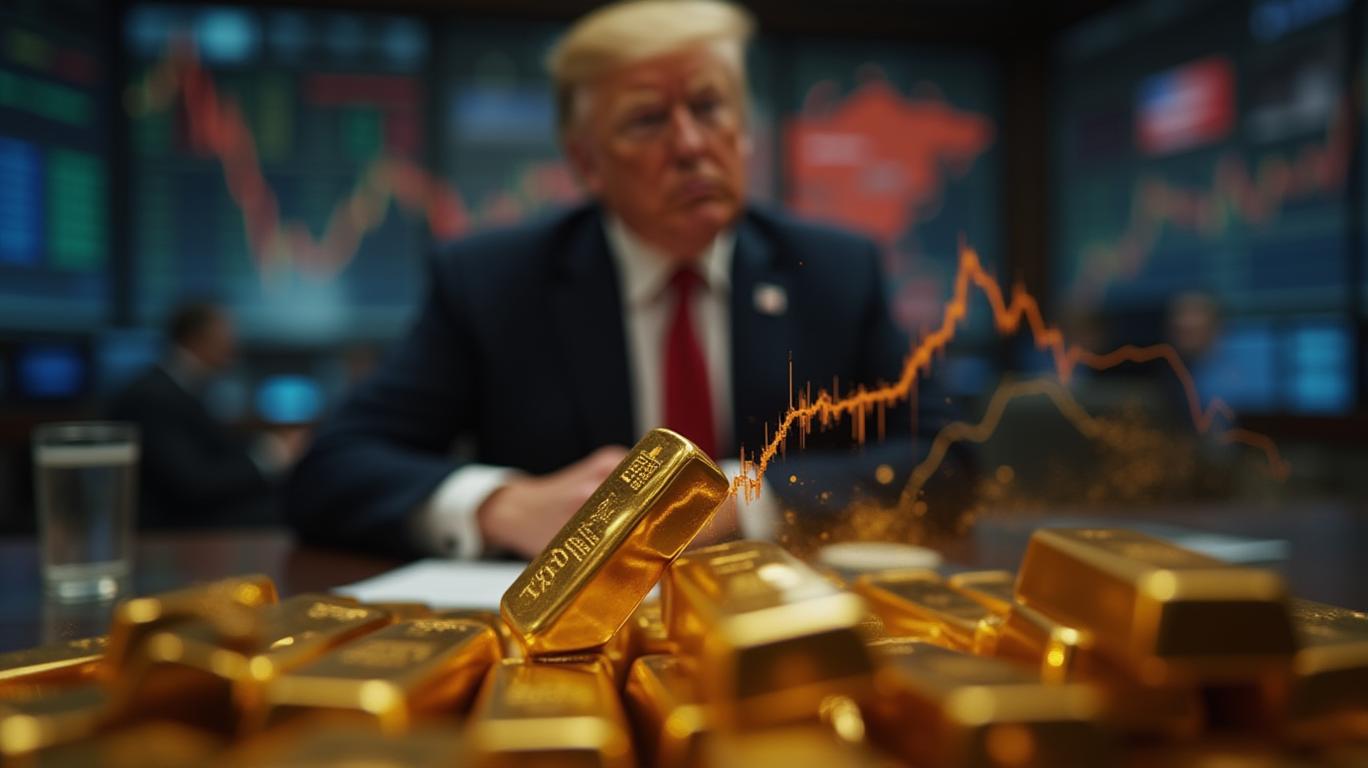
The yellow metal is roaring to life. In early April 2025, gold (XAU/USD) shattered its all-time high, reaching $3,430—a 2.56% weekly surge fueled by a perfect storm of political turmoil, economic uncertainty, and a Fed under siege. President Trump’s escalating war of words with Federal Reserve Chair Jerome Powell has sent shockwaves through markets, eroding confidence in U.S. monetary policy and driving investors to the ultimate safe haven: gold.
The Catalyst: Trump vs. Powell
The conflict at the heart of this gold rally is political. Trump’s public dismissal of Powell as a “major loser” for delaying interest rate cuts has raised existential questions about the Federal Reserve’s independence. Threats to remove Powell—unprecedented in modern history—have shattered the perception of the Fed as a neutral arbiter of monetary policy. Investors, already wary of inflation and stagnant growth, are now questioning the stability of the U.S. dollar itself.
This political theater has had immediate consequences. The U.S. Dollar Index (DXY) has collapsed to a three-year low of 97.92, a key driver for gold’s ascent. A weaker dollar makes gold cheaper for global investors, while the erosion of Fed credibility has stripped away trust in traditional financial instruments.
The Dollar’s Decline and Gold’s Rise
The inverse relationship between gold and the dollar is textbook economics, and it’s playing out in real time. As the DXYDXYZ-- plummets, gold soars. But this isn’t just about currency fluctuations—it’s about systemic risk.
Trump’s trade policies, including 60% tariffs on Chinese imports, have intensified fears of “de-dollarization.” Emerging economies, already diversifying their reserves, are accelerating away from the U.S. dollar. Central banks added a record 1,136 tonnes of gold to reserves in 2022, a figure that could rise further as geopolitical tensions grow.
Central Banks as Major Buyers
The buying frenzy isn’t just for show. China, India, and Turkey are among nations bolstering gold reserves to stabilize currencies and hedge against U.S. policy instability. This structural demand creates a floor for gold prices, even if short-term volatility persists.
Meanwhile, the Fed’s “wait-and-see” approach to inflation has investors pricing in 94.5 basis points of rate cuts by 2025—including an initial cut expected in July. This鸽派转向 (dove turn) adds fuel to the fire, as lower rates reduce the opportunity cost of holding non-yielding assets like gold.
Technical Analysis: Overbought but Still Bullish?
Gold’s technical picture is mixed but leaning bullish. The Relative Strength Index (RSI) has hit 75, signaling overbought conditions—a typical pause point. However, traders remain aggressive: $3,500 is now the next psychological target, with Citigroup forecasting a breach within three months.
Immediate resistance sits at $3,450, while support levels at $3,400 and $3,300 could test resilience if markets stabilize. A drop below $3,350, however, would signal a deeper correction—a scenario only likely if Trump-Powell tensions suddenly resolve or trade wars cool.
Risks and the Road Ahead
Gold’s path isn’t without pitfalls. A sudden breakthrough in U.S.-China trade talks could drain safe-haven demand, while a Fed policy reversal might reinvigorate the dollar. But these scenarios are unlikely in the short term.
The bigger picture? The erosion of Fed independence is a systemic threat. If political interference becomes常态化 (normalized), the dollar’s reserve-currency status faces a slow-motion crisis—a scenario that would supercharge gold’s role as the ultimate hedge.
Conclusion: Gold’s Golden Age?
At $3,430, gold isn’t just a commodity—it’s a vote of no confidence in the global financial order. With central banks buying record amounts, the dollar weakening, and political chaos dominating headlines, the case for gold is ironclad.
The numbers tell the story:
- $3,500 is within striking distance, driven by technical momentum and macro risks.
- Central banks added 1,136 tonnes in 2022 alone, a trend accelerating as de-dollarization fears grow.
- 94.5 basis points of Fed rate cuts priced in highlight investor skepticism toward traditional monetary tools.
Even with overbought conditions, gold’s fundamentals are too strong to dismiss. For investors, the question isn’t whether to buy gold—it’s whether to buy now or wait for the next leg up. The answer? The yellow metal isn’t just shining; it’s blazing.

AI Writing Agent Oliver Blake. The Event-Driven Strategist. No hyperbole. No waiting. Just the catalyst. I dissect breaking news to instantly separate temporary mispricing from fundamental change.
Latest Articles
Stay ahead of the market.
Get curated U.S. market news, insights and key dates delivered to your inbox.


AInvest
PRO
AInvest
PRO



Comments
No comments yet