
Gold's Surge Amid Rising Trade Tensions: A Safe-Haven Opportunity or a Passing Storm?
The global trade landscape in July 2025 has reached a boiling point, with reciprocal tariffs, legal battles, and geopolitical posturing reshaping the economic terrain. Amid this turmoil, gold has emerged as a luminous beacon of stability, its price surging to near $3,365 as investors seek refuge from escalating uncertainty. But is this rally a fleeting reaction or the start of a prolonged safe-haven boom? This analysis delves into the interplay between trade tensions, gold's historical resilience, and its role as a strategic hedge for investors.
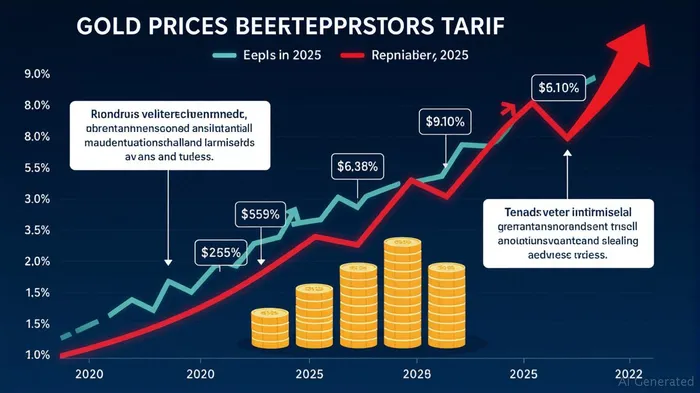
The Tariff Tsunami and Market Volatility
Recent tariff announcements have intensified trade frictions globally. The U.S. has imposed a 34% tariff on China, a 35% "fentanyl" tariff on Canada, and threatened 20–50% levies on the EU, including a 200% tariff on alcohol. Meanwhile, Brazil and Mexico face punitive measures tied to digital trade disputes. These actions, delayed by legal stays but upheld pending appeals, have created a climate of regulatory whiplash, with businesses and investors bracing for further escalation.
The Peterson Institute estimates that each 10% tariff increase adds 0.8–1.2% to headline inflation, fueling demand for gold as both an inflation hedge and a haven. With the U.S. dollar down 3% year-to-date and central banks like China and India bolstering gold reserves, the metal has become a cornerstone of diversification strategies.
Historical Precedent: Trade Wars and Gold's Role
Gold's performance during past trade conflicts underscores its reliability as a safe haven. During the 2018–2020 U.S.-China trade war, gold rose 18.4%, outperforming equities and Treasury bonds. Similarly, the 1971 Nixon Shock—marked by dollar devaluation and trade imbalances—saw gold prices surge 285% over five years.
Today's Trade Uncertainty Index (TUI) shows a 0.87 beta correlation with gold prices, meaning a 10-point TUI increase could boost gold by 2.1% over six months. The current TUI of 125 (up from 80 in 2023) aligns with gold's Q3 2025 price target of $3,310 and Goldman Sachs' 2030 forecast of $4,100, driven by de-dollarization and inflationary pressures.
Drivers of Gold's Current Rally
- Safe-Haven Demand: Geopolitical risks, including Middle East tensions and tariff-induced supply chain disruptions, are pushing investors toward gold. The Gaza ceasefire discussions and Israeli military actions in July 2025 exemplify how regional instability amplifies demand.
- Inflation and Dollar Weakness: With tariffs boosting import costs, core inflation remains sticky, eroding bond yields. A weaker USD—down 3% in 2025—further elevates gold's appeal, as its inverse correlation with the dollar is a critical tailwind.
- Central Bank Accumulation: Global central banks added 1,136 tonnes of gold to reserves in 2022, a record high. In Q1 2025, purchases hit 244 tonnes, signaling a structural shift away from dollar dependency.
Investment Strategies: Navigating the Gold Rally
For investors, gold offers multiple entry points:
- ETFs: Vehicles like the SPDR Gold Shares (GLD) and iShares Gold Trust (IAU) provide low-cost, liquid exposure. In Q1 2025, GLDGLD-- saw 84 tonnes in inflows, its strongest since 2020.
- Mining Equities: Companies such as Newmont Corporation (NEM) and Barrick Gold (GOLD) offer leverage to rising gold prices, with their stock performance often outpacing spot gold in bull markets.
- Diversification: Allocate 6–8% of a moderate portfolio to gold to hedge against tail risks. Pair with inverse USD ETFs (e.g., UDN) or energy stocks to balance volatility.
Risks and Considerations
While the outlook is bullish, risks loom large:
- Trade Deal Breakthroughs: A sudden resolution of U.S.-China or EU-U.S. disputes could reduce safe-haven demand.
- Fed Policy: If the Fed hikes rates despite inflation, bond yields might rebound, pressuring gold.
- Technical Levels: A weekly close below $3,250 could trigger profit-taking, while resistance at $3,400 tests market psychology.
Conclusion: Gold as a Pillar of Resilience
The current trade tensions are not a passing storm but a structural shift toward protectionism and de-dollarization. Gold's surge reflects its enduring role as a hedge against uncertainty, supported by inflation, central bank demand, and geopolitical volatility. For investors, now is the time to strategically allocate to gold ETFs or mining stocks to safeguard portfolios against the storm clouds on the horizon.
As the tariff wars unfold, gold's gleam may yet outshine all but the most resilient equity markets. The question is no longer whether to act, but how—and how soon—to secure a place in this enduring safe haven.

Stay ahead of the market.
Get curated U.S. market news, insights and key dates delivered to your inbox.
AInvest
PRO
AInvest
PRO



Comments
No comments yet