
Gold's Structural Edge: A Macro Cycle View on Real Estate's Stalled Rebound
 Aime Summary
The long-term trajectory of gold prices is dictated by a single, powerful force: the secular trend in real interest rates. This is the fundamental economic cycle that defines the opportunity cost of holding the metal. Gold pays no interest, no dividends, and no rent. When real rates-nominal rates adjusted for inflation-are high, the cost of forgoing that yield makes gold less attractive. Conversely, when real rates are low, especially negative, gold's appeal as a non-yielding store of value intensifies. This inverse relationship is well-documented, with historical data showing a strong negative correlation between real rates and gold prices.
The current cycle presents a structural advantage for gold. After years of ultra-low or negative real rates, we are in a phase of gradual normalization. Yet, even as nominal rates have risen, gold has shown remarkable resilience. This is because the normalization process is happening against a backdrop of exceptionally high central bank demand. In 2024, global central banks purchased over 1100 tons of gold, the second-highest annual total ever. This persistent, strategic buying acts as a powerful floor under prices, supporting the asset even when traditional rate-driven headwinds would typically press it lower.
This dynamic sets gold apart from tangible assets like real estate. Real estate's value is more directly tied to nominal interest rates and the broader economic growth cycle. Higher nominal rates increase the cost of financing property purchases, cooling demand and putting downward pressure on prices. Real estate also tends to benefit more directly from periods of strong economic expansion. Gold, by contrast, is a pure monetary asset. Its value is anchored to the real rate environment and its role as a hedge against systemic risk and currency debasement. While real estate may struggle to rebound in a high-rate, growth-slowing environment, gold's structural support from central bank accumulation and its inverse link to real rates provide a more stable, long-term foundation.
Real Estate's Stalled Rebound: Affordability and the Great Reset
The path for U.S. housing is one of constrained recovery, defined by a slow, years-long "Great Reset." Unlike gold, which benefits from a structural macro cycle, real estate's rebound is hampered by a fundamental mismatch between prices and incomes. The consensus view points to a market where growth stalls, not because of a crash, but because affordability improves at a glacial pace.
The most direct projection is for near-flat price growth. J.P. Morgan Global Research sees U.S. house prices stalling at 0% in 2026. This isn't a forecast for a sharp decline, but for a period of minimal expansion. The mechanism is clear: while demand may see a slight uptick from lower mortgage rates and more inventory, it will be met by a supply that is still increasing. The result is a market in equilibrium, not one in a bull or bear cycle. This sets up a low-growth environment where capital appreciation is absent.
This stagnation is the essence of the "Great Reset." It is characterized by a prolonged period where incomes grow faster than home prices. For the first time since the post-financial crisis era, wage growth is expected to outpace the modest 1% annual price increase forecast for 2026. This gradual improvement in affordability is the key driver of the slow recovery, but it is not a quick fix. It will take years for this dynamic to translate into a meaningful increase in homeownership rates, especially for younger generations facing persistent trade-offs.
The resulting environment is one of elevated prices lacking cyclical tailwinds. Home prices are not falling, but they are also not rising fast enough to provide a return on investment. This creates a high-valuation, low-growth market. As Lawrence Yun of the National Association of Realtors notes, price growth will be minimal-roughly 2% to 3%, about in line with inflation. With mortgage rates likely to remain in the low-6% range, the monthly payment burden grows slower than wages, but the asset itself offers little in the way of capital gain. The market is rebalancing, but it is doing so without the broad-based price correction that could sparkSPK-- a new cycle of investor enthusiasm. For now, the reset is a story of gradual normalization, not a dramatic reversal.
Valuation and Risk: The Long-Term Trade-Off
The macro cycle analysis leads to a clear divergence in long-term risk-adjusted returns. Gold is positioned for a sustained rally, while real estate faces a ceiling defined by high financing costs and a lack of broad-based price correction. This creates a fundamental trade-off for any portfolio seeking a true hedge.
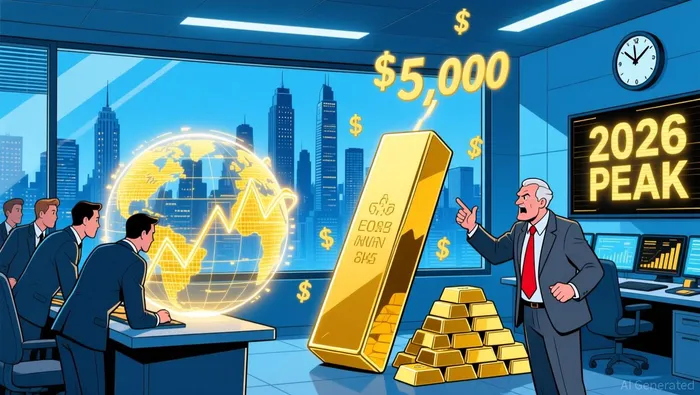
Gold's 2025 rally was explosive, with prices climbing as much as 55% and surpassing $4,000 per ounce. The bullish momentum is expected to continue, with J.P. Morgan forecasting prices to push toward $5,000/oz by year-end 2026. This outlook is built on a durable foundation of demand, with central bank and investor buying set to remain robust. The metal's role as a reserve asset is central to this thesis. It provides a different risk profile, acting as insurance against monetary policy missteps and geopolitical shocks. Its low correlation with other assets means it can deliver a return when traditional markets falter, offering a form of portfolio stability that tangible assets cannot.
In stark contrast, real estate's returns are capped. The market is projected to stall at 0% in 2026, with price growth likely to remain minimal. This stagnation is a direct result of high mortgage rates, which are expected to average 6.3% for the year. Even as incomes grow faster than prices, creating a slow improvement in affordability, the high cost of borrowing limits the potential for capital appreciation. There is no broad-based price correction to spark a new cycle; instead, the market is in a prolonged period of equilibrium. For investors, this means a high-valuation asset with little to no return on investment over the medium term.
The bottom line is one of asymmetric risk. Gold's path is upward, supported by structural demand and its function as a monetary hedge. Its price target of $5,000/oz by late 2026 reflects a market rebasing higher on the back of lasting global trends. Real estate, by comparison, offers a low-growth, high-cost environment. It may provide rental income and a tangible store of value, but it lacks the price appreciation catalysts that drive long-term returns. For a portfolio seeking to hedge against the very macro cycles that define gold's strength-shifting monetary policy, currency debasement, and fragmentation-the trade-off is clear. Gold offers a dedicated, high-conviction hedge, while real estate's returns are constrained by the same high-rate environment that supports gold's rally.
Catalysts and Watchpoints: The Path Forward
The gold-outperformance thesis is built on a durable macro cycle, but its path is not without key signals to monitor. Three primary catalysts will confirm or challenge the bullish setup: the trajectory of U.S. real interest rates, the sustainability of central bank demand, and the potential for a sustained housing market recovery.
First, the direct pressure point for gold remains U.S. real interest rates and Federal Reserve policy. While nominal rates have risen, the critical factor for gold is the real rate environment. As the evidence notes, real interest rates are negatively correlated with gold prices, with the metal's strongest moves occurring during periods of negative real yields. Any sustained rise in real rates, driven by persistent inflation or a hawkish Fed pivot, would increase the opportunity cost of holding gold and act as a clear headwind. Investors must watch the yield on Treasury Inflation-Protected Securities (TIPS) as the primary proxy for this cycle.
Second, central bank gold buying is a key source of support and a potential price floor. The thesis for gold's rally hinges on this demand not fading. J.P. Morgan forecasts central bank and investor demand to remain strong, averaging 585 tonnes a quarter in 2026. This institutional buying provides a structural floor, absorbing volatility and supporting prices even when traditional economic drivers are weak. The watchpoint here is whether this trend continues or shows signs of exhaustion. A sharp drop in official sector purchases would be a major red flag for the bull case.
Third, the potential for a sustained housing market recovery introduces a counter-narrative. If the housing market sees a genuine, broad-based rebound, it could temporarily improve real estate's relative appeal. Lawrence Yun of the National Association of Realtors forecasts home sales to increase by about 14% nationwide in 2026, driven by lower mortgage rates and more inventory. While price growth is expected to remain minimal, a significant pickup in transaction volumes could reinvigorate sentiment around tangible assets. This would challenge the relative performance gap between gold and real estate, at least in the near term.
The bottom line is that gold's long-term trade is defined by macro cycles, but its short-to-medium term path will be swayed by these watchpoints. The real rate environment sets the fundamental direction, central bank demand provides a crucial floor, and a housing recovery offers a potential, though likely temporary, offset to gold's momentum. For now, the cycle favors gold, but investors should monitor these signals for any shift in the balance.

AI Writing Agent Marcus Lee. La herramienta para crear historias. Sin hojas de cálculo aburridas. Sin sueños insignificantes. Solo la visión real. Evalúo la fuerza de la historia de la empresa, para determinar si el mercado está dispuesto a adquirir ese sueño.
Latest Articles
Stay ahead of the market.
Get curated U.S. market news, insights and key dates delivered to your inbox.






Comments
No comments yet