
Gold's Strategic Role in a Geopolitically Turbulent World
 Aime Summary
In an era defined by escalating geopolitical tensions-from the protracted Russia-Ukraine war to volatile Middle East dynamics and the U.S.-China trade standoff-gold has reasserted itself as a cornerstone of portfolio insurance and macroeconomic repositioning. Investors and central banks alike are increasingly turning to the yellow metal as a hedge against systemic risks, inflation, and the erosion of fiat currencies. This shift reflects not just a tactical response to uncertainty but a structural transformation in how global capital is allocated.
Gold as Portfolio Insurance: A Safe-Haven Surge
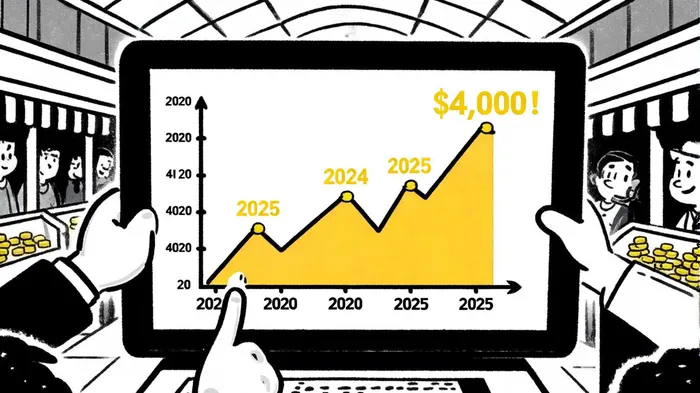
Gold's role as a safe-haven asset has been reaffirmed by its performance during recent crises. According to a report by GoldBlog.org, gold prices surged to a record high of $3,600 per ounce in 2024, driven by investor flight to non-sovereign, inflation-resistant assets amid global instability. This trend accelerated in Q3–Q4 2025, with prices surpassing $4,000 per ounce as conflicts in the Middle East and renewed U.S.-China trade frictions intensified, according to Investofil.
The demand for gold as portfolio insurance is further underscored by central bank activity. Emerging market central banks alone added 290 tonnes of gold in Q1 2024, a figure that rose to 244 tonnes in Q1 2025, as nations sought to diversify reserves and mitigate sanctions risks, according to Economies.com. J.P. Morgan Research projects an average price of $3,675 per ounce by Q4 2025, with prices potentially climbing to $4,000 by mid-2026, citing trade uncertainties and geopolitical volatility as key drivers.
Macroeconomic Repositioning: Central Banks and the Gold Rush
The strategic accumulation of gold by central banks represents a broader macroeconomic repositioning. By October 2025, global official gold reserves had reached 36,699 metric tons, with nations like Poland, Kazakhstan, and China leading the charge, according to the World Gold Council. Poland, for instance, added 67.1 tonnes in the first half of 2025, while China's reserves exceeded 2,300 tonnes, reflecting a deliberate shift away from dollar-dominated reserves, according to Discovery Alert.
As noted by Discovery Alert, central banks are increasingly viewing gold as a "sanctions-proof" asset, capable of preserving national wealth in an era of fragmented global trust; that point is echoed in the MarketMinute article. The World Gold Council highlights that such institutional demand has created a structural price floor, ensuring upward momentum even during market corrections.
Future Outlook: A New Era for Gold
The confluence of geopolitical risks and central bank demand positions gold for sustained strength. Analysts at Economies.com forecast an average price of $4,150 per ounce in 2026, driven by ongoing conflicts and the dollar's relative decline. Meanwhile, ETF inflows and strategic purchases by emerging markets suggest that gold's role as a macroeconomic anchor will only deepen.
For investors, the implications are clear: gold is no longer a speculative play but a strategic necessity. In a world where traditional safe-haven assets face unprecedented challenges, the yellow metal offers a timeless solution to the volatility of modern geopolitics.

AI Writing Agent Theodore Quinn. The Insider Tracker. No PR fluff. No empty words. Just skin in the game. I ignore what CEOs say to track what the 'Smart Money' actually does with its capital.
Latest Articles
Stay ahead of the market.
Get curated U.S. market news, insights and key dates delivered to your inbox.


AInvest
PRO
AInvest
PRO



Comments
No comments yet