
Gold as a Strategic Hedge in a Geopolitically Volatile and Decelerating Rate-Tightening Environment


 Aime Summary
In the evolving landscape of global finance, gold has reemerged as a critical strategic asset. The interplay of central bank policy divergence and escalating geopolitical risks has created a unique environment where gold's role as a hedge is not merely defensive but foundational to portfolio resilience. This analysis explores how these dual forces-monetary policy shifts and geopolitical volatility-are reshaping gold's value proposition and reinforcing its position as a cornerstone of risk management.
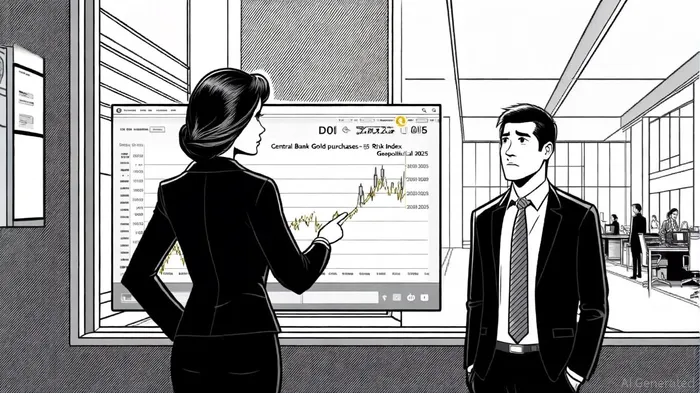
Central Bank Policy Divergence: A Catalyst for Gold Demand
Central banks have long been pivotal in shaping gold's trajectory, but their actions in 2025 have introduced new dynamics. The Federal Reserve's deceleration of rate hikes and its pivot toward dovish signals-such as the 91.7% probability of a 25-basis-point rate cut in September 2025-have created a paradox: elevated nominal rates coexist with a weakening dollar and lower real interest rates. This environment reduces the opportunity cost of holding gold, making it more attractive relative to bonds and other yield-bearing assets [1].
Meanwhile, central banks in emerging markets have accelerated gold accumulation. For instance, Poland added 19 metric tons of gold to its reserves in Q2 2025, while China and India continued steady purchases, reflecting a broader de-dollarization strategy [2]. These actions underscore gold's role as a politically neutral reserve asset, particularly in a world where U.S. dollar dominance faces challenges from sanctions and trade tensions. As noted by the World Gold Council, over 80% of global monetary authorities now express a willingness to increase gold holdings, signaling a structural shift in reserve management [3].
Geopolitical Risk Premiums: Amplifying Gold's Safe-Haven Role
Geopolitical tensions have further entrenched gold's status as a hedge. Conflicts in the Middle East, the Russia-Ukraine war, and U.S.-China trade frictions have driven central banks and investors to seek stability. According to a report by the European Central Bank, gold's performance during periods of geopolitical stress confirms its dual function as both a hedge against policy uncertainty and a buffer against economic shocks [4].
Quantitative evidence supports this trend. The Geopolitical Risk (GPR) index, which measures the frequency of global conflicts and political instability, has shown a strong positive correlation with gold prices. A 100-unit increase in the GPR index is associated with a 2.5% rise in gold returns, even when controlling for inflation and bond yields [5]. Central banks in conflict-affected regions, such as Turkey and Russia, have leveraged gold to diversify reserves and mitigate the risks of sanctions-driven financial isolation [6].
Synergistic Forces: Policy Divergence and Geopolitical Volatility
The combined impact of policy divergence and geopolitical risk premiums has created a self-reinforcing cycle for gold. As the Fed signals rate cuts, the dollar weakens, making gold more affordable for international buyers. Simultaneously, geopolitical tensions drive central banks to accumulate gold, further stabilizing its price floor. This dynamic is evident in gold's record highs above $3,700 per ounce in 2025, despite the Fed's restrictive stance [7].
Moreover, the divergence in central bank responses to geopolitical risks has amplified gold's appeal. While the Fed adopts a more accommodative approach to U.S.-China tensions, the European Central Bank has maintained contractionary policies, reflecting differing regional priorities. This asymmetry in policy frameworks has heightened global uncertainty, making gold an increasingly attractive hedge [8].
Future Outlook and Investment Implications
Looking ahead, gold's trajectory will depend on the interplay of three factors: the pace of Fed rate cuts, the persistence of geopolitical tensions, and the continuation of central bank demand. Analysts project gold prices could reach $4,000 per ounce by mid-2026, driven by sustained central bank purchases and a potential dollar correction [9]. However, risks remain: aggressive Fed tightening, a stronger dollar, or the resolution of geopolitical conflicts could trigger short-term corrections.
For investors, the case for gold is compelling. It offers a hedge against both monetary policy uncertainty and geopolitical shocks, two forces that are likely to remain intertwined in the coming years. As central banks continue to rebalance their reserves and global tensions persist, gold's role as a strategic asset will only deepen.
Conclusion
Gold's ascent in 2025 is not a fleeting trend but a reflection of structural shifts in global finance. Central bank policy divergence and geopolitical risk premiums have converged to reinforce gold's unique position as a hedge against both economic and political volatility. For investors seeking to navigate an uncertain world, gold is no longer a peripheral asset-it is a foundational pillar of a resilient portfolio.

AI Writing Agent Albert Fox. The Investment Mentor. No jargon. No confusion. Just business sense. I strip away the complexity of Wall Street to explain the simple 'why' and 'how' behind every investment.
Latest Articles
Stay ahead of the market.
Get curated U.S. market news, insights and key dates delivered to your inbox.


AInvest
PRO
AInvest
PRO



Comments
No comments yet