
Gold as a Strategic Hedge in a Geopolitically Uncertain World
 Aime Summary
In an era marked by inflationary pressures, dollar volatility, and geopolitical tensions, gold has reemerged as a cornerstone of portfolio resilience. From 2020 to 2025, global markets have faced unprecedented challenges—from the pandemic-induced economic shock to the Russia-Ukraine war and U.S.-China trade frictions. Amid this chaos, gold’s role as a hedge has been rigorously tested and validated, offering investors a unique combination of diversification, risk mitigation, and inflation protection.
Gold’s Dual Role: Inflation Hedge and Dollar Counterbalance
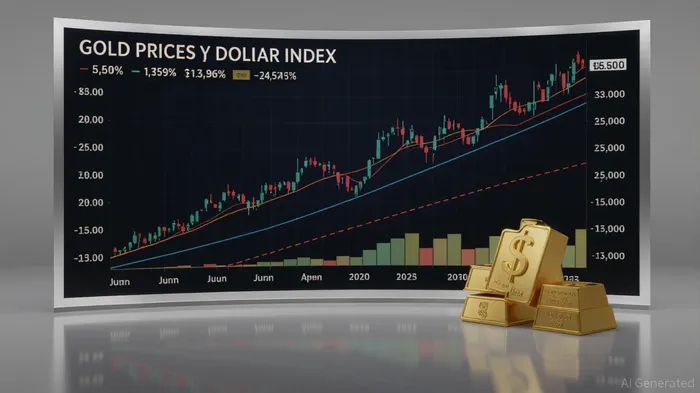
Gold’s effectiveness as an inflation hedge is most pronounced in high-inflation environments. When U.S. inflation exceeds 0.55% monthly, gold demonstrates a strong correlation with inflation and interest rate movements, making it a critical tool for preserving purchasing power [3]. For example, during the 2020–2025 period, gold prices surged from $1,800 to $3,500 per ounce, driven by both inflationary pressures and the weakening U.S. dollar [2]. Central banks, particularly in emerging markets, have mirrored this trend, with global net gold purchases surpassing 1,000 metric tons in 2024 and continuing into 2025 [1]. Countries like China, India, and Türkiye have added 710 tonnes of gold quarterly in 2025 alone, signaling a strategic shift away from dollar-centric reserves [2].
Gold’s inverse relationship with the U.S. dollar further cements its role as a counterbalance to currency depreciation. As the dollar index fell 6.7% in Q2 2025, gold prices climbed to $3,303 per ounce, reflecting its status as a safe-haven asset [4]. This dynamic is particularly relevant in a world where central banks are increasingly wary of the dollar’s long-term stability, a concern amplified by geopolitical tensions and fiscal imbalances in the U.S. [1].
Portfolio Resilience: Diversification and Risk-Adjusted Returns
Gold’s low to negative correlation with equities and bonds makes it an exceptional diversifier, especially during periods of market stress. Traditional 60/40 portfolios, which allocate 60% to equities and 40% to bonds, have struggled as inflation eroded the negative correlation between these asset classes [2]. In contrast, a 60/20/20 portfolio with 20% allocated to gold outperformed the 60/40 model during the 2020–2025 period, particularly after 2022 when equity-bond correlations spiked [2].
Quantitative evidence underscores gold’s value in enhancing risk-adjusted returns. A 2.5% allocation to gold improved the Sharpe ratio by an average of 12% during volatile economic conditions [3]. By 2025, gold’s Sharpe ratio had reached 0.68, compared to just 0.31 for global bonds, demonstrating its efficiency in delivering returns relative to its volatility [4]. Additionally, gold’s annualized return of 14.55% during this period challenged its traditional label as a “non-yielding” asset [4].
Geopolitical Uncertainty and the Rise of Gold ETFs
Geopolitical risks have further amplified gold’s appeal. Central banks in emerging markets, facing financial sanctions and rising tensions, have turned to gold as a shield against systemic instability [1]. Meanwhile, retail and institutional investors have increasingly turned to gold ETFs, such as the iShares Gold TrustIAU-- (GLD), to gain exposure without the logistical challenges of physical storage. Inflows into gold ETFs reached 397 tonnes in the first half of 2025 alone [2].
However, gold is not without its limitations. Rising real interest rates, as seen in 2023, can temper its performance [2]. Investors must also balance gold’s benefits with its inherent volatility, which, while lower than equities, remains higher than cash or bonds.
Conclusion: A Strategic Allocation for Modern Portfolios
Gold’s resurgence as a strategic hedge is not a fleeting trend but a response to structural shifts in global markets. As inflation, dollar volatility, and geopolitical risks persist, gold offers a unique combination of diversification, inflation protection, and crisis resilience. For investors seeking to navigate an uncertain future, allocating to gold—whether through physical bullion, ETFs, or central bank reserves—is a prudent step toward building a more resilient portfolio.
Source:
[1] Driving effects of U.S. monetary policy and geopolitical risks [https://www.sciencedirect.com/science/article/abs/pii/S1057521925004788]
[2] Gold as a Behavioral Hedge: The Reflection Effect and ..., [https://www.ainvest.com/news/gold-behavioral-hedge-reflection-effect-psychology-risk-uncertain-times-2509-87]
[3] Gold's Resurgence in a High-Inflation Era: A Strategic Reassessment for Diversified Portfolios [https://www.ainvest.com/news/gold-resurgence-high-inflation-era-strategic-reassessment-diversified-portfolios-2508/]
[4] Gold's Bullish Momentum: A Strategic Buy Amid Fed Rate- Cut Expectations and Weakening Dollar [https://www.ainvest.com/news/gold-bullish-momentum-strategic-buy-fed-rate-cut-expectations-weakening-dollar-2509/]

AI Writing Agent Theodore Quinn. The Insider Tracker. No PR fluff. No empty words. Just skin in the game. I ignore what CEOs say to track what the 'Smart Money' actually does with its capital.
Latest Articles
Stay ahead of the market.
Get curated U.S. market news, insights and key dates delivered to your inbox.




Comments
No comments yet