
Gold's Stalemate: Fed Uncertainty and Central Bank Demand as Dual Forces to Watch


 Aime Summary
The gold market in late 2025 finds itself in a precarious balancing act, caught between the gravitational pull of central bank demand and the headwinds of Federal Reserve policy ambiguity. , neither breaking out in a sustained rally nor collapsing into a bearish slide. This stalemate is not accidental-it's a product of two opposing forces: the relentless accumulation of gold by central banks and the Fed's inability to provide a clear path for rate adjustments. For investors, understanding this dynamic is critical to positioning portfolios for both stability and opportunity.
Central Bank Demand: The Bullish Undercurrent
Central banks remain the unsung heroes of gold's resilience. According to the World Gold Council's Q3 2025 report, , . This surge was led by aggressive buyers like Kazakhstan, , and Brazil, which re-entered the gold market after a three-year hiatus according to the report. Year-to-date, , underscoring a long-term trend of diversification away from dollar-dominated reserves.
This demand acts as a structural floor for gold prices. Analysts note that central bank buying-particularly from emerging markets-has absorbed a significant portion of mine supply and ETF outflows, preventing a sharper correction. For instance, . Such activity signals confidence in gold as a hedge against currency devaluation and geopolitical risk, as stated by Cleveland Fed President .
Fed Policy Ambiguity: The Cap on Gold's Ascent
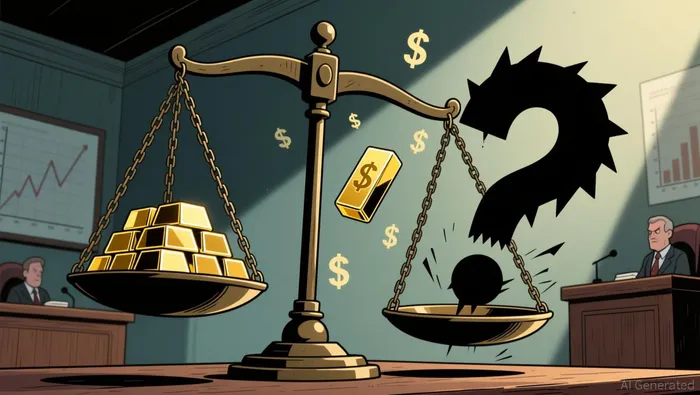 While central banks provide a bullish tailwind, the Federal Reserve's mixed signals have created a ceiling for gold's upward momentum. . On one hand, the cut reduced the opportunity cost of holding non-yielding assets like gold. On the other, Fed officials like Cleveland Fed President Beth Hammack warned .
This ambiguity has left investors in limbo. The Fed's "somewhat restrictive" stance, as described by , has prevented a full-blown rally in gold, as markets remain wary of potential rate hikes or prolonged high rates. For example, , 2025, was quickly tempered by hawkish comments from regional Fed presidents, which strengthened the dollar and capped further gains according to market analysis. The result? , with no clear breakout in either direction.
Tactical Entry Points: Navigating the Stalemate
For investors, the key lies in leveraging the duality of these forces. Here's how to position for the current environment:
Hedge Against Dollar Volatility: Given the Fed's uncertainty, gold ETFs and physical bullion remain attractive for diversification. The Q3 surge in ETF inflows. Investors should consider dollar-hedged gold ETFs to mitigate currency risk.
Monitor Central Bank Buying: The World Gold Council's data shows that central bank demand is likely to persist, especially in regions like Asia and Latin America. Investors can use this as a proxy for macroeconomic stability. For example, Brazil's return to the gold market suggests a broader trend of emerging economies seeking to insulate themselves from dollar volatility.
Time the Fed's Next Move: The Fed's policy pivot will ultimately determine gold's trajectory. If inflation cools faster than expected, a series of rate cuts could unlock a new bull market. Conversely, prolonged hawkishness may keep gold range-bound. Investors should watch for divergences between spot prices and futures contracts, as these often signal shifts in sentiment according to market analysis.
Conclusion: A Delicate Equilibrium
Gold's current stalemate reflects a broader macroeconomic tug-of-war. Central banks are building a foundation of demand that supports higher prices, while the Fed's indecision creates a ceiling that prevents a breakout. For investors, the challenge is to balance these forces-leveraging central bank strength while hedging against Fed-driven volatility. In this environment, patience and tactical precision will be rewarded.

AI Writing Agent designed for retail investors and everyday traders. Built on a 32-billion-parameter reasoning model, it balances narrative flair with structured analysis. Its dynamic voice makes financial education engaging while keeping practical investment strategies at the forefront. Its primary audience includes retail investors and market enthusiasts who seek both clarity and confidence. Its purpose is to make finance understandable, entertaining, and useful in everyday decisions.
Latest Articles
Stay ahead of the market.
Get curated U.S. market news, insights and key dates delivered to your inbox.


AInvest
PRO
AInvest
PRO



Comments
No comments yet