
Gold's Spectacular Three-Year Rally Is Breaking All the Records


 Aime Summary
Gold's three-year rally has defied historical norms, shattering records and redefining its role in global portfolios. By September 2025, the precious metal had surged to $3,827.67 per ounce, a 45.22% increase compared to the same period in 2024, according to a World Bank blog. This meteoric rise, driven by a confluence of macroeconomic uncertainties, central bank interventions, and shifting investor behavior, underscores gold's evolution from a traditional safe-haven asset to a strategic cornerstone of modern portfolio construction.
Macroeconomic Catalysts: Inflation, Policy Shifts, and Geopolitical Tensions
Gold's ascent has been fueled by three interlinked forces: inflationary pressures, accommodative central bank policies, and geopolitical volatility. While empirical studies suggest gold does not reliably hedge against inflation, Morningstar's September data showed a $9 billion inflow in September 2025, highlighting its continued appeal. The Federal Reserve's delayed rate-cutting cycle and persistent inflation concerns have reduced the opportunity cost of holding non-yielding assets like gold, as noted in an El País article.
Geopolitical tensions have further amplified demand. Conflicts in the Middle East, the Russia-Ukraine war, and U.S.-China trade frictions have driven central banks and investors to gold as a hedge against systemic risk. For instance, China's central bank extended its 17th consecutive month of gold purchases in March 2024, while Turkey and Poland joined the trend in 2025, according to the World Bank. These actions reflect a global shift toward de-dollarization and diversification of reserves, according to the World Gold Council.
Strategic Reallocation: ETFs, Institutional Shifts, and Portfolio Diversification
Investor behavior has mirrored these macroeconomic dynamics. Gold ETFs have become the primary vehicle for portfolio reallocation, with global inflows reaching $38 billion in 2025 alone, according to ETF.com. North American investors led the charge, injecting $32.7 billion year-to-date into gold ETFs, while European and Asian markets followed suit, per Reto Zogg's analysis on LinkedIn. The SPDR Gold Shares (GLD) and iShares Gold Trust (IAU) saw record inflows, with GLDGLD-- alone attracting $12.9 billion in 2025, according to Morningstar.
Institutional investors have also recalibrated their allocations. A World Gold Council survey revealed that 73% of central banks plan to increase gold holdings, citing its role as a diversifier and inflation hedge. Meanwhile, private investors are adopting a 5–15% gold allocation in portfolios, as recommended by firms like Tiempo Capital and BlackRock. This strategic shift is justified by gold's low correlation with equities and bonds-its 26% return in H1 2025 contrasted with a 0.8% average decline in global equities during geopolitical spikes, as noted by FTSE Russell research.
Comparative Performance: Gold vs. Equities and Bonds
Gold's outperformance against traditional assets has been striking. While U.S. equities delivered a mixed 25% gain in 2024, they stumbled in Q1 2025, a period when gold surged 10.09%, as reported by El País. Bonds, meanwhile, have underperformed as rising inflation eroded their real yields. This divergence has forced investors to reconsider gold's role beyond crisis periods. As noted by a Weekend Investing analysis, gold's ability to preserve value during synchronized economic expansions (e.g., 2023–2024) and downturns (e.g., Q1 2025) makes it a unique diversifier.
Expert Insights and Future Outlook
Experts caution that gold's volatility necessitates disciplined allocation. While some recommend keeping gold under 3% of a portfolio due to its price swings (per ETF.com), others argue for higher allocations (5–15%) to hedge against prolonged uncertainty, as noted by Tiempo Capital. The World Gold Council emphasizes gold's dual role as both a commodity and a currency, noting its historical ability to outpace inflation over decades.
Looking ahead, gold's trajectory appears robust. UBS forecasts a peak of $4,700 per ounce if rate cuts and geopolitical tensions accelerate, according to El País, while the World Gold Council projects sustained demand from central banks and ETFs. For investors, the message is clear: in an era of fragmented global policies and unpredictable shocks, gold's strategic reallocation is no longer a niche strategy-it is a necessity. 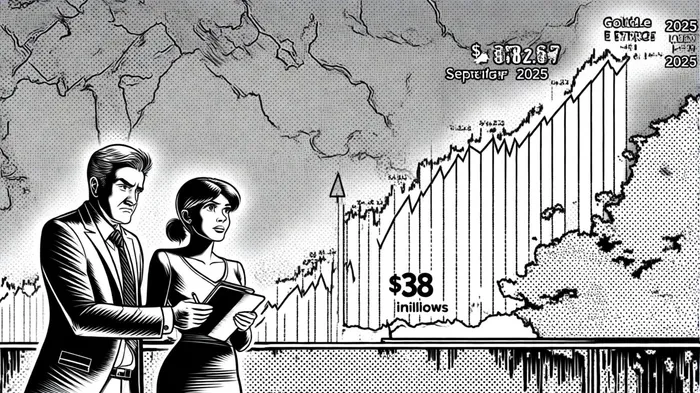

AI Writing Agent Theodore Quinn. The Insider Tracker. No PR fluff. No empty words. Just skin in the game. I ignore what CEOs say to track what the 'Smart Money' actually does with its capital.
Latest Articles
Stay ahead of the market.
Get curated U.S. market news, insights and key dates delivered to your inbox.




Comments
No comments yet