
Gold's Sideways Bias Amid Central Bank Policy Crosscurrents: A Tactical Play for Risk-Averse Investors
The price of gold has been caught in a narrow range this year, oscillating between $3,270 and $3,400 per ounce since early 2025, despite a record-breaking 28% surge in 2024. This sideways bias reflects a tug-of-war between near-term headwinds—such as a resilient U.S. dollar and cautious central bank policies—and structural tailwinds like inflation resilience, geopolitical risks, and historic central bank demand. For risk-averse investors, the challenge lies in discerning whether this consolidation is a buying opportunity or a prelude to a sustained downturn.
Central Bank Policies: A Divergent Crossroad
The U.S. Federal Reserve's reluctance to cut rates has kept the dollar anchored, even as inflation eases toward its 2% target. The Fed's “wait-and-see” approach—maintaining rates at 4.5% since early 2025—contrasts with projected rate cuts in the eurozone and emerging markets. This divergence creates a mixed landscape for gold: a weaker dollar typically boosts gold's appeal, but Fed hesitancy has prolonged dollar resilience.
Meanwhile, the European Central Bank's potential cuts by year-end could weaken the euro and reduce dollar pressure, indirectly favoring gold. Yet, political pressures—such as President Trump's public calls for faster Fed easing—add uncertainty. The World Gold Council notes that gold has historically risen 6% in the first six months of a Fed rate-cut cycle, suggesting gains if the Fed relents.
Central Bank Buying: A Structural Tailwind
The most compelling bullish factor remains central bank demand. For 15 straight years, central banks have been net purchasers of gold, and Q1 2025 saw a record 244 tonnes bought—driven by Poland (49 tonnes), China, Turkey, and India. These purchases reflect a global shift toward reserve diversification amid geopolitical instability and the decline of the dollar's hegemony.
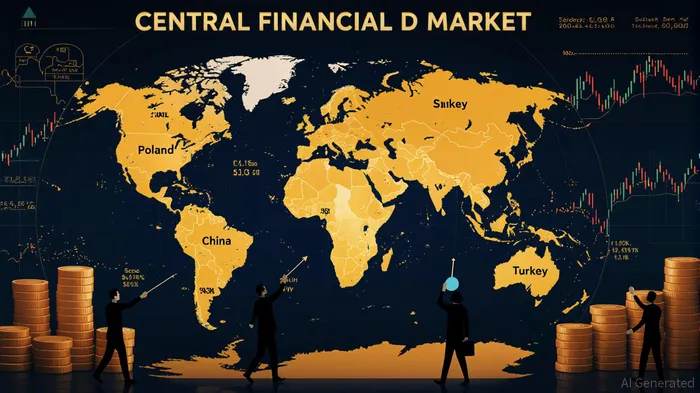
The World Gold Council forecasts 900 tonnes of central bank purchases in 2025, slightly below 2024's record 1,045 tonnes but still historically high. At 20% of global reserves, gold now constitutes the largest share of central bank holdings since the 1960s. This trend is unlikely to reverse, given rising U.S.-China trade tensions and European sovereign debt risks.
Inflation and Safe-Haven Demand: Gold's Dual Role
While U.S. inflation has cooled, it remains above the Fed's target, and supply chain disruptions in critical sectors (e.g., semiconductors, energy) threaten renewed price pressures. Gold's correlation with inflation—particularly in services-driven price spikes—remains intact.
Geopolitical risks amplify this dynamic. Proposed 30% U.S. tariffs on EU and Mexican goods, alongside flare-ups in South Korea and Syria, have kept investors in “risk-off” mode. The World Gold Council reports that gold ETF inflows rose 310 tonnes year-to-date, with Chinese holdings up 70%, underscoring its role as a portfolio stabilizer.
Technical Analysis: A Test of Key Levels
Technically, gold faces resistance at $3,400–$3,435, where short-term traders may lock in profits. Support holds near $3,300–$3,332, with the 200-day moving average ($3,280) acting as a safety net. The Relative Strength Index (RSI) remains neutral, suggesting a potential breakout higher if the Fed signals easing or geopolitical risks escalate.
Tactical Allocation: Position for the Long Game
For risk-averse investors, the near-term sideways bias argues for a gradual accumulation strategy:
1. Buy dips at $3,265–$3,300, targeting the $3,400 resistance.
2. Allocate 5–10% of a diversified portfolio to gold via ETFs like the SPDR Gold Shares (GLD) or physically backed instruments.
3. Consider gold miners (e.g., VanEck GoldGDX-- Miners ETF (GDX)) for leverage to rising prices; miners typically outperform physical gold by 2–3x in bull markets.
Risks to the Bull Case
- Dollar strength: If the Fed delays rate cuts and the DXY surges above 104, gold could retreat toward $3,200.
- Geopolitical easing: A U.S.-China trade truce or reduced Middle East tensions could reduce safe-haven demand.
- Central bank slowdown: Purchases below 500 tonnes in 2025 would weaken structural support.
Conclusion
Gold's sideways bias masks a compelling structural story. While near-term volatility persists, central bank diversification, inflation hedging, and geopolitical risks—projected to push prices toward $4,000 by 2026—make gold an essential hedge for portfolios. For cautious investors, patience and incremental buying at current levels could position them to capture the next leg of this bull market.

Stay ahead of the market.
Get curated U.S. market news, insights and key dates delivered to your inbox.


AInvest
PRO
AInvest
PRO



Comments
No comments yet