
Gold's Safe-Haven Surge: Geopolitical Storms and Central Bank Demand Fuel Record Prices
The price of gold has surged to near-record highs in 2025, driven by a perfect storm of geopolitical tension, shifting central bank policies, and investor anxiety over inflation and economic instability. As of June 20, 2025, gold traded at $3,367.91 per troy ounce, a 45% increase compared to the same period in 2024. This climb reflects a growing global appetite for safe-haven assets amid escalating Middle East conflicts, Federal Reserve uncertainty, and a historic shift in central bank reserve strategies.
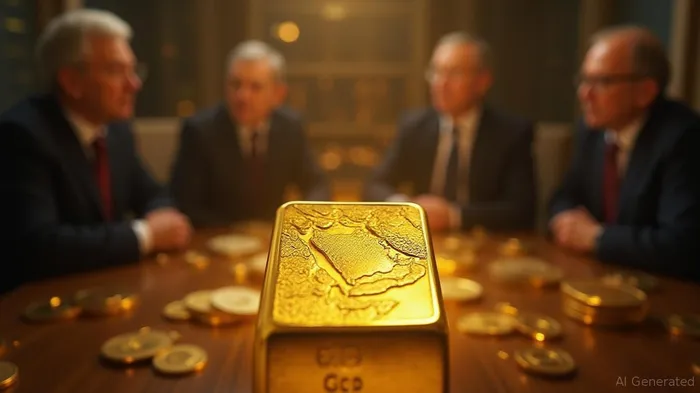
The Geopolitical Catalyst: Middle East Tensions
Gold's ascent has been supercharged by the deteriorating situation in the Middle East, where Israeli strikes on Tehran and Iranian retaliatory missile attacks—including one that struck a major Israeli hospital—have stoked fears of a broader conflict. * reveals a correlation between heightened hostilities and spikes in gold prices. For instance, the April 2025 peak of *$3,500/oz coincided with U.S. President Donald Trump's consideration of direct military action against Iran. Such instability has turned gold into a refuge for investors fleeing equities and bonds.
Analysts note that geopolitical risks are now a perpetual tailwind for gold. J.P. Morgan forecasts prices could hit $4,000/oz by mid-2026, citing the Middle East's potential to escalate into a full-blown crisis. “Every time the region's tensions escalate, gold becomes the default hedge against the unknown,” said a commodities strategist at the firm.
Central Banks: From Passive Holders to Active Buyers
Central banks have emerged as a critical driver of demand. In 2022 and 2023, they added a record 1,082 tonnes and 1,037 tonnes of gold to their reserves, respectively. This shift reflects a strategic pivot away from U.S. dollar-denominated assets amid concerns over the greenback's dominance and geopolitical weaponization of sanctions.
The U.S., Germany, France, and Italy collectively hold nearly half of global official gold reserves, but emerging economies like Turkey and India are now joining the rush. Their purchases signal a broader diversification strategy, reducing reliance on the dollar and safeguarding against economic shocks.
The Federal Reserve's Role: Low Rates and Inflation Fears
The Fed's policy stance has also fueled gold's appeal. Despite signaling two rate cuts by year-end, Chair Jerome Powell warned that tariffs and supply-chain disruptions could keep inflation elevated. This uncertainty has eroded the opportunity cost of holding non-yielding gold, while low real yields on bonds make the metal more attractive relative to traditional safe havens.
Fed forecasts of weaker growth and higher inflation by 2025 further reinforce gold's bullish case. “Gold is benefiting from a 'lose-lose' scenario for traditional assets,” said Goldman SachsGS-- analysts. “If the Fed cuts rates, gold gains; if inflation spikes, gold gains. The only losers are investors who ignore its role in portfolios.”
Market Dynamics: ETFs and Institutional Momentum
Institutional investors have amplified gold's rally through exchange-traded funds (ETFs). Year-to-date ETF inflows total 310 tonnes, including a 70% surge in Chinese holdings, as investors seek diversification. Futures positioning on the COMEX platform also reached record highs in 2024, underscoring speculative demand.
Even short-term dips, such as the June 20 dip to $3,350/oz, are seen as buying opportunities. “Volatility is inevitable,” noted a senior commodities trader, “but the structural bull case—geopolitical risks, central bank demand, and inflation—is too strong to ignore.”
Investment Takeaways
- Hold gold as a portfolio hedge: With geopolitical risks and inflationary pressures likely to persist, gold remains a critical diversifier.
- Use ETFs for accessibility: Vehicles like the SPDR Gold Shares (GLD) offer low-cost exposure to physical gold.
- Monitor central bank activity: Purchases by emerging markets could signal further price gains.
- Beware of overvaluation traps: While long-term trends favor gold, short-term corrections (e.g., dips to $3,000/oz) are possible.
Conclusion
Gold's 2025 surge is no fleeting phenomenon. It is a response to a world where geopolitical instability and monetary policy uncertainty have become the new normal. For investors, the metal's role as a defensive anchor in turbulent times is undeniable. With central banks doubling down on reserves and conflicts simmering, the path forward for gold looks paved in gold itself.
Analysts project prices to reach $3,416/oz by Q3 2025 and $3,566/oz by mid-2026.
The question isn't whether to own gold—it's how much.

Stay ahead of the market.
Get curated U.S. market news, insights and key dates delivered to your inbox.
AInvest
PRO
AInvest
PRO



Comments
No comments yet