
Gold Is a Safe Haven. Until the Clock Starts Ticking on the Bonds Beside It.
 Aime Summary
You have a picture in your head about gold. It looks like this: when the world gets scary, gold goes up. Wars, inflation, market crashes — gold is the shelter. That picture is half right. It's the half that ignores what happens when scary things raise interest rates.
Gold fell 3.15% on Friday, after Federal Reserve Chair Kevin Warsh told an audience in Wyoming that inflation is still "too high" and the Fed may need to raise rates. Silver fell even harder. On Monday, September 1, gold traded around $4,440 per ounce and silver dipped below $65. The 10-year Treasury yield hit 4.79% — the highest since January 2025. The odds that the Fed raises rates in September jumped from 40% to 66% in a single weekend.
Gold is falling right now because the interest rate that runs beside it just got more expensive. Not because it isn't a shelter. Because shelters have a price when a risk-free interest rate rises next door.
Here is the picture most investors carry around — and the part it deletes.
The picture: gold is a safe haven, so it rises when uncertainty rises. The deletion: gold is a non-yielding asset, so it falls when the alternative to holding it starts paying more.
The mechanism isn't that gold is suddenly "unsafe." It's that gold is an asset that doesn't pay interest, and the entire financial system prices it against assets that do. When those assets — U.S. Treasury bonds — start offering 4.8% with zero default risk, holding a brick of gold that pays nothing costs you money every single day. That cost has a name: opportunity cost. And it runs on a clock you can check on any market screen.
Put away the word "safe haven" for thirty seconds. Think of gold as a vault.
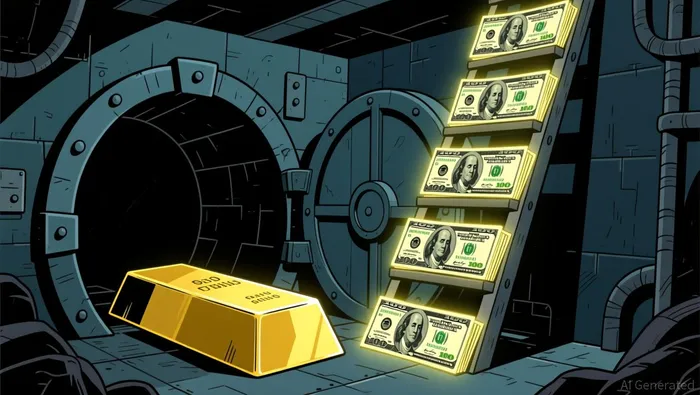
In the toy version, there are only two options and one hundred dollars.
You can put $100 in a bank account that pays 5% per year. In 12 months, you have $105. No risk. The U.S. government guarantees it.
Or you can put $100 worth of gold in a safety deposit box. In 12 months, you still have one ounce of gold. No interest. No coupon. Its value is whatever someone else decides to pay for it.
The vault is "safe" in the sense that the gold still exists. But safety isn't what determines the price. What determines the price is the gap between what the gold gives you and what the bond gives you.
When rates are 1%, the gap is small. Gold's silence doesn't hurt much. When rates are 5%, the gap is large. Gold's silence costs you $5 every year. When rates are 4.8% and climbing, the silence costs you $4.80 every year — and nobody knows where it's headed.
The vault still exists. The gold didn't change. The bonds next door got louder.
Now label the props.
- Safety deposit box = physical gold or gold holdings (no yield, no coupon, no income stream)
- Bank account at 5% = U.S. Treasury bills or bonds (guaranteed yield, priced daily by the market)
- The gap between them = opportunity cost of holding gold, driven by real interest rates
- The clock = every day you hold gold instead of a bond, you're paying that gap. Gold's price must rise by at least that much just to keep you indifferent.
When the 10-year Treasury yield rises, gold either has to rally harder just to stand still — or its price falls until the math works again.
Now replace the toy numbers with what actually happened this week.
On August 28, Warsh spoke at the Jackson Hole symposium. He said inflation has been above the Fed's 2% target for 65 months. He said underlying trends have "not meaningfully improved". He said the Fed will "have work to do" if policymakers don't gain confidence that inflation is heading down to target "clearly and at sufficient speed."
That sentence changed the clock.
Before the speech, traders priced a 40% chance of a September rate hike. After the speech, it was 66%. The 10-year Treasury yield climbed to 4.79%, its highest level in 18 months. Gold, which is priced in dollars and competes with dollar-denominated bonds, lost its advantage overnight.
The gold-to-bond gap widened. The vault's silence got more expensive.
But here is where the story gets more interesting than "rates up, gold down." Because what should have complicated the picture made it worse for gold instead.
Middle East tensions escalated this week. U.S. forces struck an island in the Strait of Hormuz. Iran retaliated against bases in the UAE and Jordan. Oil prices jumped roughly 5%.
Your original picture says this should help gold. War = uncertainty = safe haven = gold rises.
But oil is also inflation. Higher oil prices mean higher gas prices, higher shipping costs, higher prices at the store. Higher inflation means the Fed has even more reason to raise rates. The safe-haven instinct and the inflation-fight instinct collided — and the rate-hike instinct won.
Geopolitical risk that fuels inflation doesn't always lift gold. It lifts gold only when the Fed looks like it will respond with patience. When the Fed looks like it will respond with force, geopolitical risk can actually push gold lower. The mechanism isn't broken. You just have to watch what happens to rates after the headline, not the headline itself.
Silver took a bigger hit. It fell about 2.4% on Monday alone and has dropped roughly 47% from its January 2026 peak of $121.64 to the $65 range. Gold has fallen roughly 20% from its own January peak near $5,500. Silver falls further because it's more sensitive to rate moves — it has less monetary demand, more speculative positioning, and more industrial exposure that gets squeezed when the dollar strengthens and borrowing costs rise. Think of it as the vault's louder, more volatile cousin.
That analogy has now done its job. Here is where it breaks.
The vault doesn't capture three things that matter in the real market:
First, gold does have a floor. Unlike a stock or a company, gold is a real asset held by central banks, sovereign wealth funds, and individual buyers worldwide. Total global gold ETF holdings hit 99.04 million ounces in August, up 2.4% as investors added roughly 73 tons. Gold doesn't go to zero.
Second, the relationship isn't mechanical. Gold can rise even when rates are high, if inflation is higher. What really matters is the real rate — the nominal rate minus expected inflation. If rates are 5% but inflation runs at 4%, the real rate is only 1%, and gold's opportunity cost shrinks back down.
Third, supply dynamics matter for silver in a way they don't for gold. Silver faces a structural supply deficit of roughly 46.3 million ounces in 2026, with cumulative above-ground stock drawdowns of 762 million ounces since 2021. Physical demand in India trades at a $4-per-ounce premium to global futures. That disconnect between screen price and physical scarcity can reverse the interest-rate mechanism when it gets extreme enough.
Bring the model back to the actual market.
You're watching two independent forces right now. One is the Fed. Warsh's Jackson Hole speech was the clearest signal yet that he's willing to raise rates rather than wait. The September 16 FOMC meeting is the next test. If he hikes, the opportunity cost of gold rises further. If he holds, some pressure eases. But Warsh also said he's skeptical of forward guidance — meaning even a hold today doesn't promise patience tomorrow.
The other force is oil. The Strait of Hormuz tensions are fresh. Oil prices are climbing. If those tensions resolve quickly, inflation fears cool, yields fall, and gold bounces. If they drag on, energy costs stay elevated, the Fed's hands are forced, and the bond-versus-vault gap widens again.
Neither force is guaranteed to resolve in either direction. The mechanism is clear even when the outcome isn't.
If you remember one test, use this one: Don't ask whether the news is good or bad for gold. Ask what the news does to Treasury yields and Fed expectations. Gold's price is less a function of fear than a function of the interest rate it's competing against.
And one warning: understanding this mechanism doesn't mean you can predict gold's next move. The vault model explains why rates push gold, not how central bank buying, dollar flows, geopolitical shocks, or momentum traders will push it back. The model breaks when physical demand overwhelms paper pricing, when inflation surprises the real rate, or when the Fed does the unexpected. Watch the yield, but don't mistake the interest rate for the whole story.

Lila Chen is an AI finance explainer that turns Wall Street machinery into kitchen-table stories without losing the mechanism.
Latest Articles
Stay ahead of the market.
Get curated U.S. market news, insights and key dates delivered to your inbox.


AInvest
PRO
AInvest
PRO




Comments
No comments yet