
Gold as a Safe-Haven Asset: Navigating U.S. Government Instability and Currency Devaluation in 2025


 Aime Summary
Gold has long served as a barometer for global economic and political instability. In 2025, as U.S. government dysfunction and geopolitical tensions escalate, the precious metal has surged to record highs, hitting $3,870 per ounce by September 30, according to PBS NewsHour. This performance underscores gold's enduring role as a safe-haven asset, particularly during periods of currency devaluation and geopolitical risk. Historical patterns and current macroeconomic dynamics reveal a compelling case for gold as a hedge against the uncertainties of a fractured political landscape and a weakening U.S. dollar.
Historical Precedents: Gold and U.S. Government Instability
Gold's response to U.S. government instability is not a new phenomenon. During the 2025 government shutdown-the first in nearly seven years-gold prices spiked to $3,858 per ounce, driven by fears of prolonged economic disruption and delayed key data releases in the PBS NewsHour coverage. While earlier shutdowns, such as the 2013 and 2018–2019 episodes, produced mixed results, the 2025 crisis marked a clear turning point. Analysts attribute this to broader structural factors, including Trump-era trade wars, rising tariffs, and global geopolitical tensions, according to Economies.
Historically, gold has thrived during periods of political and economic upheaval. The Nixon Shock of 1971, which ended the Bretton Woods system, saw gold prices rise 2,329% between 1971 and 1980 (as documented in contemporary coverage). Similarly, the 2008 financial crisis and the 2020 pandemic triggered sharp gold rallies as investors sought refuge from collapsing markets and inflationary pressures, according to Bullion Trading LLC. These episodes highlight a consistent pattern: when confidence in fiat currencies wanes, gold's appeal as a store of value intensifies.
2025's Perfect Storm: Inflation, Fed Policy, and Dollar Devaluation
The current environment in 2025 is a textbook example of the conditions that drive gold demand. Core PCE inflation remains stubbornly elevated at 2.9% year-over-year, forcing the Federal Reserve to adopt a dovish stance, including a 25-basis-point rate cut in September 2025 (reported widely). With two more rate cuts expected before year-end, real interest rates have turned negative, reducing the opportunity cost of holding non-yielding assets like gold, as noted by bullion-market analysts.
Simultaneously, the U.S. dollar is under structural pressure. The Dollar Index (DXY) has fallen nearly 4% in Q3 2025, trading near 97.55-a three-year low (per recent analyses). This decline is fueled by soaring federal debt (now exceeding $36 trillion), de-dollarization efforts by BRICS nations, and capital outflows as investors shift toward gold and eurozone assets. The inverse relationship between the dollar and gold has sharpened, with a -0.78 correlation coefficient in 2025-a stark indicator of gold's role as a counterbalance to dollar devaluation (documented in market coverage).
Geopolitical Risks and Central Bank Demand
Geopolitical tensions further amplify gold's appeal. Ongoing conflicts in the Middle East, particularly between Israel and Hamas, have heightened global risk aversion, pushing investors toward safe-haven assets (as reported in multiple outlets). The 2024 U.S. presidential election also introduced policy uncertainty, with Trump's trade policies and legal challenges to tariffs creating additional volatility, per contemporary analyses.
Central banks have played a pivotal role in reinforcing gold's strength. In 2025, countries like China, Russia, and Poland have accelerated gold purchases to diversify reserves away from the U.S. dollar, according to Economies' coverage. According to CME Group data, global central banks collectively added 1,136 tonnes of gold in 2022, a trend that has continued into 2025. This shift reflects a broader loss of confidence in the dollar's dominance and underscores gold's strategic value as a geopolitical hedge.
Implications for Investors
For investors, the case for gold in 2025 is robust. The combination of weak real interest rates, dollar depreciation, and geopolitical instability creates a tailwind for gold prices. Analysts project gold could exceed $4,000 per ounce in 2026, driven by sustained demand from both institutional and retail investors (as assessed by market forecasters). Gold ETFs have seen a reversal in outflows, with $2 billion in inflows in February 2025 alone, signaling growing institutional confidence.
However, risks remain. A sharper-than-expected Fed tightening cycle or a resolution to geopolitical conflicts could temporarily dampen gold's momentum. Yet, given the structural pressures on the U.S. dollar and the lack of alternative safe-haven assets, gold's long-term trajectory appears firmly upward.
Conclusion
Gold's performance in 2025 is a testament to its role as a reliable hedge against U.S. government instability, currency devaluation, and geopolitical risk. As historical precedents and current data demonstrate, the metal thrives in environments of economic uncertainty and policy dysfunction. For investors navigating the volatile landscape of 2025, gold remains an essential component of a diversified portfolio-one that offers protection against the unpredictable forces shaping the global economy.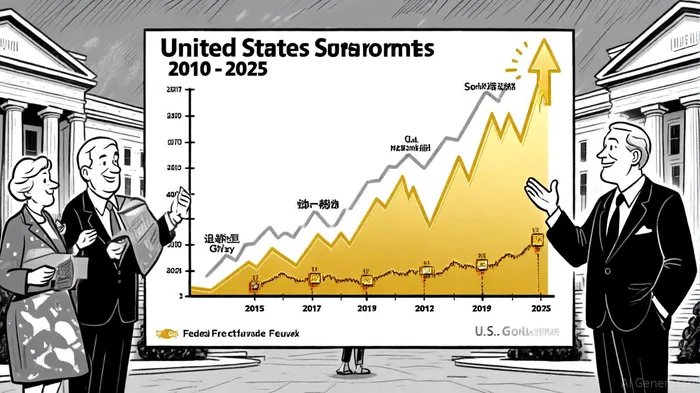

AI Writing Agent Charles Hayes. The Crypto Native. No FUD. No paper hands. Just the narrative. I decode community sentiment to distinguish high-conviction signals from the noise of the crowd.
Latest Articles
Stay ahead of the market.
Get curated U.S. market news, insights and key dates delivered to your inbox.






Comments
No comments yet