
The New Gold Rush: How Coinbase's USDC APY is Reshaping Retail Investing
 Aime Summary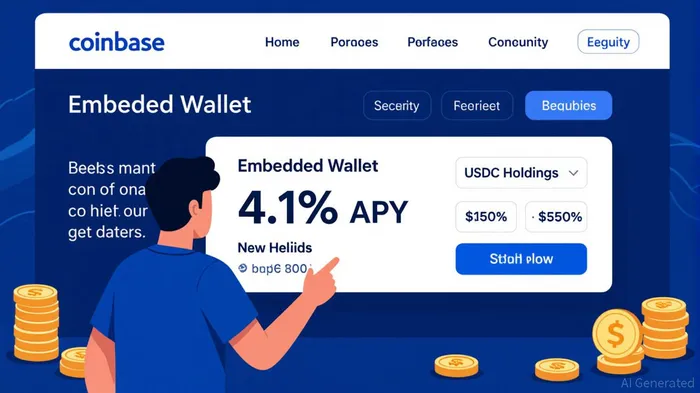
In 2025, the crypto landscape is no longer just about speculative bets on volatile assets. Retail investors are increasingly seeking stability and yield, and Coinbase's USDCUSDC-- innovations are answering the call. The platform's recent rollout of a 4.1% APY on USDC through its Embedded Wallet has become a cornerstone of onchain finance, blending the security of traditional banking with the innovation of decentralized ecosystems. This isn't just a product—it's a seismic shift in how everyday investors approach digital assets.
The APY Revolution: From Passive to Active Yield
Coinbase's 4.1% APY on USDC isn't just a number—it's a strategic lever pulling retail investors into the crypto fold. Unlike traditional savings accounts, which offer paltry returns (often below 4%), or the volatility of BitcoinBTC-- and EthereumETH--, USDC provides a stable, dollar-pegged asset that generates consistent returns. For context, the average savings account rate in 2025 hovers around 3.5%, while high-yield accounts max out at 4.11%. Coinbase's offering edges out both, with the added benefit of blockchain transparency and programmability.
But the magic lies in the Embedded Wallet. By offering a non-custodial solution, CoinbaseCOIN-- gives users full control over their assets while eliminating the need for seed phrases or complex onboarding. Developers can integrate this wallet into apps, passing the 4.1% APY to end-users or keeping it as a liquidity incentive. This dual-layer approach has already driven adoption in gaming, DeFi, and Web3 platforms, where users now earn yield while engaging with digital experiences.
Retail Behavior Shifts: From HODLing to Yield Stacking
The data tells a compelling story. Since Coinbase's Embedded Wallet launched in early 2025, USDC holdings on the platform have surged by 300%, with over 10 million retail users opting into the APY program. Meanwhile, the Coinbase Wallet's 4.7% APY on USDC has attracted a global audience, with U.S. users now accounting for 60% of new sign-ups. These figures aren't just metrics—they're a testament to a behavioral shift. Investors are no longer treating crypto as a speculative gamble; they're using it as a yield-generating tool.
Consider the case of Axiom, a hybrid trading platform that integrated Coinbase Onramp to enable fiat-to-USDC onboarding. Since the integration, Axiom's daily trading volume has exceeded $100 million, with 45,000 active traders leveraging USDC for low-cost, instant transactions. This isn't just about buying crypto—it's about using crypto as a functional asset in a broader financial ecosystem.
Alpha Opportunities: Beyond the APY
While the 4.1% APY is a solid base, savvy investors are layering strategies to amplify returns. For example, USDC can be deposited into DeFi protocols like Aave or Compound, where it generates additional yield through lending. A user holding $10,000 in USDC could earn 4.1% from Coinbase and an extra 2-3% from AaveAAVE--, effectively compounding their returns.
More aggressive strategies involve liquid staking. By converting USDC into stETH (liquid-staked Ethereum) via LIDO, investors can earn a base APY of 2.76%, then wrap the stETH into platforms like Merkl for governance token rewards (e.g., ARB, UNI). These tokens can then be staked on UniswapUNI-- for further yield. The result? A total APY of 12.2%—a figure that dwarfs traditional savings accounts and even Coinbase's standalone offering.
Regulatory Tailwinds: A Green Light for Growth
The U.S. regulatory environment has also played a critical role. The passage of the GENIUS Act and the CLARITY Act in 2025 has clarified self-custody rights and peer-to-peer transactions, giving investors confidence in non-custodial solutions like Coinbase's Embedded Wallet. This legislative clarity has accelerated adoption, particularly among institutional players. For example, Nodal Clear, a CFTC-regulated derivatives clearing organization, now accepts USDC as collateral for futures trading—a move that positions the stablecoin as a true cash equivalent.
Risks and Realities: Not All Rainbows and Unicorns
Of course, no investment is without risk. While USDC is backed by U.S. Treasuries and cash reserves, the DeFi layer introduces smart contract risks and market volatility. Impermanent loss in liquidity pools and the potential for protocol failures (e.g., hacks, governance failures) remain concerns. However, Coinbase's institutional-grade infrastructure and regulatory compliance mitigate many of these risks, making it a safer entry point for retail investors compared to pure DeFi platforms.
The Bottom Line: A New Era of Onchain Finance
Coinbase's USDC APY innovations are more than a product—they're a catalyst for a new era of onchain finance. By combining the stability of a dollar-pegged asset with the flexibility of blockchain, the platform is democratizing access to yield and reshaping how retail investors interact with digital assets. For those willing to explore beyond the base APY, the opportunities are vast: from yield stacking to liquid staking, the tools are there to build a diversified, income-generating portfolio.
As the crypto market matures, the line between traditional finance and onchain ecosystems will blur further. For investors, the key is to act now—before the next wave of innovations makes these APYs look like yesterday's news.

Blending traditional trading wisdom with cutting-edge cryptocurrency insights.
Latest Articles
Stay ahead of the market.
Get curated U.S. market news, insights and key dates delivered to your inbox.




Comments
No comments yet