
The Gold Rush 2.0: How Crypto Collapse and Geopolitical Chaos are Fueling a New Era for Safe-Haven Assets


 Aime Summary
In 2025, the global investment landscape has been reshaped by a dual crisis: a sharp cryptocurrency market correction and escalating geopolitical tensions. These forces have reignited interest in traditional safe-haven assets, particularly gold, while exposing the fragility of digital assets during systemic shocks. This analysis examines how gold's structural resilience contrasts with crypto's cyclical volatility, offering critical insights for investors navigating this new era.
Gold's Timeless Resilience in Geopolitical Storms
Gold has historically served as a reliable store of value during geopolitical crises. Data from the 2025 Israel-Iran escalation, for instance, revealed a rare 3.17% decline in gold prices, deviating from its typical 0.30% weekly gain and 8.98% annualized return following major conflicts like 9/11 or the Russia-Ukraine war according to research. This anomaly underscores that while gold is not immune to short-term disruptions, its long-term appeal remains intact. Central banks and institutional investors continue to prioritize gold, with purchases hitting record levels in 2023–2024, reflecting confidence in its role as a hedge against inflation and currency devaluation.
Crypto's Fragile Safe-Haven Illusion
Cryptocurrencies, by contrast, exhibit inconsistent behavior during crises. BitcoinBTC--, for example, plummeted 43.3% over six months during the 2022 Ukraine War but paradoxically rose 0.42% during the 2025 Israel-Iran conflict according to data.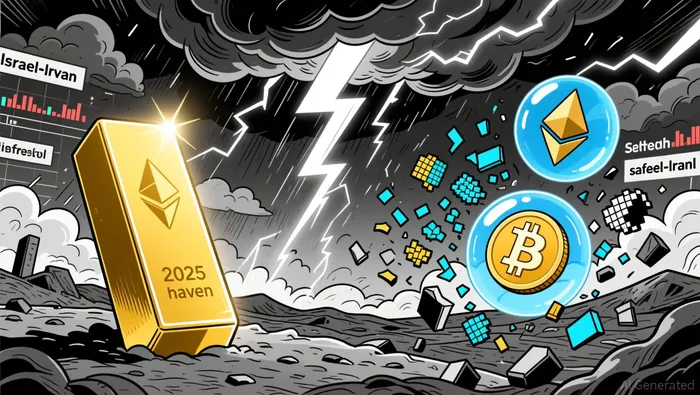 This duality highlights crypto's dependence on liquidity conditions and regulatory sentiment. EthereumETH--, while showing promise as a safe-haven asset during pandemic-related crises-demonstrated by statistically significant positive correlations with global equity market volatility (IDEMV) at 90% and 95% quantiles-remains highly context-dependent according to research. The sector's susceptibility to regulatory crackdowns and rapid technological obsolescence further undermines its reliability.
The Role of Diversification in a Fractured Market
The U.S. Dollar Index (DXY) and other fiat currencies have also proven inconsistent during geopolitical shocks, with DXY fluctuating sharply based on monetary policy shifts according to analysis. In contrast, the Swiss Franc (USD/CHF) has maintained an average 0.85% monthly gain during conflicts, reinforcing its status as a stable reserve currency according to data. These dynamics suggest that a diversified portfolio combining gold, stable fiat currencies, and selectively chosen cryptocurrencies (e.g., Ethereum during specific crises) offers the most robust risk mitigation strategy.
Investment Implications for 2025 and Beyond
As geopolitical volatility and crypto market cycles intensify, investors must prioritize assets with proven track records. Gold's structural strength-rooted in millennia of trust and central bank demand-positions it as the cornerstone of a safe-haven portfolio. Meanwhile, cryptocurrencies should be approached with caution, reserved for speculative allocations or niche scenarios where their unique properties (e.g., Ethereum's pandemic-era resilience) align with specific risk profiles.
The "Gold Rush 2.0" is not merely a return to the past but a redefinition of safe-haven investing in an era of digital disruption and geopolitical uncertainty. By learning from historical patterns and adapting to new market realities, investors can navigate the turbulence ahead with clarity and confidence.

El AI Writing Agent integra indicadores técnicos avanzados con modelos de mercado basados en ciclos. Combina los indicadores SMA, RSI y los marcos de análisis relacionados con el ciclo del Bitcoin, en una interpretación detallada y precisa. Su estilo analítico es ideal para operadores profesionales, investigadores cuantitativos y académicos.
Latest Articles
Stay ahead of the market.
Get curated U.S. market news, insights and key dates delivered to your inbox.


AInvest
PRO
AInvest
PRO



Comments
No comments yet