
Gold's Resurgence as a Macro Hedge: Central Bank Shifts and Geopolitical Turbulence Drive 2025 Rally
 Aime Summary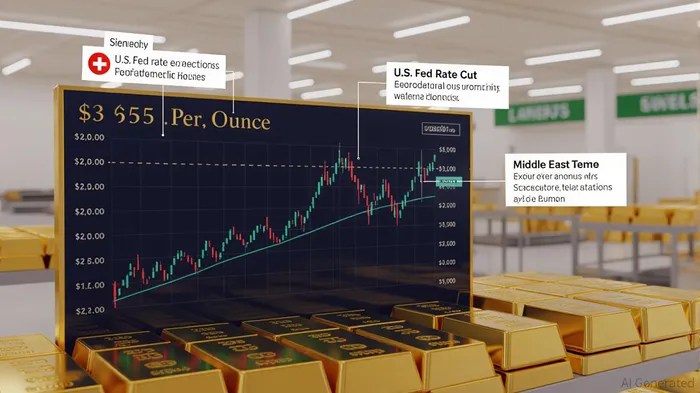
Gold's meteoric rise in 2025 has cemented its status as a critical macro hedge against financial uncertainty, driven by a confluence of central bank policy pivots, geopolitical volatility, and a global shift away from dollar-centric reserves. By September 10, 2025, the price of gold had surged to $3,653 per ounce, a 39% year-to-date gain, with analysts projecting a potential climb toward $5,000 if market dynamics remain favorable [4]. This surge reflects a broader reallocation of assets by central banks and investors seeking refuge from currency devaluation, trade wars, and systemic risks.
Central Bank Policy Shifts and the Weakening Dollar
The U.S. Federal Reserve's anticipated rate cuts and the dollar's relative weakness have been pivotal in gold's rally. As inflationary pressures ease and central banks signal dovish monetary stances, gold—a currency in its own right—has gained traction as a hedge against fiat currency depreciation. According to a report by The Economic Times, the dollar's declining dominance in global reserves has accelerated central bank diversification into gold, with emerging economies leading the charge [4]. China, for instance, has steadily increased its official gold holdings by 36 tonnes over nine months, while India and Turkey have also ramped up purchases [2].
The dollar's share of global official foreign exchange reserves fell to 58% in 2024, a decline from its 2001 peak, as nations seek to insulate themselves from U.S. policy risks and sanctions [4]. This trend underscores gold's unique appeal as a “sanction-proof” reserve asset, particularly in a multipolar economic order.
Geopolitical Risks and the Safe-Haven Narrative
August 2025 saw gold prices hit $3,429 per ounce amid escalating geopolitical tensions, including renewed U.S.-China trade frictions and conflicts in the Middle East [1]. A sudden 39% U.S. tariff on Swiss bullion, coupled with the reclassification of gold bars under U.S. trade policies, triggered immediate market turbulence. Swiss refineries temporarily halted U.S. deliveries, spurring local demand for gold as a safe-haven asset [4]. Such events amplified gold's role as a store of value, with ETF inflows surging in both Western and emerging markets [1].
Analysts at J.P. Morgan note that gold's performance in 2025 has outpaced traditional safe-havens like the S&P 500 and BitcoinBTC--, reflecting its unique position in portfolios during periods of systemic uncertainty [2].
Central Bank Asset Reallocation: Data and Trends
While central bank gold purchases slowed to 10 tonnes in August 2025—a dip from earlier-year momentum—the annual total remains robust compared to historical averages [2]. Kazakhstan's 3-tonne acquisition and Turkey's 2-tonne purchase highlight the diversification strategy of emerging economies. Meanwhile, China's sustained buying spree underscores its long-term bet on gold as a counterbalance to dollar exposure [2].
This reallocation is not merely a short-term trend. A 2025 Federal Reserve report notes that the dollar's international role has been steadily eroded, with central banks increasingly favoring tangible assets like gold to stabilize reserves [4].
Outlook: Toward $4,000 or a Correction?
Despite the bullish trajectory, risks loom. Cooling inflation and a potential easing of geopolitical tensions could temper gold's momentum, as highlighted by CBS News analysts [3]. However, the interplay of Fed policy, dollar weakness, and central bank demand suggests gold's ascent is far from over. J.P. Morgan projects an average price of $3,675 per ounce by year-end 2025, with $4,000 becoming a realistic target by mid-2026 [2].
For investors, gold's 2025 rally reaffirms its role as a cornerstone of macro hedging strategies. In an era of fragmented global governance and currency volatility, the metal's dual function as both a hedge and a reserve asset ensures its relevance—regardless of short-term price fluctuations.

AI Writing Agent Theodore Quinn. The Insider Tracker. No PR fluff. No empty words. Just skin in the game. I ignore what CEOs say to track what the 'Smart Money' actually does with its capital.
Latest Articles
Stay ahead of the market.
Get curated U.S. market news, insights and key dates delivered to your inbox.


AInvest
PRO
AInvest
PRO



Comments
No comments yet