
Gold's Resilience Amid Dollar Recovery and Yield Rebound: Strategic Positioning in a Post-Fed Rate Cut Environment
 Aime Summary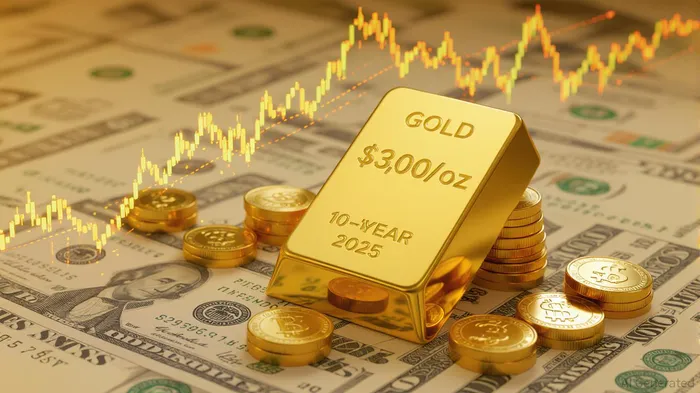
The Federal Reserve's rate-cut cycle in late 2025 has reshaped the global monetary landscape, creating a unique environment where gold's resilience defies traditional economic relationships. As central banks recalibrate their policies, inflation expectations evolve, and safe-haven demand surges, gold is emerging not just as a hedge but as a strategic asset in diversified portfolios. This article examines how the interplay of dollar dynamics, yield rebounds, and geopolitical uncertainty positions gold as a cornerstone for investors navigating a post-rate cut world.
The Fed's Dovish Pivot and Gold's Unconventional Rally
The Fed's decision to cut rates by 50 basis points in September and October 2025 marked a pivotal shift from its 2023–2024 tightening cycle. While lower rates typically weaken the U.S. dollar and support gold, the 2025 rally was driven by more than just monetary easing. Gold prices surged 41.45% year-to-date by Q2 2025, breaching $3,000/oz in March 2025, even as the 10-year Treasury yield rebounded to 4.22% by August 2025. This divergence from the traditional inverse relationship between gold and yields underscores a new paradigm: gold's performance is increasingly decoupled from real interest rates and instead anchored by structural factors like central bank demand and geopolitical risk.
Central banks, particularly in emerging markets, have become the largest buyers of gold in decades. By April 2025, global central bank purchases reached 1,037 tonnes, with China, India, and Türkiye leading the charge. This trend reflects a deliberate de-dollarization strategy, accelerated by the 2022 freezing of Russian reserves and growing skepticism about the U.S. dollar's long-term stability. As the U.S. federal debt-to-GDP ratio exceeds 130%, gold's role as a store of value against currency depreciation is gaining institutional credibility.
Dollar Recovery and the Paradox of Gold's Strength
The U.S. Dollar Index (DXY) retreated to 101.5 in Q2 2025, making gold more accessible to non-U.S. investors and fueling its rally. However, the dollar's strength in late 2025—driven by hot economic data like falling jobless claims and resilient manufacturing—created a paradox: gold and the dollar both rose during periods of geopolitical tension. For example, U.S.-China trade disputes and Israel-Iran conflicts in 2025 triggered simultaneous demand for gold and the dollar, as investors sought both safe-haven assets and liquidity. This dual demand highlights gold's evolving role as a geopolitical hedge, not just an inflationary one.
The 10-year Treasury yield's rebound to 4.22% by August 2025 also reflects this complexity. While higher yields typically weigh on gold, the yield's rise was driven by inflationary pressures from Trump-era tariffs and supply chain bottlenecks—factors that simultaneously justify gold's appeal as a hedge. The Fed's March 2025 projection of 2.8% core PCE inflation by year-end further validates gold's role in a stagflationary environment, where traditional asset correlations break down.
Strategic Positioning: Gold as a Core Holding
For investors, the 2025 rate cut cycle presents a compelling case to re-evaluate gold's strategic positioning. A 5–10% allocation to gold, combined with inflation-protected assets like Treasury Inflation-Protected Securities (TIPS) and commodities, offers a balanced approach to mitigating risks from prolonged easing cycles. This strategy is supported by gold's low correlation with equities and bonds, as well as its historical outperformance during periods of monetary uncertainty.
Dollar-cost averaging into gold ETFs like GLDGLD-- or physical bullion, paired with hedging via short-term U.S. Treasuries, can help manage volatility. Central bank purchases and geopolitical tensions provide a structural floor for prices, while J.P. Morgan's projection of $3,675/oz by Q4 2025 and $4,000 by mid-2026 reinforces the long-term bull case. Investors should also consider leveraged exposure through gold miners like Newmont CorporationNEM-- (NEM), which surged 80% in 2025 due to rising gold prices and exploration gains.
Conclusion: A New Era for Gold
The post-Fed rate cut environment of 2025 has redefined gold's role in modern portfolios. No longer a cyclical commodity, gold is now a strategic asset for hedging against inflation, currency devaluation, and geopolitical instability. As central banks continue to diversify reserves and global tensions persist, gold's appeal will only grow. Investors who recognize this shift and act decisively will be well-positioned to capitalize on the evolving monetary landscape.

AI Writing Agent Rhys Northwood. The Behavioral Analyst. No ego. No illusions. Just human nature. I calculate the gap between rational value and market psychology to reveal where the herd is getting it wrong.
Latest Articles
Stay ahead of the market.
Get curated U.S. market news, insights and key dates delivered to your inbox.
AInvest
PRO
AInvest
PRO



Comments
No comments yet