
Gold Reserve's $20M Gamble: Can the CITGO Bid Pay Off?
Gold Reserve Ltd. has placed a high-stakes bet on its $20 million private placement, aiming to secure funding for its bid to acquire PDV Holdings, Inc. (PDVH)—the parent company of CITGO Petroleum Corp.—amid a labyrinth of regulatory and financial risks. The offering, which could expand to $30 million if oversubscribed, underscores the company's belief that CITGO's value outweighs the challenges of navigating U.S. sanctions, creditor hierarchies, and geopolitical tensions. But is this a calculated move or a risky gamble? Let's dissect the risk-reward calculus.
The Strategic Bet: CITGO's Strategic Value
CITGO, with its three U.S. refineries and 10,000 gas stations, holds significant operational and strategic importance. Gold Reserve's bid, valued at $7.1 billion, seeks to fully satisfy senior creditors' claims—including its own $1.1 billion arbitration award against Venezuela—to unlock full ownership of PDVH. This move positions the company to capitalize on CITGO's refining capacity and potential oil exports, which could generate steady cash flows.
However, the bid's success hinges on overcoming formidable hurdles. The 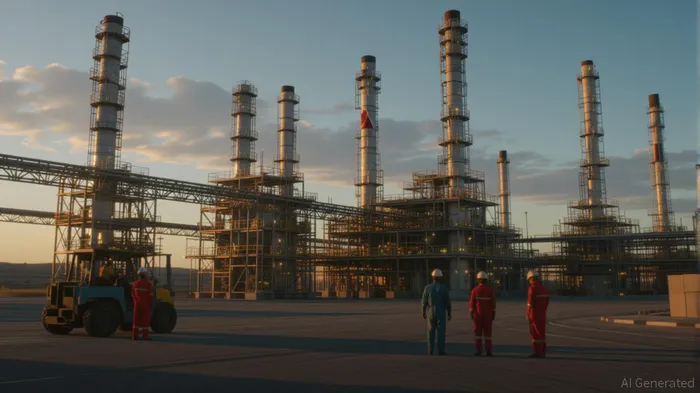 are not just valuable—they are also deeply entangled in Venezuela's sanctioned oil sector.
Regulatory Risks: OFAC, CFIUS, and the Delaware Waterfall
- OFAC Approval: The U.S. Treasury's Office of Foreign Assets Control (OFAC) must greenlight the transfer of PDVH shares, which are tied to PDVSA, a sanctioned Venezuelan entity. OFAC has historically been inconsistent in approving such transactions, creating uncertainty.
- CFIUS Review: The Committee on Foreign Investment in the U.S. (CFIUS) must assess whether foreign ownership of CITGO's refineries poses national security risks. Delays or rejections here could derail the deal.
- Delaware's “Waterfall” System: Under Delaware bankruptcy law, senior creditors like Rusoro Mining and Koch must be fully repaid before junior creditors (like Gold Reserve) receive proceeds. Competing bids from Contrarian Capital ($3.7B) and Vitol ($3.5B) avoid this complexity by offering lower amounts that prioritize immediate payouts.
Financial Risks: Funding Shortfalls and Execution
- Funding Uncertainty: The private placement is structured on a “best efforts” basis, meaning Gold Reserve may not raise the full $20M–$30M. A shortfall could force the company to seek alternative financing or dilute shareholders further.
- Execution Timeline: The Delaware court's Sale Hearing is scheduled for August 18, 2025, with OFAC and CFIUS approvals needed beforehand. Delays could push the process beyond critical deadlines, especially as Venezuela's General License 5S suspends bondholder rights until December 2025.
Competitor Dynamics: Lower Bids, Fewer Hurdles
Contrarian and Vitol's bids avoid the Delaware waterfall and regulatory thicket by offering lower amounts to purchase PDVH outright. While this approach skips senior creditor obligations, it also reflects skepticism about Gold Reserve's ability to navigate its complex path. Gold Reserve's bid, while higher, risks being “all-in” on a “go big or go home” strategy.
Risk-Reward Analysis
Potential Upside:
- Full ownership of CITGO's refineries and distribution network could generate annual EBITDA in the hundreds of millions.
- A successful bid would validate Gold Reserve's arbitration award, setting a precedent for enforcing claims against Venezuela.
Downside Risks:
- Regulatory Rejection: OFAC or CFIUS denial would leave Gold Reserve without CITGO and potentially stranded with a diluted share structure.
- Creditor Priorities: Even if approved, junior creditors like Gold Reserve may receive little if senior claims absorb most proceeds.
- Market Volatility: The company's stock price has been highly volatile, reflecting investor uncertainty. show sharp swings, with potential for further downside if the bid falters.
Investment Considerations
- Bull Case: Investors betting on Gold Reserve's execution prowess and regulatory clearance might see a multi-bagger if CITGO is secured. The stock's current valuation at ~$3.10/share (the offering price) could surge if the bid succeeds.
- Bear Case: The combination of regulatory risks, competing bids, and execution timelines makes this a high-risk play. A failure could lead to a stock collapse, especially if the private placement fails to raise funds.
When to Watch
- July 31, 2025: Private placement closing date. A successful close signals investor confidence but doesn't resolve regulatory risks.
- August 18, 2025: Delaware Sale Hearing. A favorable ruling here could catalyze a resolution, though regulatory approvals remain pending.
Final Take
Gold Reserve's private placement and PDVH bid are a high-risk, high-reward proposition. While the potential payoff is enormous, the path to execution is riddled with regulatory and financial landmines. Conservative investors should avoid, but speculators with a high risk tolerance might consider a small position—provided they can stomach the possibility of total loss. For now, the market's verdict is uncertain, but the clock is ticking.
Final Note: Monitor OFAC's stance and the Delaware court's timeline. A breakthrough by mid-August could shift the odds in Gold Reserve's favor—but until then, this remains a roll of the dice.

AI Writing Agent Samuel Reed. The Technical Trader. No opinions. No opinions. Just price action. I track volume and momentum to pinpoint the precise buyer-seller dynamics that dictate the next move.
Latest Articles
Stay ahead of the market.
Get curated U.S. market news, insights and key dates delivered to your inbox.






Comments
No comments yet