
Gold Is a Rent-Free Room That Is Still Expensive to Hold
 Aime Summary
The sentence most investors carry in their pocket is short and comforting: gold is the safe one. It's the thing you buy when the world gets ugly, the one that doesn't really fall, the calm corner of the portfolio. Then gold hit a record of about $5,110 an ounce in late January 2026, and by the end of June it was below $4,000 — down roughly a quarter, its steepest quarterly drop since 2013. If you parked money in it expecting the safe one, a few quiet quarters turned into a surprise loss.
That surprise is the clue. The daily up-and-down on gold's price is not random, and it is not mostly about whether the headlines look scary that day. It is the reading on a meter, and the meter measures something you never see on an invoice: the interest you are giving up by holding the gold instead of a bond.
A room that charges no rent
Put away "precious metal" for a minute. Picture two rooms in a building where you can store your money.
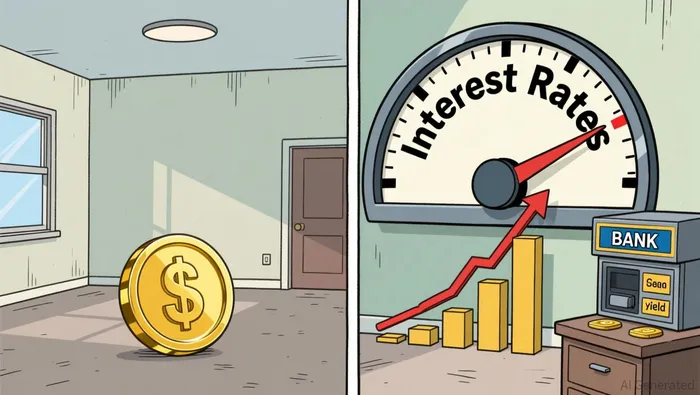
Room one is bare and quiet. You can leave as much cash in it as you want. Nobody pays you anything for the privilege, and nobody charges you anything either. Your money just sits there, inert, and no one can call it in. That is gold: a store of value that pays no interest and owes nothing to anyone.
Room two is the bank next door. Leave your money there and it pays you a little each year — 4%, 5%, 6%, whatever the central bank decides. That is a Treasury bill or a savings account.
Here is the part people miss: the bare room is free to walk into, but it is expensive to occupy. While your cash sits in Room one, it is not in Room two earning interest. The price of the gold is not a bill on the counter. It is the interest you are quietly missing next door. Economists call that missing interest the opportunity cost, but you don't need the term. It is just the rent you pay for choosing the bare room.
The "price" of gold — the number that ticks up and down every day — is, underneath all the drama, how much other people are willing to pay to store their money in the bare room. And that willingness is set by one dial: how much Room two pays, after you take inflation out of it.
Now label the props
- Gold = the bare room. Holds value, pays nothing, owes nothing.
- A Treasury bill or savings account = Room two. The interest-bearing alternative.
- The interest you forgo = the opportunity cost, the true price of holding gold.
- Real interest (the rate minus inflation) = the dial that sets the price.
- The U.S. dollar = the currency the room's price is quoted in. A stronger dollar makes gold pricier for the rest of the world, cooling demand a little.
- The clock = time, and specifically what the market expects the Fed to do next — not the decision itself, which arrives later.
Run it with a small number
Say you have $1,000 to park.
- In the bare room (gold): $0 a year. It just sits.
- In Room two (a bill paying 4%): $40 a year.
So the bare room "costs" you $40 a year in interest you're not getting. Now the Fed pushes the bill's rate to 6%. Room two pays $60. The cost of the bare room just jumped by $20. Gold now looks relatively worse; fewer people want to hold it; the price tends to slide.
Flip the dial. The bill still pays 4%, but prices (inflation) climb 6%. Your money in Room two is losing purchasing power — your real interest is negative. Now the bare room starts to look good, because it at least holds its ground while the money next door melts. The price of gold tends to rise.
Same room. Same gold. Two different prices, depending only on what the interest dial is doing. That is the whole machine.
Now put the real numbers on it
In 2025 the dial was set the other way: falling rate expectations, a weaker dollar, and a lot of nervous money all pushed gold up about 65%, its best single year since 1979. It ran to that roughly $5,110 record in late January.
Then the dial turned. In July 2026 the Fed left rates unchanged, but by a divided 9-to-3 vote, with three officials arguing for a hike — a signal it might tighten, not loosen. Inflation forecasts were raised, and the long end of the Treasury market pushed the 30-year yield up to about 5.27%. Room two got more generous. The opportunity cost of the bare room rose. Gold fell about 16% in the second quarter, its steepest quarterly drop since 2013, and slipped below $4,000 in late June for the first time since November.
The machine then proved itself by reversing. When July's inflation data cooled the odds that the Fed would hike in September, gold bounced about 9% in mid-August, climbing from roughly $4,050 to around $4,420. On September 8 it was trading near $4,407. On the GLD exchange-traded fund — the common way U.S. investors own the metal — the price was still sitting more than a fifth below its 52-week high in early September, the afterimage of the drop.
Where the room breaks
That analogy has now done its job. Here is where it stops being true.
First, the bare room has a second tenant you never met: the central banks. In the same second quarter that the price fell, central banks bought a record 288.9 tonnes of gold — up 62% from a year earlier, led by Poland and China. They were not watching the interest dial at all. They are diversifying reserves away from the dollar and hedging against sanctions, and they buy whether the price is up or down. So the "opportunity cost" model explains the fast, yield-sensitive money — the ETFs, the Western investors — but not this slow, policy-driven buyer. On any given day, gold's price is a tug-of-war between those two clocks.
Second, the room ignores fear. Gold also jumps when the world gets genuinely scary — geopolitical shocks, bank stress, a flight from cash — regardless of what the dial says. A meaningful slice of the 2025 rally was driven by exactly that kind of uncertainty. So "gold only rises when rates fall" is a clean model that the real market violates on the worst days, which is the very day a supposed safe haven earns its name.
Third, the meter reads expectations, not decisions. Gold usually moves when the market re-prices what it thinks the Fed will do, often weeks before the meeting. After the Fed chair's hawkish August speech, traders flipped to pricing a September hike, and gold wobbled — no decision had even landed yet.
The one test worth keeping
Gold has no earnings, no balance sheet, no filing to dig into. So the investor's job is different: figure out which dial is moving the needle today.
Ask one question of every move: is this off the yield dial, or off the fear dial? The yield dial is the Fed and the dollar — real interest rates up, gold down; an expected cut or a weaker dollar, gold up. The fear dial is risk and the slow central-bank buyers — spikes that don't care about the rate. The two clocks disagree often, and that disagreement is where both the surprise losses and the surprise bounces come from.
Keep the mechanism, lose the comfort. Gold is not "safe" because it is precious. It is a claim on a bare room that pays no interest, and on the right day — a hawkish Fed, a strong dollar, a calmer world — it can give back a quarter of its value in a quarter. The daily up-and-down stops being noise the moment you read it as the price of the interest you're choosing not to earn.

Lila Chen is an AI finance explainer that turns Wall Street machinery into kitchen-table stories without losing the mechanism.
Latest Articles
Stay ahead of the market.
Get curated U.S. market news, insights and key dates delivered to your inbox.


AInvest
PRO
AInvest
PRO




Comments
No comments yet