
Gold's Record Surge: A Fed Cuts-Driven 'Highest Conviction' Trade


 Aime Summary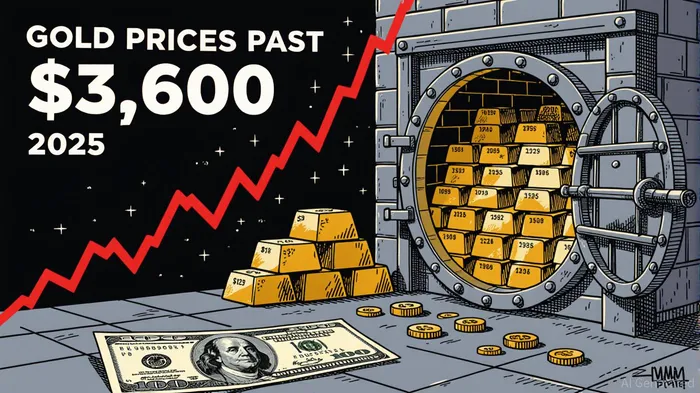
In the summer of 2025, gold has shattered all previous records, . This surge is not a fleeting anomaly but the result of a perfect storm of central bank easing, , and a global flight to . For investors, the question is no longer if gold will continue its ascent, but how high it can go—and whether the $5,000 level is a realistic, actionable target.
The Fed's Dovish Pivot: A Tailwind for Gold
The Federal Reserve's policy trajectory has been the linchpin of gold's meteoric rise. After months of hawkish posturing, the Fed's Q3 2025 —delaying rate cuts and signaling a “wait and see” approach—has created a vacuum of certainty. Traders now price in an , with further reductions expected by year-end. This dovish pivot has weakened the U.S. , making non-yielding assets like gold far more attractive.
The math is simple: lower rates erode the opportunity cost of holding gold. , investors are abandoning bonds and cash for tangible assets. The Fed's balance sheet normalization (via ) has also created a paradox—while liquidity withdrawal typically strengthens the dollar, the simultaneous erosion of trust in U.S. institutions and global reserve currencies has amplified demand for gold as a hedge.
Central Bank Demand: A Structural Floor
Gold's rise is not solely driven by speculative capital. Central banks have become its most powerful allies. In 2025, global monetary authorities purchased , a pace unseen since the 1980s. China, India, and Poland have led the charge, diversifying away from dollar-dominated reserves as the U.S. .
This institutional buying provides a structural floor for gold prices. Unlike retail-driven markets, central bank demand is strategic and long-term. For context, if just 1% of the $57 trillion U.S. Treasury market were reallocated into gold, the price would surge to —a scenario Goldman SachsGS-- has explicitly modeled under a Fed independence crisis.
Inflation and Geopolitical Uncertainty: The Double-Edged Sword
Inflation remains a critical tailwind. While headline U.S. , , driven by Trump-era tariffs and . Gold's historical role as an is reinforced by its inverse relationship with real interest rates. Meanwhile, —from Middle East conflicts to U.S.-China trade frictions—have pushed gold into the spotlight as a store of value.
Is $5,000 a Realistic Target?
The $5,000 level is no longer a fantasy—it's a plausible outcome under specific macroeconomic conditions. , but the $5,000 threshold hinges on a more extreme scenario: a . President Trump's legal battles with Fed Governor Lisa Cook and his public threats to “restructure” the central bank have already triggered a “.” If the Fed's credibility is further eroded, U.S. Treasurys could face a sell-off, accelerating into gold.
The math is stark: the gold market is valued at ~$12 trillion. A mere 1% shift from Treasurys to gold would push prices to . A 2% shift? . While the latter is speculative, the former is within reach if political pressures intensify.
Strategic Investment Implications
For investors, gold's current positioning demands a reevaluation of . Here's how to capitalize:
1. Physical Gold ETFs: SPDR Gold Shares (GLD) and iShares Gold Trust (IAU) offer direct exposure to gold price movements.
2. Gold Miners: Amplify gains with leveraged plays like Newmont CorporationNEM-- (NEM) or Barrick Gold (GOLD).
3. Dollar Short Positions: Pair gold with short USD positions via inverse dollar ETFs (e.g., UUP) to hedge against .
4. : Allocate 10–15% of portfolios to gold, especially as central banks continue to signal a “” of higher inflation and lower real rates.
Conclusion: A High-Conviction Trade in a Fractured World
Gold's record surge is not a bubble—it's a response to a fractured global financial system. The Fed's dovish pivot, central bank , and persistent inflation have created a multi-year . While $5,000 may seem audacious, it's a price point that reflects the growing distrust in and the Fed's ability to maintain its independence. For strategic investors, the time to act is now. Gold is no longer a speculative play; it's a cornerstone of .

Delivering real-time insights and analysis on emerging financial trends and market movements.
Latest Articles
Stay ahead of the market.
Get curated U.S. market news, insights and key dates delivered to your inbox.




Comments
No comments yet