
Gold's Record Rally: Fed Rate Cuts and the Case for Rebalancing Portfolios Now


 Aime Summary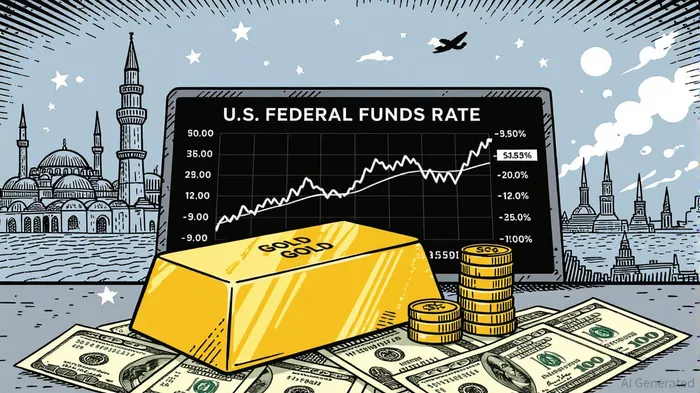
The year 2025 has witnessed an extraordinary surge in gold prices, with the precious metal breaching $3,527 per ounce—a level unseen in modern history. This rally is not a fleeting anomaly but a structural shift driven by a confluence of macroeconomic tailwinds. At the heart of this phenomenon lies the Federal Reserve's pivot toward rate cuts, a move that has fundamentally altered the risk-reward calculus for investors. For those seeking to rebalance portfolios in 2025, gold's role as a hedge against monetary policy shifts and geopolitical uncertainty has never been more compelling.
The Fed's Pivot: A Catalyst for Gold's Resurgence
The Federal Reserve's decision to cut interest rates in 2025 has been the primary driver of gold's meteoric rise. Historically, gold and interest rates move in inverse directions. When rates fall, the opportunity cost of holding non-yielding assets like gold diminishes, making the metal more attractive. The Fed's shift from a tightening to an easing cycle—marked by a target range of 4.25% to 4.50% held since December 2024—has created a perfect storm for gold.
By July 2025, gold had surged 34% year-to-date, with analysts revising forecasts upward from $2,756 in January to $3,220 by mid-year. The market now prices in a 75% probability of a September rate cut, with expectations for multiple cuts through 2026. This shift has not only reduced the cost of holding gold but also signaled a broader reevaluation of risk. Investors are increasingly allocating to gold as a buffer against potential inflationary pressures and policy errors, particularly as the Fed's dual mandate of price stability and maximum employment faces renewed challenges.
Dollar Weakness: A Tailwind for Global Demand
The U.S. dollar's decline has further amplified gold's appeal. Since January 2025, the dollar has fallen nearly 11%, driven by the return of Donald Trump to the White House and the implementation of new tariffs. A weaker dollar makes gold more affordable for international buyers, as the metal is priced in U.S. currency. This dynamic has been a critical tailwind for gold, with the dollar's inverse relationship to gold strengthening in 2025.
The dollar's weakness is also a reflection of narrowing interest rate differentials with other major economies. As the Fed cuts rates while central banks in Europe and Asia remain on hold, the dollar's relative value has eroded. This trend is expected to persist, providing additional support for gold prices. For investors, this means that gold's rally is not solely a function of U.S. policy but a global phenomenon driven by currency dynamics.
Central Bank Demand: A Structural Shift in Reserve Management
Central banks have played a pivotal role in gold's bull market. In 2025, global central bank gold purchases reached 900 tonnes, with China, Russia, and India leading the charge. The People's Bank of China, for instance, added gold for nine consecutive months through July 2025, signaling a strategic shift toward de-dollarization.
World Gold Council surveys reveal that 25% of central banks plan to increase gold holdings in the next year, with none anticipating reductions. This structural demand is not merely a short-term trend but a long-term reassessment of gold's role in global reserves. For investors, central bank buying provides a floor for gold prices, ensuring that even in periods of market volatility, the metal retains strong institutional support.
Geopolitical Uncertainty: Gold's Safe-Haven Premium
Geopolitical tensions have further reinforced gold's appeal. Conflicts in the Middle East, the Russia-Ukraine war, and rising U.S.-China tensions have created a risk premium that benefits gold. Investors are increasingly viewing the metal as essential portfolio insurance against unexpected global developments.
The perceived independence of the Federal Reserve has also come under scrutiny, with political interventions—such as attempts to remove Governor Lisa Cook—raising concerns about the central bank's autonomy. These uncertainties have prompted some investors to shift allocations to gold and other assets outside the traditional financial system.
Strategic Rebalancing: Why Gold Belongs in 2025 Portfolios
The case for rebalancing portfolios toward gold in 2025 is robust. The confluence of Fed rate cuts, dollar weakness, central bank demand, and geopolitical risks creates an unusually favorable environment for gold. Unlike previous cycles driven by a single factor, this rally is supported by multiple interlocking dynamics.
For investors, the key is to position for both the near-term and long-term. Gold's technical indicators—such as a relative strength index (RSI) suggesting consolidation—indicate potential short-term pauses, but fundamental support remains strong. Analysts project gold to trade between $3,600 and $3,900 in the near to medium term, with a potential test of $4,000 in 2026 if uncertainties persist.
Conclusion: A New Era for Gold
Gold's record rally in 2025 is not a speculative bubble but a response to profound macroeconomic and geopolitical shifts. The Fed's rate cuts have reduced the cost of holding gold, while dollar weakness and central bank demand have created a structural bull case. For investors, the time to act is now—rebalancing portfolios to include gold as a hedge against monetary policy shifts and global uncertainty is a strategic imperative. In a world of rising risks and diminishing yields, gold remains the ultimate store of value.

Delivering real-time insights and analysis on emerging financial trends and market movements.
Latest Articles
Stay ahead of the market.
Get curated U.S. market news, insights and key dates delivered to your inbox.


AInvest
PRO
AInvest
PRO



Comments
No comments yet