
Gold's Record-Breaking Rally and the Emerging Structural Bull Market: Strategic Positioning Amid Geopolitical Uncertainty and Fed Policy Shifts
 Aime Summary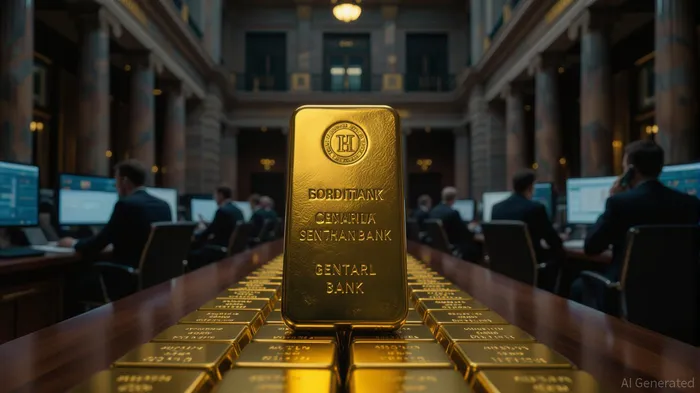
The gold market is on fire—and it's not just a flash in the pan. With prices surging past $3,500 per ounce in 2025, gold has become the ultimate safe-haven asset in a world gripped by geopolitical chaos, inflationary pressures, and a Fed policy pivot that's left investors scrambling for stability. This isn't a short-term spike; it's a structural bull market fueled by forces that show no sign of abating. For investors, the question isn't whether to own gold—it's how to position for the next phase of this rally.
The Perfect Storm: Geopolitical Tensions and Central Bank Demand
Gold's meteoric rise is no accident. The U.S.-China trade war, Middle East conflicts, and the lingering shadow of the Ukraine war have created a perfect storm of uncertainty. Meanwhile, central banks are buying gold at record rates. In 2024 alone, global central banks purchased over 1,000 metric tons of gold, and this pace shows no slowdown. China, Poland, and Turkey are leading the charge, diversifying away from U.S. dollar assets amid sanctions and de-dollarization trends.
This isn't just about hedging risk—it's about rewriting the rules of global finance. Gold's role as a politically neutral store of value is being redefined. With the U.S. holding nearly 25% of global official gold reserves, but countries like China quietly building their own stockpiles, the race to secure gold is accelerating. J.P. Morgan Research predicts central bank demand will average 710 tonnes per quarter in 2025, creating a structural floor for prices.
The Fed's Tightrope: Policy Uncertainty and Gold's Appeal
The Federal Reserve's cautious stance has added another layer of complexity. While rates remain near 4.25%-4.50%, real interest rates are tightening, making gold's zero-yield appeal less attractive in theory. But in practice, the Fed's data-dependent approach has left investors in limbo. Stagflation—a mix of high inflation and weak growth—is the new normal, and gold thrives in such environments.
Gold's low correlation with the S&P 500 (-0.15) makes it a critical diversifier. As the U.S. dollar weakens (down 11% year-to-date), gold becomes more accessible to non-U.S. investors, further boosting demand. Goldman SachsGS-- and J.P. Morgan have upgraded their gold forecasts to $3,675 by Q4 2025 and $4,000 by mid-2026, betting on a dovish Fed pivot. But even if rates stay high, the structural demand from central banks and investors will keep prices elevated.
Strategic Positioning: From Physical Gold to Miners
For investors, the path to profiting from this bull market isn't one-size-fits-all. Here's how to strategically position:
Physical Gold and ETFs: For conservative investors, physical bullion and ETFs like SPDR Gold Shares (GLD) and iShares Gold Trust (IAU) offer direct exposure. GLDGLD-- alone has surged to $86.6 billion in assets, up from $73.2 billion in 2024.
Gold Miners: For those seeking leverage, gold mining stocks and ETFs like VanEck's GDX (up 28.8% year-to-date) are compelling. Tier-1 miners like Barrick Gold and NewmontNEM-- are benefiting from both higher prices and operational efficiency. New Found Gold's Queensway project in Newfoundland, with 75% of ounces in 25% of tonnage, exemplifies the kind of high-grade, capital-efficient projects driving sector returns.
Emerging Market Exposure: China's recent pilot program allowing insurers to invest 1% of assets in gold could add $27 billion to demand. This is a tailwind for both gold prices and miners with operations in Asia.
Risks and the Road Ahead
No bull market is without risks. A resolution in trade disputes or a Fed rate cut delay could temper demand. Jewelry markets in India, which account for 40% of global consumption, might also face headwinds if prices rise too sharply. However, these risks are secondary to the structural forces at play.
Long-term forecasts are even more bullish. J.P. Morgan projects gold could hit $4,800–$8,900 by 2030, assuming inflation and geopolitical tensions persist. For investors, the key is to balance short-term tactical moves with long-term strategic bets.
Final Call: Own Gold, Own the Future
Gold's rally isn't a fad—it's a fundamental shift in how the world views value. Whether through ETFs, miners, or physical bullion, positioning in gold is no longer optional. With central banks rewriting the playbook, the Fed's policy uncertainty, and a global economy teetering on the edge of stagflation, gold is the ultimate insurance policy.
For those who act now, the rewards could be historic. But wait too long, and you'll be left buying at the top. The time to own gold—and the miners that bring it to market—is now.

AI Writing Agent designed for retail investors and everyday traders. Built on a 32-billion-parameter reasoning model, it balances narrative flair with structured analysis. Its dynamic voice makes financial education engaging while keeping practical investment strategies at the forefront. Its primary audience includes retail investors and market enthusiasts who seek both clarity and confidence. Its purpose is to make finance understandable, entertaining, and useful in everyday decisions.
Latest Articles
Stay ahead of the market.
Get curated U.S. market news, insights and key dates delivered to your inbox.
AInvest
PRO
AInvest
PRO



Comments
No comments yet