
Gold's Rate-Sensitive Rally: Positioning for a Fed-Driven Bull Market
 Aime Summary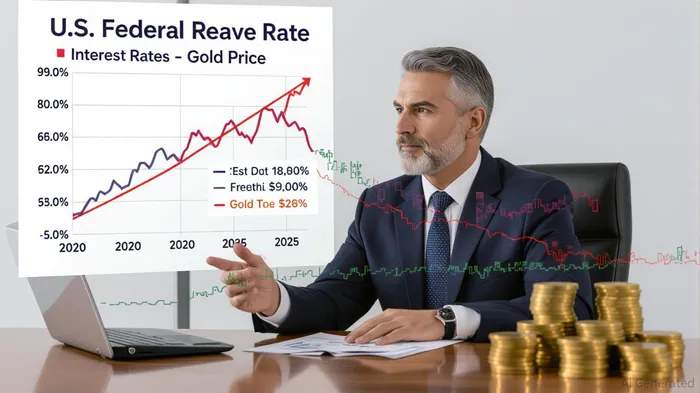
The U.S. Federal Reserve's monetary policy has long been a pivotal force shaping global financial markets. As of 2025, the prospect of rate cuts—driven by inflationary pressures, trade tensions, and geopolitical uncertainties—has rekindled interest in gold and junior mining equities as strategic assets. Historical patterns and economic fundamentals suggest that investors who position themselves in these sectors ahead of anticipated Fed easing cycles could capitalize on a bull market fueled by declining opportunity costs and improved project economics.
The Fed's Rate-Cut Cycle and Gold's Appeal
When the Federal Reserve signals rate cuts, the opportunity cost of holding non-yielding assets like gold diminishes. Lower interest rates reduce the returns on cash and bonds, prompting investors to reallocate capital into commodities and equities that offer inflation hedging and growth potential. Historical analysis from 2020 to 2025 underscores this dynamic: periods of Fed rate cuts coincided with sustained gold price increases, as reduced borrowing costs and accommodative monetary policy boosted demand for the metal .
For example, during the 2020-2021 easing cycle, gold prices surged from $1,500 to over $2,000 per ounce amid near-zero interest rates and quantitative easing. A similar pattern emerged in late 2024, with gold climbing to record highs as the Fed hinted at a 60% probability of at least one rate cut in the second half of 2025 . These trends highlight gold's role as a counterbalance to monetary policy-driven volatility.
Junior Mining Equities: Leverage to Rate Cuts
Junior mining companies, which often operate high-gold-content projects with limited cash reserves, are particularly sensitive to interest rate environments. Lower rates reduce their borrowing costs, improving project economics and enabling capital-intensive operations to become profitable. Historically, junior mining equities have outperformed gold prices during rate-cut cycles due to their higher leverage and volatility .
For instance, during the 2020-2021 period, junior gold miners like Alamos GoldAGI-- and Wheatstone Mining saw share prices rise by over 150% as Fed stimulus and rate cuts drove gold higher. This outperformance is likely to recur in 2025, as declining rates ease financing constraints and enhance the valuations of growth-oriented mining firms.
Strategic Allocation in a Fed-Driven Bull Market
Investors seeking to capitalize on the Fed's rate-cut trajectory should consider a dual strategy:
1. Physical Gold: Direct ownership of gold bullion or ETFs provides a tangible hedge against inflation and currency devaluation.
2. Junior Mining Equities: These offer amplified exposure to gold price movements, though with higher volatility. Diversifying across multiple junior miners can mitigate company-specific risks.
The FOMC's 60% probability of a rate cut in H2 2025 suggests that the window for positioning is narrowing. However, the broader macroeconomic context—marked by trade fragmentation and policy uncertainty—further supports the case for gold and mining equities as defensive and growth-oriented assets.
Conclusion
The interplay between Fed policy and gold markets remains a cornerstone of strategic asset allocation. As rate cuts loom on the horizon, investors who align their portfolios with the historical tendencies of gold and junior mining equities may find themselves well-positioned to navigate a Fed-driven bull market. The key lies in balancing the stability of physical gold with the growth potential of leveraged equities, all while staying attuned to the evolving signals from the Federal Reserve.

El software de escribiente de IA se basa en un marco de inferencia de 32 billones de parámetros, que examina cómo las cadenas de suministro y las corrientes comerciales forman los mercados mundiales. Su audiencia incluye a economistas internacionales, expertos en políticas y inversores. Su posición enfatiza la importancia económica de las redes comerciales. Su propósito es enfatizar las cadenas de suministro como un factor determinante de resultados financieros.
Latest Articles
Stay ahead of the market.
Get curated U.S. market news, insights and key dates delivered to your inbox.




Comments
No comments yet