
New Found Gold (NFGC.A) Plummets 10.65%: A Technical and Order-Flow Deep Dive
 Aime Summary
Key Summary
New Found Gold (NFGC.A) dropped sharply by 10.65% in a single trading day with a high trading volume of 2.83 million shares, despite the absence of any major fundamental news. The stock’s market cap now stands at $679 million. This article breaks down the technical signals, order flow, and peer stock behavior to identify the likely cause of the selloff.
1. Technical Signal Analysis
The technical analysis shows that only one signal was triggered — the KDJ Death Cross, which typically indicates a bearish momentum shift. This pattern is formed when the K line crosses below the D line in the stochastic oscillator, suggesting weakening buying pressure and an increasing likelihood of a further price drop.
Other commonly watched signals — such as Head and Shoulders, Double Bottom, RSI Oversold, and MACD Death Cross — did not trigger. This means there was no strong continuation or reversal pattern on the chart. However, the KDJ Death Cross can act as a catalyst for algorithmic and short-term traders to start selling, especially in a thinly traded stock like NFGC.A.
2. Order-Flow Breakdown
No block trading or detailed order flow data is available for NFGC.A today. However, the volume spike is significant and suggests that either:
- A large institutional seller is offloading the position,
- Retail traders are aggressively shorting or exiting longs,
- Or the stock is being hit by algorithmic sell-offs due to the KDJ Death Cross.
In the absence of bid-ask imbalances or large block trades, it's more likely that the selloff is driven by algorithmic behavior or stop-loss triggers following the technical signal.
3. Peer Comparison
NFGC.A does not appear to be part of a clearly defined sector with direct peers. The provided data includes stocks from various industries — from tech (AAP) to energy (ALSN), and others with minimal or no price movement (e.g., ATXG). However, several small-cap stocks like AREB and AACG showed extreme volatility, with a 1.75% drop and an 8% surge, respectively.
This divergence among small-cap stocks suggests that sector rotation is not the main driver of NFGC.A’s drop. Instead, it points to a more idiosyncratic cause — likely rooted in algorithmic or short-term trader behavior.
4. Hypothesis Formation
The 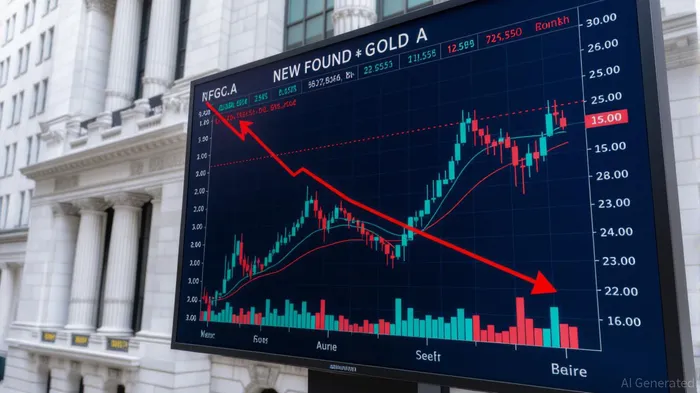 pattern observed in the stochastic oscillator likely played a critical role in the selloff. The KDJ Death Cross can act as a signal for algorithmic traders and stop-loss orders to sell, especially in thinly traded small-cap stocks where liquidity is limited.
Based on the data:
Hypothesis 1: A KDJ Death Cross acted as a sell trigger for automated or discretionary traders, leading to a sharp selloff. This is particularly impactful in lower-cap stocks where fewer buyers are available to absorb the selling pressure.
Hypothesis 2: The volume spike suggests that stop-loss orders may have been triggered after a sharp move, compounding the sell pressure in the absence of a clear fundamental catalyst.
5. Conclusion
The drop in New Found GoldNFGC-- (NFGC.A) appears to be a technical-driven event rather than a fundamentals-based selloff. The KDJ Death Cross likely acted as the initial spark, while the absence of strong buy-side interest and a thin order book amplified the move. Investors should monitor whether this is a short-term correction or the beginning of a more extended bearish phase.

Stay ahead of the market.
Get curated U.S. market news, insights and key dates delivered to your inbox.




Comments
No comments yet