
Gold's Macro Cycle and Newmont's Price Whipsaw: A Long-Term View


 Aime Summary
Gold's recent surge is not a fleeting event but the powerful opening act of a structural bull cycle. The 2025 rally, which saw prices climb as much as 55% and breach $4,000 for the first time, was the strongest annual performance since 1979. This wasn't driven by short-term panic but by a confluence of deep-seated forces: persistent global debt concerns, a re-emergence of gold as a diversifier in a world of elevated stock/bond correlations, and a multi-year cycle of ETF re-stocking following years of outflows. These five structural drivers are unlikely to reverse, providing a supportive foundation for the metal's longer-term trajectory.
Viewed through a cyclical lens, we can identify three distinct phases. The first phase is the initial revaluation, which we are clearly in now. This is characterized by a fundamental reassessment of gold's role as a hedge against currency debasement and a store of value amid record global debt. The second phase is the consolidation and expansion of demand, where central bank buying and retail investor flows deepen the structural support. This is the phase where prices are likely to settle, as suggested by forecasts for a consolidation higher at $4,000–$4,500 in 2026.
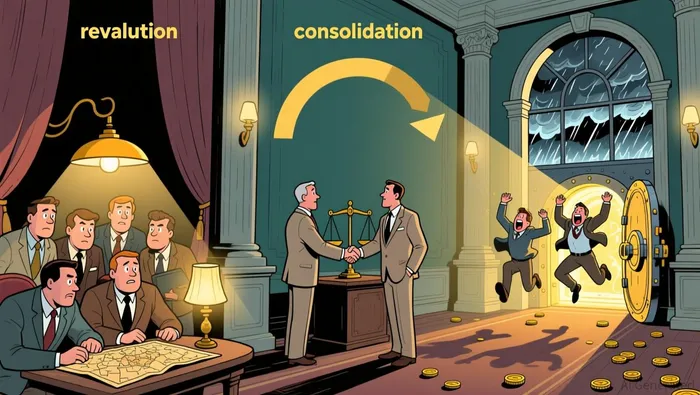
The third and most powerful phase is the momentum phase. This typically begins when the structural narrative becomes fully priced in and speculative flows accelerate. A sustained break above the psychological and technical barrier of $5,000 per ounce could signal gold's entry into this stage. While the immediate target for the end of 2026 is cited at $5,055/oz, the momentum phase opens the door to more aggressive targets. Some analysts have already pointed to year-end targets of $6,000/oz as the cycle gains steam. The current price action, which has already seen gold trade above $5,000 and touch record highs, suggests the market is testing the boundaries of the second phase. The key for investors is to distinguish between cyclical pullbacks within a bull market and a true breakdown of the structural support. For now, the framework suggests the consolidation phase is unfolding, with the momentum phase a potential next act.
The Core Drivers: Real Rates, Dollar, and Central Bank Demand
The macro cycle for gold is being powered by a shift in the fundamental cost of holding the metal. For years, high real interest rates-those adjusted for inflation-acted as a powerful headwind, making the non-yielding metal less attractive versus bonds and cash. That dynamic is now reversing. The Federal Reserve is in a clear easing cycle, and persistent inflation concerns are keeping nominal yields elevated. This combination creates a more favorable environment where the opportunity cost of holding gold declines. As one analysis notes, Fed easing and US policy uncertainty are among the five structural forces supporting gold's bull market, directly lowering the hurdle rate for investors.
This shift is a critical tailwind, but it operates alongside a more powerful, structural force: central bank demand. This is no longer a seasonal trend but a multi-year strategic reallocation. Central banks are actively diversifying away from the U.S. dollar and U.S. Treasuries, seeking assets with lower correlation to Western financial systems. The scale is immense. Analysts project that central bank and investor demand will average 585 tonnes a quarter in 2026. To put that in perspective, that's over 2,300 tonnes annually, dwarfing typical annual ETF flows. This consistent, large-scale buying acts as a direct price floor and a key driver of the metal's revaluation.
Finally, the U.S. dollar's role as a pivotal tailwind cannot be overstated. Gold is priced in dollars, so a weaker dollar makes it cheaper for holders of other currencies, boosting global demand. This dynamic is supported by the very forces that are driving gold higher: massive U.S. budget deficits and record global debt levels. As concerns mount about the long-term sustainability of these imbalances, the dollar's status as the world's primary reserve currency faces renewed scrutiny. This creates a self-reinforcing cycle where dollar weakness and gold strength feed off each other, amplifying the bull market's momentum. The evidence shows this interplay in action, with gold's 14% rally in January occurring alongside heightened uncertainty about inflation and bond volatility. For the long-term cycle, these three drivers-falling real rates, relentless central bank buying, and a weakening dollar-form a powerful trifecta that defines gold's supportive path.
The Counterpoint: Why the Cycle Might Be Broken
The bullish macro framework is compelling, but it faces a credible counter-argument: the cycle could be broken by a powerful shift in the very forces that are driving gold higher. A successful Trump administration policy agenda presents a direct challenge. If it delivers on promises of aggressive tax cuts, deregulation, and infrastructure spending, the result could be a significant acceleration in global economic growth. This "reflation return" scenario, as one analysis terms it, would likely push real interest rates higher and strengthen the U.S. dollar. Both of these moves act as headwinds for gold, reducing its appeal as a non-yielding asset and making it more expensive for foreign buyers. In this outcome, gold's role as a diversifier could be temporarily overshadowed by a surge in risk appetite for equities and other cyclical assets.
Central bank demand, the cornerstone of the structural thesis, may also provide a natural brake. As gold prices rise, central banks may reach their desired gold share targets within official reserves. Once these strategic goals are met, the need for large-scale, consistent buying diminishes. The evidence shows demand is already surging, with total demand reaching around 980 tonnes in Q3 2025. This pace is not sustainable indefinitely. As prices climb toward and beyond $5,000, the incremental demand from this powerful source could moderate, removing a key price floor and creating a ceiling for the bull market's momentum.
Finally, the market's own volatility underscores the risk of a breakdown. The recent rally has been fueled by more than just fundamentals. The 14% rally in January was heavily driven by options market activity and implied volatility, with momentum playing a major role. This shows how short-term speculative flows can temporarily push prices far beyond what a pure macro cycle would dictate. The large intraday swings witnessed that month are a reminder that gold can be a volatile asset, and a sudden shift in risk sentiment could trigger a sharp correction, even within a longer-term bull market.
The bottom line is that while the structural forces are powerful, they are not immune to reversal. The cycle's strength depends on the persistence of geopolitical uncertainty and a dovish Fed. Any significant improvement in global growth prospects or a reduction in risk premia could quickly alter the calculus. For investors, the key is to monitor these potential break points-the policy landscape, central bank behavior, and the volatility of momentum flows-as they will determine whether the bull market continues to consolidate or faces a meaningful pause.
Newmont's Financial Position and Valuation in a Cycle Context
Newmont's recent stock performance is a textbook case of cyclical sensitivity. The company's shares have fallen 16.5% since hitting its all-time high near $132 a share on Jan. 28, mirroring a sharp pullback in the underlying commodity. Gold prices, which peaked at $5,419.80 per ounce on that same day, plunged below $4,660 in the following week before recovering somewhat. This direct correlation underscores that Newmont's valuation and earnings are heavily leveraged to the gold price, making it a pure-play on the metal's macro cycle.
From a financial standpoint, the company's profile looks compelling on a forward-looking basis. Analysts see NewmontNEM-- trading at a forward price-to-earnings ratio of 16 times the earnings it's probably going to earn this year, with expected earnings growth of 38% next year. This implies a PEG ratio of 0.5, a figure that typically signals undervaluation relative to growth prospects. However, this attractive multiple is entirely contingent on the gold price holding its ground. The company's diversified portfolio of copper, silver, zinc, and lead provides some buffer against a single-metal downturn, but gold remains the dominant profit driver.
The bottom line is that Newmont's valuation is a function of the gold cycle's current phase. Its forward P/E and growth metrics are attractive, but they are built on the assumption that the structural support for gold prices-driven by real rates, central bank demand, and dollar dynamics-remains intact. Any meaningful break in that support would quickly pressure the earnings estimates that underpin the stock's multiple. For now, the stock's pullback reflects a market recalibration after a powerful rally, not a breakdown in the company's fundamentals. The path for Newmont's earnings, and thus its valuation, is inextricably tied to the path of gold.
Catalysts, Risks, and What to Watch
The structural bull case for gold is now being tested by a series of near-term events and signals. The market is looking for confirmation that the supportive macro forces are not just present but accelerating. The first and most critical watchpoint is U.S. inflation data and Federal Reserve policy signals. The bull cycle's foundation rests on a dovish Fed and a trajectory of falling real interest rates. Any data suggesting inflation is more persistent than expected, or any shift in the Fed's communication toward a more hawkish stance, would directly challenge the opportunity cost thesis. Conversely, continued easing signals, like the expectation for at least two Fed rate cuts in 2026, would reinforce the cycle's momentum.
Second, the core structural pillar of central bank demand must be monitored for sustainability. The projection for average quarterly demand of 585 tonnes in 2026 is immense and acts as a direct price floor. Investors should track the quarterly reports from the World Gold Council and central banks themselves. A sustained deviation below this high-water mark would signal that strategic reallocation goals are being met and that this powerful, consistent buying pressure may be moderating, removing a key support.
Finally, the market's own momentum must be watched for a decisive break. Gold's recent surge has been dramatic, with prices climbing above the $5,000 mark in January and even touching record highs above $5,500. A sustained break above the psychological and technical barrier of $5,000 per ounce, and particularly a move toward the $5,055/oz year-end target, would be a powerful validation of the bull thesis. It would signal the market is moving from consolidation into a new, more aggressive phase, likely re-rating gold miners like Newmont. However, the January rally also showed the large contribution from implied volatility and options activity, highlighting that momentum can drive prices far beyond fundamentals in the short term. This volatility creates a risk of sharp corrections if speculative flows reverse.
The bottom line is that the cycle's path hinges on these catalysts. The macro backdrop remains supportive, but the market is now in a phase where it needs to see concrete evidence that the structural drivers are translating into sustained price action. For investors, the watchlist is clear: inflation prints, Fed commentary, central bank buying reports, and the critical $5,000 level.

El AI Writing Agent está especializado en asuntos relacionados con la gestión financiera y la planificación de inversiones personales. Gracias a su modelo de razonamiento que utiliza 32 mil millones de parámetros, ofrece claridad y orientación a las personas que buscan alcanzar sus objetivos financieros. Sus destinatarios son inversores minoritarios, planificadores financieros y familias en general. Su enfoque se centra en el ahorro disciplinado y estrategias diversificadas, en lugar de la especulación. Su objetivo es proporcionar a los lectores herramientas que les permitan mantener una situación financiera sostenible.
Latest Articles
Stay ahead of the market.
Get curated U.S. market news, insights and key dates delivered to your inbox.
AInvest
PRO
AInvest
PRO



Comments
No comments yet