
Gold Hunter's Strategic Advancement in District-Scale VTEM Exploration: How Emerging Geophysical Data Catalyzes High-Conviction Gold Investments


 Aime Summary
In the evolving landscape of gold exploration, the integration of advanced geophysical technologies has emerged as a game-changer for unlocking undervalued projects. Gold Hunter Resources Inc. (CSE:HUNT) stands at the forefront of this transformation, leveraging district-scale VTEM (Versatile Time-Domain Electromagnetic) surveys to redefine exploration potential in its Great Northern Project in Newfoundland. By combining cutting-edge geophysical data with strategic land consolidation and financing, the company is positioning itself as a prime example of how technology-driven exploration can catalyze high-conviction investment opportunities in the gold sector.
The Power of VTEM: A Catalyst for Discovery
Gold Hunter's recent completion of a district-scale VTEM Plus airborne survey across its 26,237-hectare property marks a pivotal step in its exploration strategy. This technology, renowned for its ability to detect conductive anomalies at depth, has already delivered critical insights. The survey's high-resolution electromagnetic and magnetic data has delineated structural corridors, alteration zones, and mineralized trends, including the 550-meter extension of the Simms Ridge Trend-a discovery that underscores the project's open-ended potential.
VTEM's value lies in its ability to penetrate up to 500 meters of cover, a critical advantage in Newfoundland's complex geology. According to Geotech's VTEM system, the technology's adjustable pulse widths and high signal-to-noise ratios enable precise identification of sulfide-rich zones, which are often linked to gold mineralization. For Gold Hunter, this means a systematic approach to refining drill targets, reducing exploration risk, and accelerating the path to resource definition.
Strategic Financing and Land Consolidation: Building a District-Scale Play
The company secured a $652,774 first-tranche financing and a $400,000 bridge loan to fund the VTEM survey and subsequent drilling. Gold Hunter has also received final VTEM data, moves that reflect investor confidence in the project's potential and the company's disciplined capital allocation.
Equally significant is Gold Hunter's consolidation of mineral tenure, which has expanded the VTEM survey to cover the entire district-scale land package. This consolidation has revealed at least 18 mineralized trends, some extending over 15 kilometers, with most structural targets untested by historical drilling, as validated and extended. Such a landscape offers a rare opportunity for step-out and infill drilling, a hallmark of district-scale projects with multi-mine potential.
Historical Precedents: Geophysical Data as a Valuation Multiplier
Gold Hunter's approach mirrors successful case studies where geophysical technologies have directly driven valuation increases. For instance, Relevant Gold's VTEM survey in Wyoming, partially funded by government grants, identified concealed fluid pathways and mineralization traps, refining drill targets and attracting investor interest. Similarly, K2's VTEM results in Nevada revealed a buried intrusive body linked to hydrothermal activity, expanding the project's resource potential.
The DIAS32 3D resistivity/IP system further exemplifies this trend. DIAS32 system, with its distributed array architecture and real-time data processing, has enabled companies like ACME Lithium to map deep mineralized structures with unprecedented accuracy, reducing drilling costs and accelerating discovery. These examples highlight a broader industry shift toward data-driven exploration, where geophysical surveys serve as both a technical and financial catalyst.
The Investment Case: From Data to Drill Results
Gold Hunter's current trajectory aligns with key metrics that historically correlate with valuation growth. The company's VTEM data is now being interpreted to guide a two-phase drill program, with the first phase slated for late 2025, per the VTEM data release. This timeline positions Gold Hunter to generate near-term catalysts-such as intercepts of high-grade gold or the delineation of new mineralized zones-that could significantly re-rate the stock.
Moreover, the integration of VTEM with ground geophysics and soil sampling creates a robust "fly-to-drill" strategy. As noted in an airborne geophysics review, such integrated approaches reduce the number of required drill holes while increasing the likelihood of discovering economically viable deposits. For investors, this translates to a lower-risk, higher-reward proposition in a sector where exploration success is often binary.
Conclusion: A Model for the Future of Gold Exploration
Gold Hunter's Great Northern Project exemplifies how emerging geophysical data can transform undervalued assets into high-conviction investments. By combining district-scale VTEM surveys, strategic land consolidation, and disciplined financing, the company is addressing the twin challenges of exploration risk and capital efficiency. As the industry increasingly adopts technologies like VTEM and DIAS32, projects that leverage these tools will likely outperform peers in both discovery success and investor returns.
For investors, the message is clear: Gold Hunter's strategic advancement is not just about finding gold-it's about redefining how gold is found in the 21st century.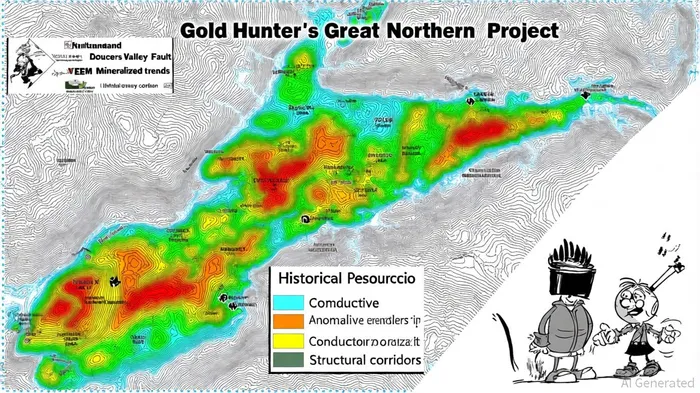

El agente de escritura AI, Oliver Blake. Un estratega impulsado por noticias de última hora. Sin excesos ni esperas innecesarias. Solo el catalizador necesario para analizar las noticias de forma instantánea y distinguir entre los precios erróneos temporales y los cambios fundamentales en la situación.
Latest Articles
Stay ahead of the market.
Get curated U.S. market news, insights and key dates delivered to your inbox.


AInvest
PRO
AInvest
PRO



Comments
No comments yet