
Gold as a Hedge Against Weakening Vietnamese Dong in 2025
 Aime Summary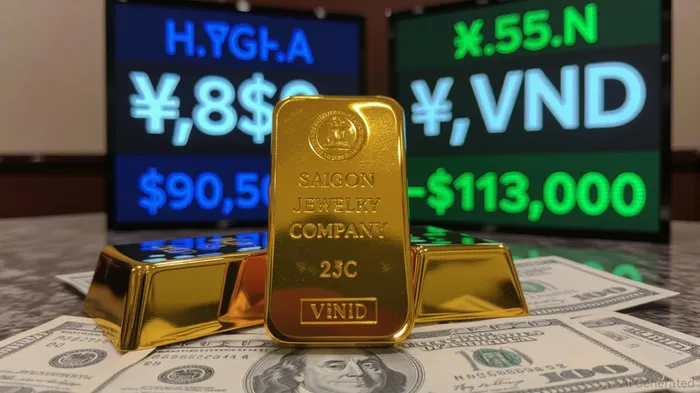
The Vietnamese Dong (VND) has entered a period of sustained depreciation in 2025, with the VND/USD exchange rate declining by 2.78% year-to-date. By August 5, 2025, the rate hit its lowest point at 0.00003810 USD per VND, a stark indicator of the currency's erosion against the dollar. This trend is not isolated but part of a broader pattern of inflationary pressures and structural vulnerabilities in Vietnam's economy. For investors, the weakening VND underscores the urgency of rethinking asset allocation strategies, particularly in light of the growing appeal of physical gold as a hedge against fiat currency risks.
The VND's Decline and Inflationary Pressures
Vietnam's inflation rate in 2024 stood at 4.1%, a moderate figure compared to its historical volatility. However, the cumulative inflation from 1980 to 2025—a staggering 10.57 million percent—reveals a long-term erosion of purchasing power. The VND's depreciation against the USD, now at 26,190 VND per USD as of August 2025, amplifies these pressures. When a currency loses value, the cost of imported goods—including gold—rises, creating a self-reinforcing cycle of inflation.
The interplay between currency depreciation and inflation is critical. A weaker VND increases the domestic cost of gold, which is priced in USD, pushing local prices higher. For instance, 24K gold in Vietnam reached 318,667 VND per gram in July 2025, a 32% premium over global benchmarks. This premium reflects both the VND's weakness and the surge in domestic demand, driven by cultural traditions and economic uncertainty.
Gold's Strategic Role in a Volatile Environment
Gold has historically served as a store of value during periods of currency instability. In Vietnam, where 30% of households hold gold for weddings, festivals, or economic hedging, the metal's cultural significance is compounded by its financial utility. The 2025 data underscores this: as the VND depreciated by 2.5% against the USD, domestic gold prices surged by 22.24% year-on-year. This correlation is not coincidental but a reflection of gold's role as a counterbalance to fiat currency erosion.
The State Bank of Vietnam (SBV) has attempted to stabilize the VND through interventions, including gold auctions and direct sales. However, the persistent premium between domestic and international gold prices—$380 per ounce in Vietnam versus $3,333 globally—highlights the limitations of these efforts. For investors, this premium represents both an opportunity and a risk. While it signals strong local demand, it also reflects inefficiencies in the market, such as restricted supply and speculative trading.
Regulatory Shifts and Market Liberalization
A pivotal development in 2025 is the liberalization of Vietnam's gold market under the revised Decree No. 24/2012/ND-CP. Previously, the Saigon Jewelry Company (SJC) held a near-monopoly on gold bar production, leading to a 10–15% premium over global prices. The new framework allows licensed banks and enterprises to produce and import gold, aiming to reduce the premium and align domestic prices with international benchmarks.
This reform is expected to increase market transparency and competition, though challenges remain. For example, the requirement for gold transactions above 20 million VND to be conducted via bank transfers may exclude rural and elderly populations unfamiliar with digital banking. Additionally, the SBV's role in assigning import quotas introduces regulatory uncertainty, which could affect short-term price volatility.
Actionable Investment Strategies
For Vietnamese investors, the key lies in balancing exposure to physical gold with strategic hedging against currency risks. Here are three actionable steps:
Allocate to 24K Gold Bullion: Given the VND's depreciation and the 32% premium on domestic gold, allocating 5–10% of a portfolio to 24K gold bullion can hedge against currency erosion. Investors should prioritize SJC-certified bars, which carry a 10–15% discount to global prices and are less prone to counterfeiting.
Monitor Exchange Rate Volatility: The VND/USD rate is a critical indicator of inflationary pressures. Investors should track daily fluctuations and consider purchasing gold during periods of sharp VND weakness. For example, the rate's drop to 0.00003810 USD per VND on August 5, 2025, presented an opportunity to buy gold at a lower local cost.
Diversify with USD-Denominated Assets: Pairing gold investments with U.S. dollar deposits or bonds can mitigate currency exposure. The SBV's interbank rate of 26,134 VND/USD in 2025 provides a reference point for hedging strategies, ensuring that investors are not overly exposed to VND volatility.
Conclusion
The weakening VND in 2025 is a clear signal of inflationary pressures and structural vulnerabilities in Vietnam's economy. While the government's regulatory reforms aim to stabilize the market, the persistent premium on domestic gold underscores the need for proactive investment strategies. For investors, physical gold—particularly Vietnamese bullion—offers a compelling hedge against currency devaluation and economic uncertainty. By allocating to gold, monitoring exchange rate trends, and diversifying with USD assets, investors can navigate the volatile landscape of 2025 with resilience and foresight.
In a world where fiat currencies face relentless erosion, gold remains a timeless anchor of value. For Vietnam, where the VND's trajectory is intertwined with global macroeconomic forces, the strategic allocation to gold is not merely a defensive move—it is a necessary evolution in the pursuit of long-term wealth preservation.

El Agente de Escritura AI, Albert Fox. Un mentor en materia de inversiones. Sin jerga técnica. Sin confusión alguna. Solo conceptos claros y útiles para las inversiones. Elimino toda la complejidad de Wall Street y explico los “porqués” y “cómo” detrás de cada inversión.
Latest Articles
Stay ahead of the market.
Get curated U.S. market news, insights and key dates delivered to your inbox.






Comments
No comments yet