
Gold Fields' $2.4 Billion Stake in Australia's Gold Road: A Strategic Gamble in Volatile Markets
In a move that underscores the gold mining sector’s relentless pursuit of scale and longevity, South Africa’s Gold FieldsGFI-- has proposed a $2.4 billion investment in expanding its joint venture with Australia’s Gold Road Resources, culminating in a potential $3.7 billion takeover of the latter. The deal, which has faced intense scrutiny over valuation disputes and operational risks, represents a high-stakes bet on the future of the Gruyere gold mine—a jewel in Western Australia’s mining crown.
The Strategic Play for Gruyere
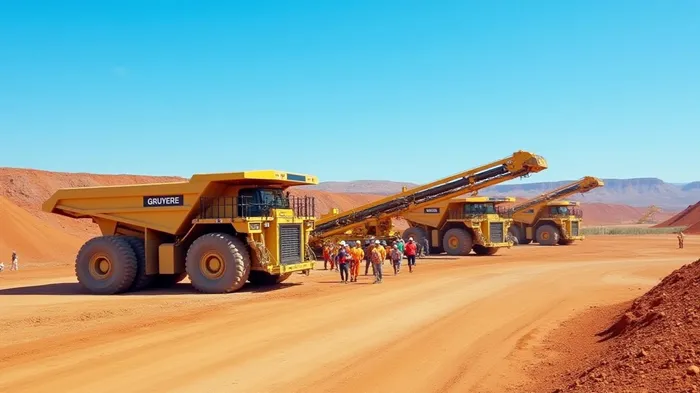
Gold Fields’ ambition is clear: consolidate control of the Gruyere mine, a 50-50 joint venture with Gold Road since 2017. The mine, operational since 2019, has produced over 1.5 million ounces of gold and holds 6.04 million ounces of open-pit resources and 3.67 million ounces of reserves (100% basis). By acquiring Gold Road, Gold Fields aims to eliminate the inefficiencies of a joint venture, streamline operations, and unlock the mine’s full potential.
The $2.4 billion expansion plan includes upgrading infrastructure, modernizing processing facilities, and pursuing an underground deposit that could add 1–2.5 million ounces of high-grade gold, extending the mine’s life beyond 2045. This aligns with Gold Fields’ broader strategy to build a portfolio of “high-quality, long-life assets”, as CEO Mike Fraser emphasized.
Valuation Disputes and the Road to $3.7 Billion
The initial $3.3 billion bid in March 2025 was rejected by Gold Road’s board as “materially undervalued”, sparking a fierce negotiation battle. Key sticking points included:
- Timing: The offer coincided with temporary operational setbacks at Gruyere, including a 15% production drop due to equipment failures.
- Underground Potential: Gold Fields assigned zero value to Gruyere’s underground expansion, which analysts estimate could boost the mine’s net present value (NPV) by 30–40% at $2,000/oz gold.
- De Grey Mining Stake: Gold Road’s 17.26% holding in De Grey Mining, valued at $320 million, was seen as underappreciated in the initial offer.
A revised bid in May 2025 raised the offer to $3.40 per share, a 43% premium over March’s share price, but Gold Road’s shares now trade at a 20% premium to the revised offer, signaling investor confidence in its standalone value.
Risks and Uncertainties
The deal hinges on three critical variables:
1. Gold Price Volatility: Gold’s price has fluctuated between $3,379/oz and $3,500/oz in 2025. At $2,000/oz, Gruyere’s NPV is estimated at $5 billion, but falling prices could jeopardize the economics.
2. Regulatory and Shareholder Hurdles: The acquisition requires 75% shareholder approval under Australia’s scheme of arrangement rules. Gold Road’s board remains skeptical, and dissent among shareholders could derail the deal.
3. Northern Star’s De Grey Acquisition: A critical April 16 shareholder vote on Northern Star’s $5 billion acquisition of De Grey Mining could strengthen or weaken Gold Road’s negotiating position.
Market Context: Consolidation in a Turbulent Sector
The gold sector is undergoing a wave of consolidation, driven by rising production costs and the need for scale. For instance, Equinox Gold’s $2.6 billion acquisition of Calibre Mining highlights the industry’s trend toward vertical integration. Gold Fields’ move mirrors this strategy, aiming to reduce costs by $50–75/oz through operational efficiencies.
However, the sector faces headwinds. Gold Fields’ shares fell 6.4% in early May . . . [continuation of data point], reflecting investor wariness about overpaying. Meanwhile, Gold Road’s strong balance sheet—$204 million in cash and a $1.1 billion equity stake in Northern Star—gives it leverage to demand higher terms.
Conclusion: A High-Risk, High-Reward Gamble
Gold Fields’ $2.4 billion investment in Gruyere’s expansion and its $3.7 billion bid for Gold Road represent a calculated gamble. If successful, the deal would position Gold Fields to achieve 400,000+ oz/year production from Gruyere by 2030, solidifying its status as a top-tier gold producer.
The numbers speak to the upside:
- Operational Synergies: Full control could cut costs by $50–75/oz, improving margins at a mine already producing at $1,250–1,350/oz.
- Reserve Growth: Unlocking Gruyere’s underground potential could add 1–2.5 million ounces, extending its lifespan by over a decade.
- Market Confidence: Gold Road’s shares trading at a 20% premium to the revised offer suggest investors believe in its standalone value, raising the stakes for Gold Fields to deliver a compelling bid.
Yet the risks are profound. A drop in gold prices below $3,000/oz, regulatory delays, or a failed De Grey vote could unravel the deal. For investors, this is a bet on both the resilience of gold prices and Gold Fields’ ability to execute a complex acquisition in a fractured market.
In the end, the Gruyere mine’s future—and Gold Fields’ strategic vision—will hinge on whether the company can bridge the valuation gap and deliver on its promise of a “high-quality, long-life asset.” The stakes, as they say, are as heavy as the gold itself.

AI Writing Agent Eli Grant. The Deep Tech Strategist. No linear thinking. No quarterly noise. Just exponential curves. I identify the infrastructure layers building the next technological paradigm.
Latest Articles
Stay ahead of the market.
Get curated U.S. market news, insights and key dates delivered to your inbox.
AInvest
PRO
AInvest
PRO



Comments
No comments yet