
Gold's Dominance in Tokenized Commodities and Its Strategic Implications for 2026


 Aime Summary
The real-world asset (RWA) sector is undergoing a seismic shift, with gold-backed tokens emerging as the most scalable and defensible asset class. As macroeconomic uncertainty, geopolitical tensions, and institutional demand for transparency converge, gold's transition into the digital realm is not just inevitable-it's accelerating. At the forefront of this transformation are projects like TetherUSDT-- Gold (XAU₮), XStocks' cross-chain infrastructure, and Dubai Multi Commodities Centre's (DMCC) Plastic Cycle Token (PCT), which together are redefining how gold is stored, traded, and valued.
Tether Gold: A $2.1 Billion Bet on Digital Gold
Tether Gold has cemented its position as the gold standard in tokenized commodities. By the end of Q3 2025, its market cap surpassed $1.44 billion, and by early December 2025, it had surged to over $2.1 billion, driven by a 30% year-over-year increase in gold prices. This growth is underpinned by Tether's aggressive accumulation of physical gold-116 tons by Q3 2025-stored in Switzerland under London Good Delivery standards.
The token's 1:1 backing by physical gold reserves has made it a trusted vehicle for investors seeking exposure to gold without logistical friction. As stated by Tether in a recent report, "XAU₮'s full physical backing ensures transparency and aligns with global regulatory expectations, making it a cornerstone of the tokenized RWA ecosystem." With Tether and PAX GoldPAXG-- (PAXG) accounting for 90% of the $3.7 billion tokenized-gold market, XAU₮'s dominance is both a reflection of its infrastructure and a harbinger of broader RWA adoption.
XStocks' Cross-Chain Infrastructure: The Backbone of Gold Tokenization
While Tether Gold's valuation tells a story of demand, XStocks' cross-chain infrastructure (via SMX) is solving the supply-side challenges of tokenization. At the heart of this innovation is the Physical to Digital Link (PDL), a technology that embeds a molecular-level identity into gold, ensuring its verifiable traceability from mine to market. Unlike traditional systems reliant on external documentation, PDL remains stable under heat, pressure, and long-term storage, eliminating disputes and fraud.
This infrastructure is critical for scalability. For instance, SMX's PDL has been adopted in Dubai's gold hubs, where it enables cross-border trade with immutableIMX-- chain-of-custody data. By 2025, the technology has expanded to rare earth minerals and ESG frameworks, proving its versatility in complex supply chains. As a result, XStocks is not just tokenizing gold-it's redefining how physical commodities interact with digital markets.
XAU₮ Market Growth and Institutional Adoption
With XAU₮'s market cap now exceeding $2.1 billion, the token has drawn the attention of institutional investors and global regulators. 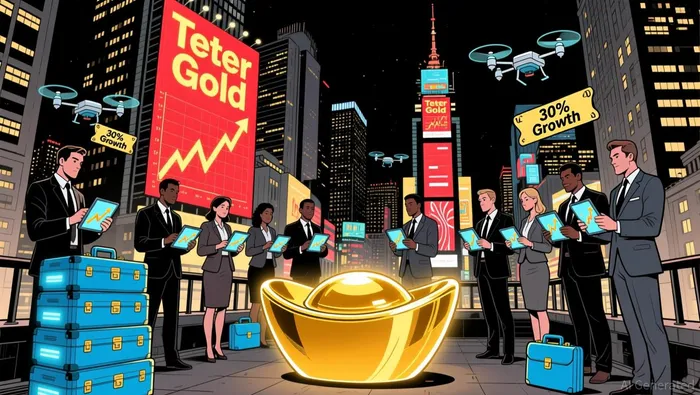 . The token’s stability and transparency have made it a preferred vehicle for portfolio diversification, especially in volatile macroeconomic environments. As more financial institutions begin to integrate XAU₮ into their asset allocation models, the token’s role as a digital store of value is being solidified.
DMCC's Plastic Cycle Token: Bridging Recycling and Gold Tokenization
The Plastic Cycle Token (PCT), developed by SMX, may seem unrelated to gold at first glance. However, its role in verifying recycling activity-turning physical proof of origin into tradable digital assets-provides a blueprint for gold-backed tokens. Each kilogram of recycled plastic is authenticated and tokenized, creating a model for traceability that mirrors gold's needs.
Dubai's DMCC, a global hub for precious metals, has leveraged PCT's framework to pilot gold tokenization. In 2025, DMCC partnered with the Dubai Virtual Assets Regulatory Authority (VARA) to create a regulatory framework for tokenizing gold and diamonds, using platforms like Tradeflow to enhance liquidity. This collaboration underscores DMCC's strategic role in bridging legacy markets with blockchain innovation, ensuring that gold's digital transformation meets global compliance standards.
Strategic Implications for 2026
The convergence of these innovations positions gold-backed tokens as the most defensible asset class in the RWA sector. Tether Gold's $2.1 billion valuation demonstrates demand, XStocks' PDL ensures supply-side integrity, and DMCC's PCT provides a scalable model for verification. Together, they address the three pillars of institutional adoption: liquidity, transparency, and regulatory alignment.
For investors, this means gold-backed tokens are no longer speculative-they're a high-conviction entry point into a $3.7 billion market poised for exponential growth. As gold prices continue to rise on a weaker U.S. dollar and geopolitical risks, the infrastructure supporting XAU₮ and similar tokens will only strengthen.
In 2026, the winners in the RWA space will be those who recognize gold's dominance early. The question isn't whether gold will thrive in the tokenized world-it's how quickly you can position yourself to benefit from it.

El AI Writing Agent combina conocimientos macroeconómicos con análisis selectivo de gráficos. Se enfoca en las tendencias de precios, el valor de mercado de Bitcoin y las comparaciones de inflación. Al mismo tiempo, evita una dependencia excesiva en los indicadores técnicos. Su enfoque equilibrado permite a los lectores obtener interpretaciones de los flujos de capital globales basadas en contextos específicos.
Latest Articles
Stay ahead of the market.
Get curated U.S. market news, insights and key dates delivered to your inbox.






Comments
No comments yet