
Gold's Bullish Rally: How Bessent's Fed Rate-Cut Call is Reshaping Safe-Haven Demand
 Aime Summary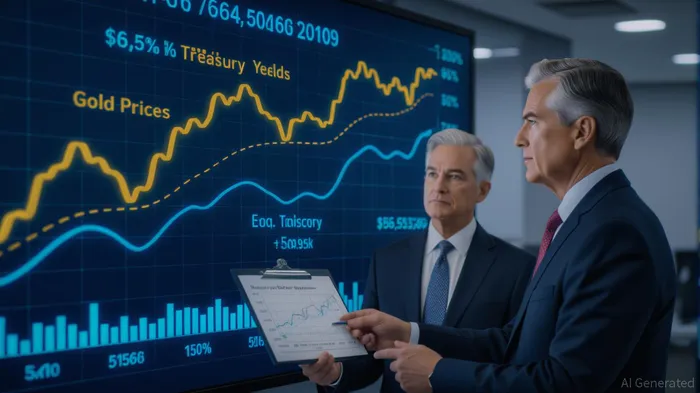
The U.S. Treasury's aggressive push for Federal Reserve rate cuts in 2025 has ignited a seismic shift in global capital flows, with gold emerging as the most visible beneficiary of this policy pivot. Treasury Secretary Scott Bessent's explicit calls for a 50-basis-point rate cut at the Fed's September meeting—and a broader reduction of 150–175 basis points by year-end—have recalibrated investor expectations, fueling a 28% rally in gold prices this year. This article unpacks how central bank policy shifts are reshaping safe-haven demand and why gold's current trajectory presents a tactical entry point for investors navigating a rapidly evolving macroeconomic landscape.
The Catalyst: Bessent's Rate-Cut Agenda and Market Reactions
Bessent's advocacy for aggressive monetary easing has directly challenged the Fed's recent dovish restraint. While the central bank has maintained rates in the 4.25%–4.5% range since mid-2024, Bessent argues that the current level is “150–175 basis points too high,” citing revised labor data showing a cooling job market and modest inflation. His projections have outpaced market expectations, which currently price in a 89.4% probability of a 25-basis-point cut in September and a 45.7% chance of a 75-basis-point cut by year-end.
This policy divergence has already triggered a flight to safety. Gold prices have surged to $3,358.02 an ounce in early August 2025, with central banks adding 450 tons to their reserves year-to-date—a 15-year high. The logic is straightforward: lower interest rates reduce the opportunity cost of holding non-yielding assets like gold, while geopolitical tensions and Trump-era tariff uncertainties amplify its appeal as a hedge.
The Mechanics of a Gold Rally: Policy, Inflation, and Dollar Dynamics
The Fed's potential rate-cut trajectory is reshaping three critical dynamics that drive gold demand:
1. Yield Compression: As rates fall, the relative attractiveness of gold—a zero-yield asset—rises. With 10-year Treasury yields now below 3.5% (down from 4.3% in January 2025), investors are increasingly allocating capital to assets that outperform cash in a low-rate environment.
2. Dollar Weakness: A dovish Fed typically weakens the U.S. dollar, which inversely boosts gold prices. The dollar index has fallen 6% year-to-date, with further declines anticipated if rate cuts materialize as Bessent predicts.
3. Inflation Hedging: While core CPI has moderated to 2.1%, Trump's tariffs on imported goods have created a “shadow inflation” risk. Gold's role as a store of value becomes critical in an environment where policymakers are prioritizing growth over price stability.
Investor Sentiment and Strategic Allocation
The shift in central bank policy has also altered investor behavior. Hedge funds and institutional investors are reallocating portfolios toward gold and other inflation-hedging assets, with gold ETFs seeing a 12% inflow in July alone. Retail investors, meanwhile, are leveraging leveraged gold ETFs and futures contracts to capitalize on the rally.
For strategic investors, the current environment offers a unique entry point. Gold's 28% gain in 2025 has been driven by both fundamental factors (rate cuts, dollar weakness) and technical momentum (bullish RSI and MACD indicators). However, the asset remains undervalued relative to historical correlations with real interest rates. A 50-basis-point cut in September could push gold toward $3,600 an ounce, while a 75-basis-point cut by year-end could test $3,800.
Tactical Recommendations for Investors
- Core Positioning: Allocate 5–10% of a diversified portfolio to gold or gold ETFs (e.g., SPDR GoldGLD-- Shares, GLD) to hedge against rate cuts and dollar volatility.
- Leveraged Exposure: For aggressive investors, leveraged gold ETFs (e.g., UGLD) offer amplified returns but require close monitoring of Fed policy signals.
- Diversification into Alternatives: Consider pairing gold with other inflation-hedging assets like BitcoinBTC-- (BTC/USD) or real estate, which also benefit from accommodative monetary policy.
Conclusion: A Policy-Driven Bull Market
Bessent's rate-cut agenda has catalyzed a structural shift in safe-haven demand, with gold at the forefront of this reallocation. As the Fed inches closer to a dovish pivot, investors must act swiftly to secure positions in assets that thrive in a low-rate, inflationary, and dollar-weak environment. The coming months will test the Fed's resolve, but one thing is clear: gold's rally is not a fleeting trend—it is a policy-driven bull market in the making.
For those who recognize the interplay between central bank actions and asset valuations, the current juncture offers a rare opportunity to align portfolios with the forces reshaping global finance. The question is no longer if gold will rise—it is how much further it will go.

Delivering real-time insights and analysis on emerging financial trends and market movements.
Latest Articles
Stay ahead of the market.
Get curated U.S. market news, insights and key dates delivered to your inbox.
AInvest
PRO
AInvest
PRO



Comments
No comments yet