
Gold's $5,550 Flash: The Gamma Squeeze That Exposed a Sovereign Crisis
 Aime Summary
The "golden ceiling" hasn't just been breached; it has been atomized.
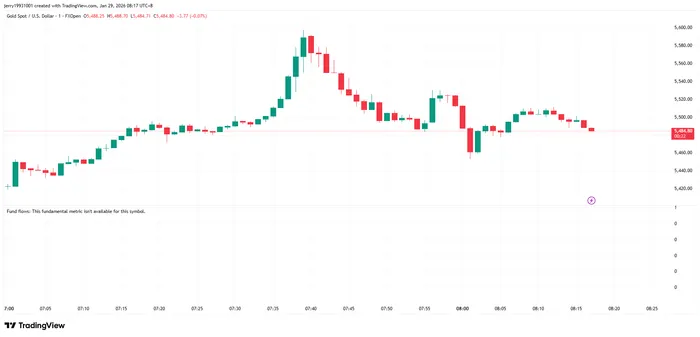
In a move that stunned desks from London to Tokyo, gold prices tore through the psychological $5,550 per ounce barrier late Wednesday, marking a definitive new chapter in the metal's historic 2026 run. While the spot price has since cooled, stabilizing around the $5,500 pivot, the velocity of the move suggests this is far more than a simple safe-haven play. We are witnessing a structural repricing of the world's oldest reserve asset, driven by a volatile cocktail of algorithmic hedging, sovereign anxiety, and a market structure that was woefully unprepared for this elevation.
For the first time in decades, the "fear of missing out" (FOMO) isn't coming from retail speculators—it's coming from the sovereign sector and the options dealers forced to chase them.
The Mechanics: Inside the Gamma Squeeze
To understand why gold surged $150 in mere hours, one must look beyond the physical vaults and into the derivatives ledger. The move to $5,550 was a textbook "gamma squeeze," a phenomenon where options dealers are forced to buy the underlying asset aggressively to hedge their exposure as prices rise.
As detailed in recent analysis regarding the surge in options volume, market makers had sold massive quantities of April call spreads at the $5,550 and $5,600 strikes. These positions, originally written as low-probability bets, suddenly moved "at-the-money" as gold broke $5,300 earlier in the week.
When the spot price accelerated, dealers found themselves "short gamma"—meaning their exposure to price moves increased the higher the market went. To remain delta-neutral, they had to buy gold futures indiscriminately. Data from the trading session showed over 5,000 lots of the April $5,550/$5,600 call spreads trading in a rapid clip, creating a gravitational pull that vaulted prices upward.
"The street was positioning for $5,500 by March," noted one senior metals trader. "We got there in January. The liquidity vacuum above $5,400 forced a scramble that likely isn't over."
The 'Debasement Trade' Goes Mainstream
While algorithms provided the fuel, the spark came from a darker fundamental narrative. The rally is being underpinned by what strategists are terming the "Debasement Trade"—a flight from sovereign debt and fiat currencies rather than a traditional inflation hedge.
Investors are no longer buying gold solely because they fear consumer prices rising; they are buying it because they fear the currency itself is being diluted to fund fiscal deficits. With the Federal Reserve navigating a complex rate-cut cycle, the opportunity cost of holding non-yielding assets has collapsed.
This shift was highlighted when prices first broke the $5,000 barrier, triggering a "sovereign value reassessment." The logic is brutal but simple: if G7 governments are committed to "fiscal dominance"—printing money to service debt—then gold is the only neutral reserve asset left standing.
The Official Sector: A Floor, Not a Ceiling
Crucially, the dip-buying behavior has changed. In previous cycles, high prices would deter physical buying from China and India. In 2026, the buyers are price-agnostic central banks.
Reports indicate that the Official Sector is maintaining a relentless bid, with forecasts suggesting central bank purchases could exceed 755 tonnes this year alone. Emerging market central banks, particularly those in the BRICS bloc, are diversifying reserves away from Treasuries at a pace that creates a permanent floor under the market.
J.P. Morgan Global Research has noted that this structural trend has "further to run," estimating that even with prices at record highs, central banks are underweight gold relative to historical norms. This relentless accumulation means that every technical pullback—like the drop from $5,550 to $5,500—is met with a wall of sovereign bids, preventing the deep corrections that bears are hoping for.
Blue Sky Territory: The Path to $6,000
The retreat to $5,500 is viewed by bulls as a healthy consolidation—a "checking of the floor" before the next leg up. The market has now entered a vacuum zone where historical resistance levels are nonexistent.
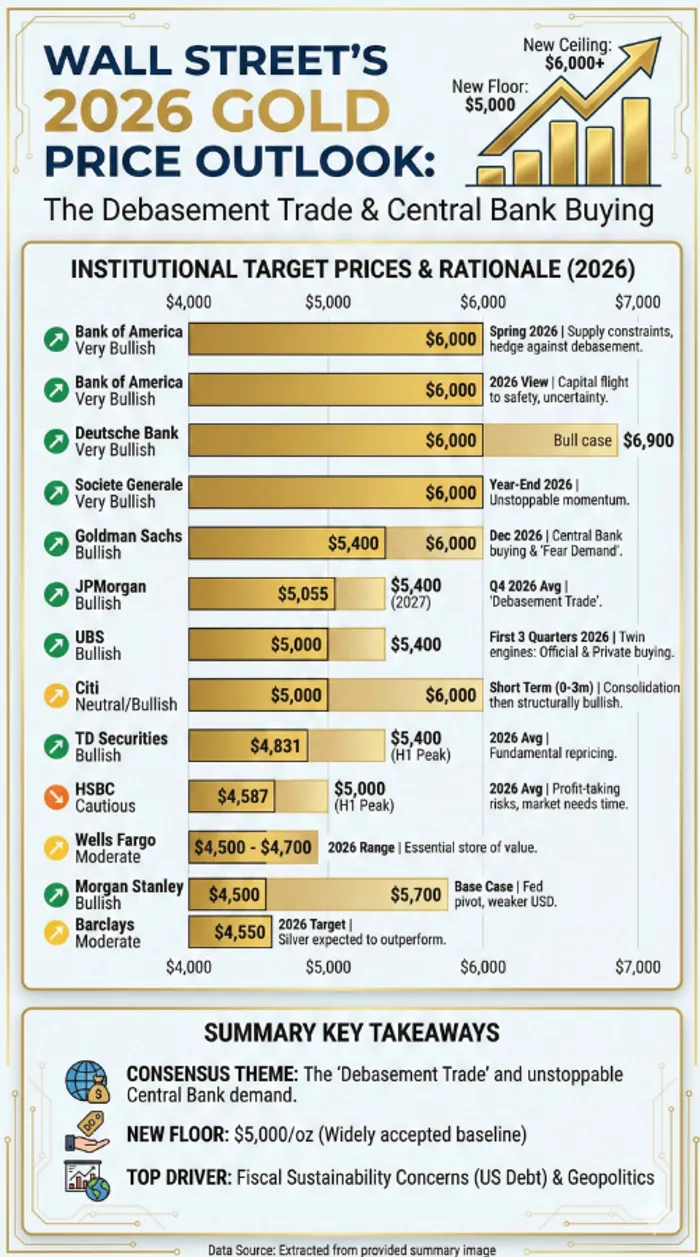
Wall Street is swiftly updating its models to match reality. Following the breakout, Bank of America released a stunning forecast, predicting prices could surge to $6,000 as early as this spring if geopolitical tensions fail to ease. Their analysts argue that the premium on non-sovereign assets must expand as the global debt burden grows.
Similarly, Goldman Sachs has raised its year-end target to $5,400, citing the return of Western ETF buyers. For years, Western investors sold gold while the East bought. Now, with the Fed cutting rates, Western capital is returning to the market, chasing the rally that the East started. This "synchronization" of buying pressure is the perfect storm for higher prices.
What to Watch Next
Traders should keep a close eye on the $5,480–$5,500 zone. If this level holds as support into the weekly close, it confirms that the breakout was legitimate.
However, the options market remains the best leading indicator. Volume data shows traders are already rolling their exposure higher, with significant open interest building in September $6,000 calls. This suggests that the "smart money" isn't cashing out at $5,550—they are positioning for the next milestone.
The breach of $5,550 was not the finale of the 2026 gold rush; it was likely just the opening act of a year defined by volatility, debasement, and the relentless repricing of real assets.

Rodder Shi is a market analyst covering U.S. stocks and prediction markets. He holds a Master’s degree in Financial Engineering from UCLA and dual degrees from UC San Diego, with research experience at CICC and Rayliant. An IAQF quantitative research award winner, he has over six years of equity and options investing experience focused on data-driven and risk-aware market analysis.
Latest Articles
Stay ahead of the market.
Get curated U.S. market news, insights and key dates delivered to your inbox.


AInvest
PRO
AInvest
PRO



Comments
No comments yet